Which states have the lowest barriers to money transmitter licensure? This guide covers the states with simpler requirements, lower net worth thresholds, and more straightforward application processes.
Easiest States to Get a Money Transmitter License
Not all money transmitter licenses are created equal. Some states impose high net worth requirements, substantial surety bonds, audited financial statement requirements at launch, and lengthy review timelines. Others have lower barriers to entry that make them a practical starting point for early-stage fintechs building out their licensing footprint.
This guide examines which states are generally considered easier to license in, why that is, and how to use that information strategically as part of your multi-state fintech licensing strategy.
What Makes a State "Easy" to License In?
When compliance professionals refer to a state as an "easier" licensing jurisdiction, they typically mean some combination of the following factors:
- Lower net worth requirements — Some states require only a modest minimum net worth to qualify, making it accessible for early-stage companies
- Lower surety bond amounts — Bond premiums add real cost; states with lower bond floors are less expensive to enter
- Simpler documentation requirements — Some states ask for fewer exhibits, simpler business plans, or less voluminous compliance documentation
- Faster processing times — Certain state regulators consistently process applications more quickly than others
- Less intensive examination programs — Some states conduct less frequent or less intensive exams of smaller licensees
"Easy" is always relative. No MTL application is simple — all require a complete business, a functioning compliance program, background checks on control persons, audited financials, and ongoing reporting obligations. The differences are in degree, not kind.
States Generally Considered More Accessible
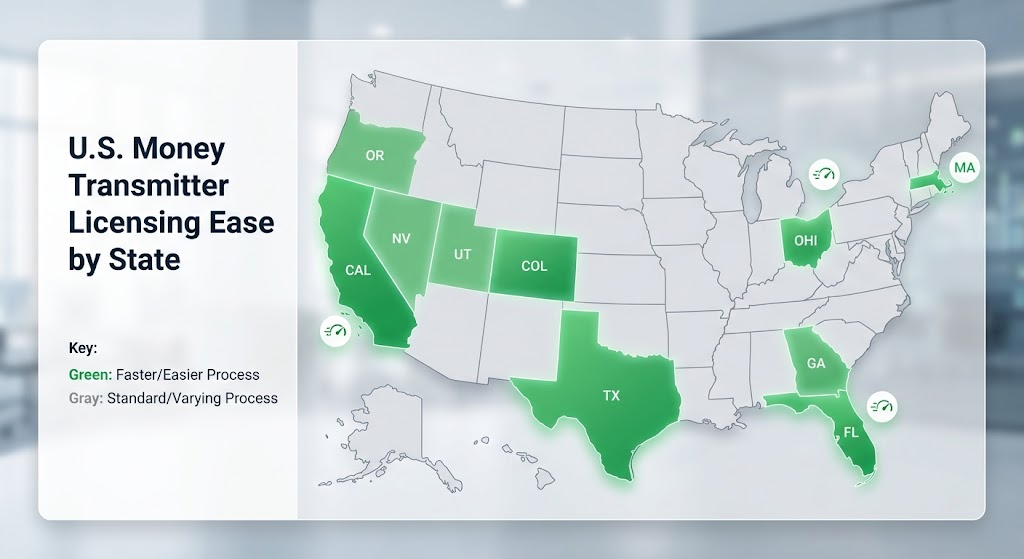
The following states are commonly identified by compliance professionals as having relatively lower barriers to MTL entry. This is not a guarantee — requirements change, and every application is evaluated on its own merits.
Montana
Montana has historically been one of the more accessible MTL states. Its net worth and bond requirements are generally lower than coastal states, and its Division of Banking and Financial Institutions has a reputation for processing applications efficiently. Montana is also notable for having an MSB-specific registration pathway that some businesses can use alongside or in lieu of a full MTL. See our guide on getting a money transmitter license in Montana.
Wyoming
Wyoming has positioned itself as a fintech and crypto-friendly state with a progressive regulatory framework. For fintechs — particularly those in the digital asset space — Wyoming's regulatory environment is often cited as more business-friendly than average. Its net worth and bond requirements are competitive with other small-population states. See our guide on getting a money transmitter license in Wyoming.
Kansas
Kansas maintains relatively straightforward MTL requirements with lower financial thresholds than many coastal or high-population states. Its State Bank Commissioner processes applications under a clear statutory framework with defined documentation requirements. See our guide on getting a money transmitter license in Kansas.
Nebraska
Nebraska is often cited as a practical early-licensing state for fintechs serving the Midwest. Its net worth requirements and bond amounts are generally lower than states like New York or California, and its Department of Banking and Finance has a track record of processing applications on reasonable timelines. See our guide on getting a money transmitter license in Nebraska.
Iowa
Iowa's Division of Banking administers MTL licensing with requirements generally accessible to early-stage companies. For fintechs targeting Midwest customers, Iowa alongside Nebraska and Kansas can form a logical early cluster of licenses. See our guide on getting a money transmitter license in Iowa.
States That Are Comparatively Harder
For contrast, the following states are generally regarded as having more demanding MTL requirements:
- New York — The BitLicense (for crypto) and traditional MTL both require extensive documentation, high net worth, and significant bonding. NY is one of the most demanding licensing states in the country. NY MTL guide here.
- California — California's DBO imposes substantial net worth requirements and a thorough examination program. It is essential for any fintech with meaningful US customer volume but not an easy starting point. CA MTL guide here.
- Texas — Texas has significant bond requirements and a detailed application process through the Department of Banking. A must-have license for US fintechs but not the simplest to obtain. TX MTL guide here.
See our companion guide on MTL requirements, costs, and timelines by state for a full comparison.
Why Starting in an "Easier" State Is a Legitimate Strategy
Many fintechs license strategically — starting in states with lower barriers while they build out compliance infrastructure and audited financial history, then applying in harder states once they have a track record. This approach makes sense for several reasons:
- A license in any state demonstrates to other regulators that you have a functioning compliance program
- NMLS applications are largely standardized — core documents built for one state are reused in others
- Net worth and bond requirements in high-bar states are easier to meet once you have operating history
- Regulatory examination history in easier states helps you prepare for more intensive reviews elsewhere
That said, you must prioritize states where your customers actually are. If you have significant Texas or California customer volume, those states cannot be deprioritized regardless of how challenging they are to license in.
The Real Cost Savings Are in Bond and Net Worth Requirements
The difference between easy and hard licensing states is most pronounced in two areas: surety bond amounts and minimum net worth requirements. Some states require net worth in the millions; others require far less. Bond amounts in high-volume states can run into the hundreds of thousands of dollars in annual premiums. See our complete breakdown of MTL net worth requirements by state and MTL bond requirements by state.
How to Build Your Multi-State Licensing Roadmap
The most effective licensing strategies balance three factors: where your customers are, what your compliance infrastructure can support, and what your balance sheet can sustain. Starting in lower-barrier states while building your compliance track record is a legitimate approach — but it should be part of a deliberate plan to reach all required states within a defined timeline.
See our complete guide on how to prioritize your state MTL applications and our overview of MTL timelines, costs, and requirements by state.
Frequently Asked Questions
Can I legally operate in a state without an MTL if I'm licensed elsewhere?
No. Each state's MTL covers only activities in that state. A Nevada license does not permit you to transmit money for New York customers. You must be licensed in every state where you have customers who require it. Learn more about the consequences of unlicensed operation.
Are there states that don't require an MTL at all?
Yes — a small number of states either have no money transmission law or provide meaningful exemptions for certain business models. However, this group is small, and most fintechs with meaningful US customer volume will need MTLs in the majority of states. See our guide on MTL requirements by state for details.
Does starting in an easy state speed up my application in a harder state later?
Having an existing license helps indirectly — it demonstrates a functioning compliance program and regulatory track record that other states find reassuring. However, each state evaluates applications independently and having one license does not automatically accelerate others.
How much does it cost to get started with licensing?
Costs vary significantly by state. See our complete guide on how much a money transmitter license costs and our state-by-state MTL fees breakdown.
Disclaimer: This article is for informational purposes only and does not constitute legal or compliance advice. Licensing requirements change frequently. The characterization of certain states as "easier" reflects general patterns observed in the compliance community and may not reflect your specific circumstances. Always verify current requirements with each state regulator and consult a qualified compliance professional.
Talk to the ComplyOne team to get started.