A complete guide to what state regulators expect in a money transmitter license business plan — what to cover, common mistakes, and how to write one that avoids deficiency notices.
Money Transmitter License Business Plan Requirements: What to Include
Every money transmitter license (MTL) application requires a business plan. But what exactly do state regulators want to see in it? The business plan is one of the most commonly deficiency-noticed components of MTL applications — not because applicants are dishonest, but because they don't know what level of detail regulators actually expect.
A well-written business plan that anticipates regulators' questions can significantly reduce deficiency rounds and accelerate your path to approval. This guide covers what to include, section by section, and the most common mistakes that slow applications down.
Why the Business Plan Matters So Much
The business plan serves multiple purposes in an MTL application. It tells regulators who you are and what you do, how your money transmission activities work in practice, what compliance controls you have in place, whether your financial projections are realistic, and whether your team has the experience to operate safely. A weak business plan signals to regulators that you may not fully understand your own operations or compliance obligations — triggering deeper scrutiny of everything else in your application. A thorough, well-organized business plan creates a favorable first impression and reduces the back-and-forth that extends processing timelines. See our guide on what to prepare for your MTL application for the full document list.
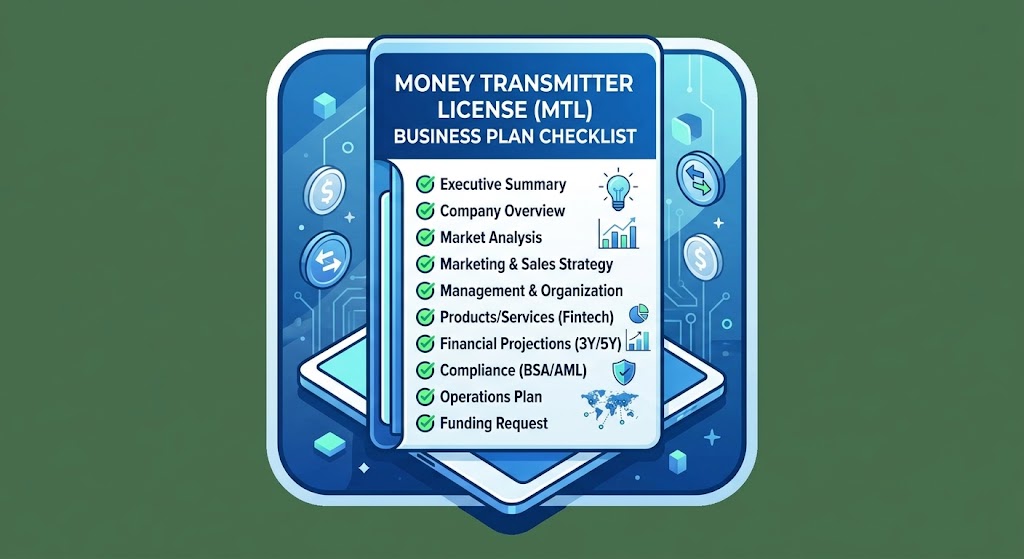
Core Sections of an MTL Business Plan
1. Company Overview
Start with a clear description of your company: legal name, trade name(s), state of formation, formation date, principal place of business, and ownership structure. Include a brief history of the company and how it came to be pursuing a money transmitter license. Regulators want to understand who is behind the application before they read anything else.
2. Business Model and Products
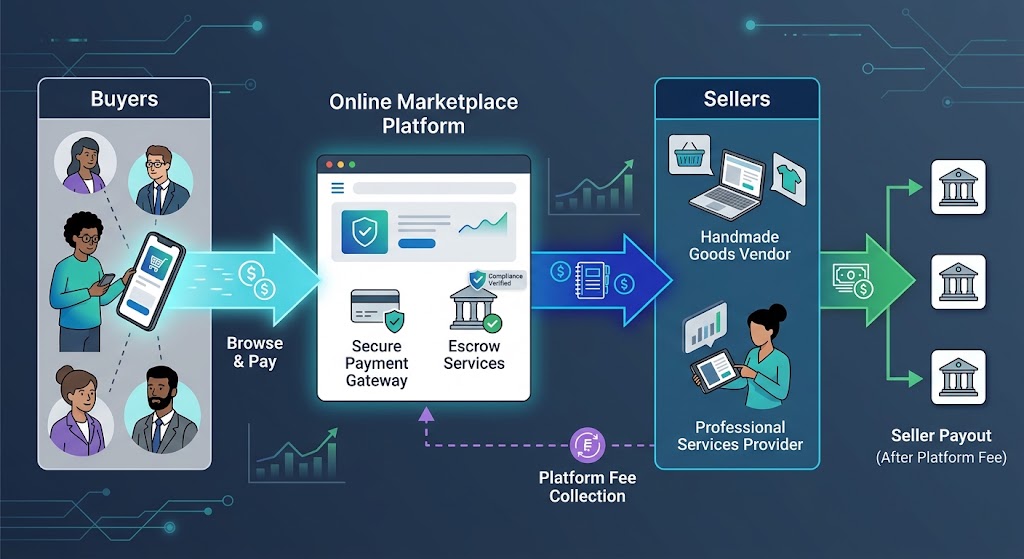
Describe precisely what money transmission activities you conduct or plan to conduct. Be specific: how do customers send money, how do funds flow, where do they go, and through what channels? Common activities to describe include domestic peer-to-peer payments, international remittance, digital wallet services, payment processing for merchants, crypto-to-fiat conversion, and mobile payment apps.
Include diagrams of money flows if your model is complex. Regulators review dozens of applications — clear diagrams reduce ambiguity and avoid follow-up questions.
3. Target Markets and Customer Base
Describe your target customers: consumer or business, domestic or international, demographic profile, and geographic focus. If you target specific customer segments — such as international workers sending remittances, small businesses processing payments, or crypto traders — say so explicitly. This helps regulators understand your risk profile and the AML controls they'll expect you to have.
4. Transaction Volume Projections
Most states require projected transaction volumes for the first 1–3 years of operations. Include monthly or annual projections of the number of transactions, average transaction size, and total dollar volume. Explain the basis for your projections — customer acquisition assumptions, existing pipeline, comparable platform benchmarks, or other underlying data. Regulators are not looking for perfection; they are looking for reasonable projections based on thoughtful analysis.
Transaction volume projections also directly affect your surety bond requirement in many states, so being thoughtful here has financial consequences as well. See our guide on MTL bond requirements by state.
5. Geographic Scope
Identify the states (and countries, if applicable) in which you currently operate or plan to operate. Describe your multi-state licensing plan if you are applying in multiple states simultaneously. This gives regulators context for your overall compliance program and confirms you understand the scope of your licensing obligations.
6. Compliance Program Overview
This is often the most important section of the business plan for regulators. Describe your AML/BSA compliance program, including:
- Your designated compliance officer and their qualifications
- Your customer identification program (CIP) and KYC procedures
- How you conduct transaction monitoring and identify suspicious activity
- Your SAR filing procedures
- How you screen customers and transactions against OFAC sanctions lists
- Your AML training program
- Your independent audit or testing schedule
See our guide on what an AML compliance program must cover. Note that many states also require separate, standalone AML program documentation — the business plan overview should be consistent with your program documentation but does not replace it.
7. Technology and Systems
Describe the technology you use to conduct money transmission — your platform, core processing systems, and any third-party service providers involved in the transaction flow. Regulators want to understand how your technology works and where the compliance controls are embedded. If you use a third-party payment processor, compliance platform, or banking partner, identify them and describe their role.
8. Management Team and Key Personnel
Provide brief biographies for your key executives, compliance officer, and other personnel material to your money transmission operations. Highlight relevant experience in financial services, payments, or compliance. Background on your leadership team reassures regulators that you have the experience to operate safely. This section should be consistent with the MU2 disclosures filed through NMLS for each control person.
9. Financial Overview
Summarize your current financial position and capital resources. This section should be consistent with the audited financial statements you submit separately. Many states want to understand how you are funded, whether you have adequate capital to operate compliantly, and what your path to profitability looks like. See our guide on MTL audited financial statement requirements.
10. Risk Assessment
Some states explicitly require a risk assessment as part of or alongside the business plan. Even where it is not required, including a brief risk assessment — identifying your key money transmission risks (customer risk, product risk, geographic risk, channel risk) and your controls for each — demonstrates compliance maturity and reduces regulator questions. See our guide on how to conduct an AML risk assessment.
Common Business Plan Deficiency Triggers
The following are the most common reasons regulators issue deficiency notices related to the business plan:
- Vague product descriptions — "We facilitate payments" is not a product description. Describe exactly how your product works, step by step
- Missing or unsupported transaction volume projections — Regulators want to see the basis for your projections, not just round numbers
- Compliance section that's a one-paragraph summary — Your compliance program overview should be detailed enough to demonstrate you have actually thought through how you will meet BSA/AML requirements
- No mention of third-party relationships — If you rely on a sponsor bank, payment processor, or compliance vendor, disclose it
- Inconsistency with NMLS forms — Ownership, management, and financial information in the business plan must match what's in the MU1 and MU2 forms exactly
How Long Should an MTL Business Plan Be?
There is no universal page requirement, but well-received business plans for money transmitters typically run 15–40 pages depending on the complexity of the business model. A simple domestic peer-to-peer payment app might require a shorter plan than a crypto exchange offering cross-border services in 30 countries. Quality and specificity matter more than length.
State-Specific Requirements
While the sections above are broadly applicable across all NMLS states, individual states may have specific requirements or preferred formats. Always review the state regulator's published application checklist before finalizing your business plan. Some states explicitly list required business plan sections; others leave more latitude. See our state-specific MTL guides for guidance on individual states:
Frequently Asked Questions
Can I use the same business plan for every state?
A core business plan document can be reused across states, but it should be reviewed and customized for each state's specific requirements before submission. Geographic scope and any state-specific compliance notes should be updated per state.
How long does it take to write a good MTL business plan?
For a company starting from scratch, expect to spend 2–4 weeks drafting and reviewing a thorough business plan. The compliance section in particular benefits from careful review by someone with AML/BSA expertise. Rushing the business plan is one of the most common ways companies create avoidable delays.
Does the business plan become public once submitted?
Business plans submitted as part of an MTL application are generally treated as confidential regulatory submissions and not disclosed publicly. However, you should assume that regulators may share relevant information with other state regulators through NMLS and other inter-regulatory coordination channels.
Should I include a formal organizational chart?
Yes. A clear organizational chart showing ownership percentages, corporate structure, and key personnel roles is expected in virtually every MTL application. It can be included as an appendix to the business plan or submitted as a separate exhibit.
Disclaimer: This article is for informational purposes only and does not constitute legal or compliance advice. Business plan requirements vary by state and change over time. Always review each state's current checklist and consult a qualified compliance professional before submitting your application.
Talk to the ComplyOne team to get started.