Does your marketplace, platform, or gig economy app need a money transmitter license? This guide explains when payment flows trigger MTL requirements and how to assess your obligations.
When Does a Marketplace Need a Money Transmitter License?
Online marketplaces, gig economy platforms, and two-sided payment apps occupy one of the grayer areas of US money transmission law. Whether your platform needs a money transmitter license (MTL) depends on the specific structure of how money flows through your system — and the answer varies by state.
Getting this wrong is expensive. Platforms that assumed they were exempt have faced regulatory enforcement, mandatory licensing programs, and civil penalties. This guide explains how regulators analyze marketplace payment flows and how to assess your own platform's licensing obligation.
The Core Question: Are You Receiving and Transmitting Money?
The fundamental trigger for money transmitter licensing is receiving money from one person and transmitting it to another. The legal question for marketplace operators is whether the platform itself is "receiving" funds in a legal sense, or whether it is merely facilitating a direct payment between a buyer and seller.
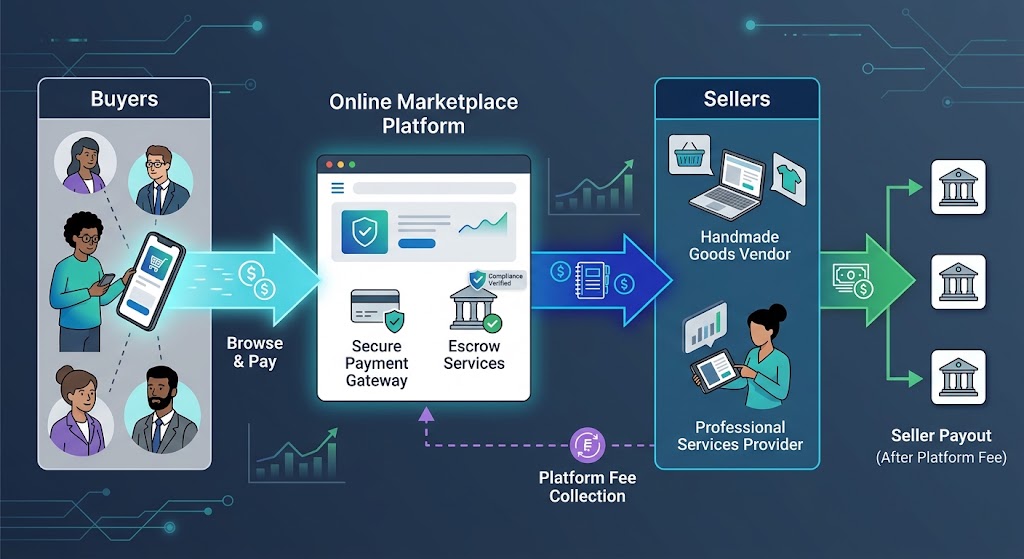
This distinction matters enormously. If money passes through your platform — through a pooled account, a merchant account you control, or a stored-value balance you maintain on behalf of users — regulators in most states will consider you to be engaged in money transmission. If payments go directly from buyer to seller's own bank account without touching your control, the analysis is different.
The key indicator is control over funds: if your platform controls, holds, or commingles funds — even briefly — before disbursing them to the intended recipient, most states will classify that as money transmission.
Common Marketplace Payment Models and Their Licensing Implications
Model 1: Pooled Settlement Account (High MTL Risk)
You collect payments from buyers into a platform-controlled account, hold the funds (even briefly), and then disburse them to sellers minus your fee. This is the most common marketplace model and is almost universally treated as money transmission by state regulators. Most two-sided marketplaces (e-commerce, gig economy, service marketplaces) that use this model need MTLs in every state where they operate.
Model 2: Pass-Through via Payment Processor (Variable)
You route all payment flows through a licensed payment processor (such as Stripe, Square, or Braintree) and the processor, not you, holds and disburses funds. In this model, the processor is the money transmitter, not the platform. However, whether the platform itself needs a license depends on whether it controls any funds at any point in the flow — including holdbacks, reserves, or deferred payouts.
Model 3: Stored Value or Wallet Features (High MTL Risk)
You maintain user balances on your platform — users can deposit funds, hold a balance, and withdraw to external accounts. Any platform that holds user balances is almost certainly engaged in money transmission. This includes gift card balances, loyalty point programs with cash redemption, and user wallet features.
Model 4: Payment Facilitator Model
You operate as a payment facilitator — onboarding sub-merchants under your master merchant account and settling funds on their behalf. This model is specifically addressed in many states' money transmission laws. Payment facilitators often do need MTLs depending on how funds are held and how quickly they are disbursed. See our guide on payment facilitator licensing and compliance.
Model 5: Direct Peer-to-Peer Transactions Only (Lower Risk)
You connect buyers and sellers but do not touch money at any point — all payment processing goes directly between the parties' own bank accounts or cards, with no platform-controlled intermediary account. This model is less commonly treated as money transmission, but some states take a broad view. If your platform even briefly holds or controls funds or offers escrow, the analysis changes immediately.
The Agent of the Payee Exemption
Some states recognize an "agent of the payee" exemption that allows certain platforms to receive payments on behalf of merchants without triggering money transmitter licensing. Under this theory, a platform that collects payment on behalf of a seller (as the seller's agent) is not transmitting money but simply completing a payment on the seller's behalf.
This exemption is not universally available — not every state recognizes it — and the requirements for qualifying as an agent of the payee are specific and fact-dependent. Do not assume this exemption applies without a legal analysis of your specific payment model and the states in which you operate.
State-by-State Variation
How states treat marketplace payment flows varies, and some states are significantly more aggressive than others. California, New York, and Texas have broad money transmission statutes and are more likely to require licenses for marketplace operators. Other states take a narrower view.
This means you may need MTLs in some states but not others — and the compliance burden is to assess your position in every state where you have customers, not just the states with the most obvious requirements. See our MTL requirements by state and who needs a money transmitter license for the full picture.
FinCEN MSB Registration for Marketplaces
In addition to state MTLs, marketplaces that are classified as money transmitters also need to register as money services businesses (MSBs) with FinCEN at the federal level. This is a separate requirement from state licensing and applies regardless of which states you're licensed in. See our guides on MSB registration and how to register as an MSB with FinCEN.
AML/BSA Obligations for Licensed Marketplaces
If your marketplace is classified as a money transmitter, you also inherit the full BSA/AML compliance obligations that apply to all money transmitters — including a Customer Identification Program (CIP), transaction monitoring, SAR filing, OFAC screening, and annual independent testing. These obligations apply to the platform, not just the individual buyers and sellers on it. See our guide on AML compliance program requirements for fintechs.
How to Assess Your Marketplace's Licensing Obligation
The right way to assess your obligation is a step-by-step analysis of your payment flows in each state:
- Map every step of the payment flow from when a buyer pays to when a seller receives funds
- Identify every point at which your platform controls, holds, or commingles funds
- For each state where you have customers, assess the state's money transmission definition against your payment flows
- Determine whether any exemptions (agent of the payee, de minimis transaction, etc.) apply in each state
- Develop a licensing roadmap for states where you are required to be licensed
This analysis is complex and state-specific. Most marketplace operators benefit significantly from working with a compliance professional experienced in multi-state money transmission law to conduct this assessment. See our guide on fintech compliance for startups for how to build your compliance program from the ground up.
Frequently Asked Questions
Do gig economy apps like Uber or DoorDash need money transmitter licenses?
Large gig platforms typically have robust compliance programs that include MTLs where required. Whether a smaller gig economy platform needs an MTL depends entirely on how its payment flows are structured. If the platform collects, holds, and disburses payments to gig workers, it is likely engaged in money transmission.
Does using Stripe or Square mean I don't need an MTL?
Using a licensed payment processor for your underlying payments does not automatically mean you don't need an MTL. If your platform holds any funds — even in a sub-account or as a payout holdback — or maintains user balances, you may still be classified as a money transmitter in some states. The analysis depends on your specific payment architecture.
What is the difference between a marketplace and a payment facilitator?
A payment facilitator (PayFac) is a specific business model where the platform onboards sub-merchants under its own master merchant agreement with an acquiring bank and settles funds on their behalf. Marketplaces can operate as PayFacs, but not all do. Both models can trigger money transmitter licensing depending on how funds are handled. See our PayFac guide for detail.
What's the risk of not getting an MTL if my marketplace needs one?
Significant. Operating without a required MTL can result in civil penalties, enforcement actions, and cease-and-desist orders in any state where you are unlicensed. Regulators have taken enforcement action against several well-known platforms for this. Learn more about the consequences of unlicensed money transmission.
Disclaimer: This article is for informational purposes only and does not constitute legal advice. Whether your marketplace needs a money transmitter license is a fact-specific legal question that depends on your payment flows, business model, and the laws of each state where you operate. Always consult a qualified attorney and compliance professional before making licensing decisions.
Talk to the ComplyOne team to get started.