A Payment Facilitator (PayFac) is a company that enables sub-merchants to accept card payments under its own merchant account. For fintechs building embedded payments, understanding the PayFac model — and the licensing and compliance obligations that come with it — is essential.
What Is a Payment Facilitator? Licensing and Compliance for Fintechs
The Payment Facilitator (PayFac) model has become one of the most popular structures for fintechs embedding payments into their platforms. But becoming a PayFac — or deciding whether you actually need to — requires understanding a specific set of regulatory obligations that many founders and product teams underestimate.
This guide covers what a payment facilitator is, how it differs from other payment models, what licensing and compliance obligations apply, and how to evaluate whether the PayFac model is right for your business.
What Is a Payment Facilitator?
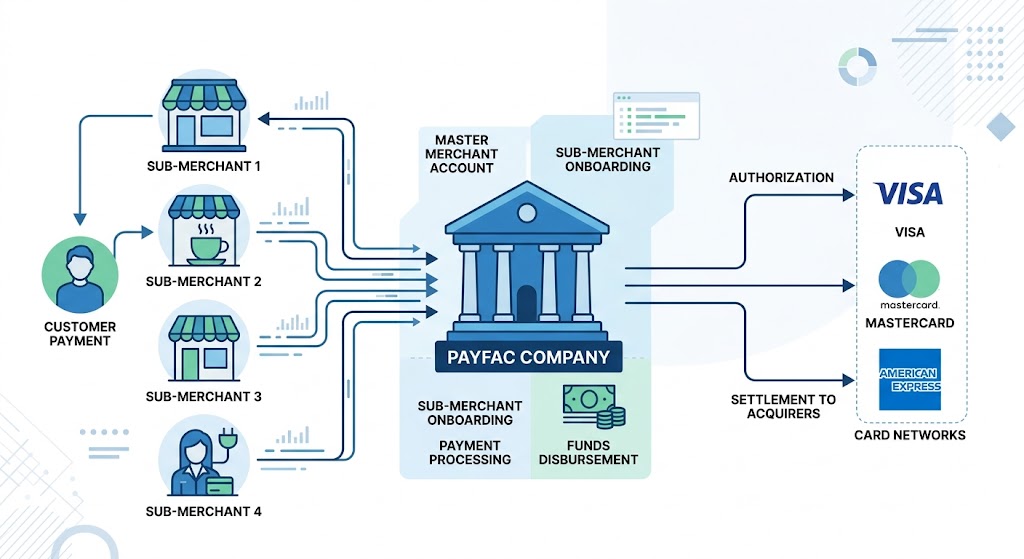
A Payment Facilitator is a company that signs a master merchant agreement with an acquiring bank (the "acquirer") and uses that agreement to onboard sub-merchants — typically small businesses or platforms — to accept card payments. The PayFac aggregates the card payment volume of its sub-merchants under its own merchant account.
Instead of each sub-merchant having a direct relationship with an acquiring bank, they operate under the PayFac's master merchant umbrella. The PayFac takes on responsibility for underwriting, onboarding, monitoring, and risk management for each sub-merchant it sponsors.
Well-known examples of the PayFac model include Stripe, Square, and PayPal — all of which allow businesses to accept payments under their respective master merchant accounts without the business needing to establish its own direct acquiring relationship.
Payment Facilitator vs. Payment Processor vs. ISO
These terms are frequently confused. Understanding the differences is essential for navigating compliance obligations correctly.
The key distinction: as a PayFac, your company becomes the merchant of record for your sub-merchants. This means you bear the financial and compliance risk, not an acquirer or processor.
Does a Payment Facilitator Need a Money Transmitter License?
This is one of the most common questions for fintechs evaluating the PayFac model. The answer depends on several factors:
If you are only facilitating card payments (not holding funds or transmitting money): Many PayFacs operate without a money transmitter license because they are strictly facilitating card-network-based transactions where funds flow directly between the acquirer, card networks, and merchants. However, this analysis is highly fact-specific.
If you hold sub-merchant funds before disbursement: Holding and transmitting funds to sub-merchants — particularly if you control the timing and amount of disbursements — is more likely to trigger money transmitter licensing requirements in states where you operate.
If you offer additional payment services: ACH origination, cross-border payments, payouts to bank accounts, or offering stored value or digital wallets alongside your PayFac model will typically trigger money transmitter licensing in states where those activities occur.
There is no universal exemption for PayFacs from state money transmitter licensing. The determination requires a careful review of your specific product architecture and the laws of each state where you operate.
Card Network Registration Requirements
Independently of state licensing, any company acting as a Payment Facilitator must register with the major card networks — Visa and Mastercard — as a registered PayFac. This registration is managed through your acquiring bank and requires:
- Sponsoring acquirer agreement: A registered acquiring bank that agrees to sponsor your PayFac program
- Compliance with card network PayFac rules: Both Visa and Mastercard publish extensive PayFac operating rules covering sub-merchant underwriting, chargeback management, and prohibited merchant categories
- Sub-merchant underwriting standards: Card networks require PayFacs to perform Know Your Customer (KYC) and risk assessment on each sub-merchant before onboarding
- Transaction monitoring and fraud controls: Active monitoring of sub-merchant transaction patterns for fraud, excessive chargebacks, and prohibited activities
- Chargeback liability: PayFacs are liable for their sub-merchants' chargebacks. High chargeback rates can result in losing card network registration
KYC and AML Obligations for Payment Facilitators
PayFacs have significant Know Your Business (KYB) and AML compliance obligations for their sub-merchant portfolios. These include:
Sub-Merchant Onboarding (Know Your Business)
- Verify the legal existence and good standing of each sub-merchant
- Collect and verify beneficial ownership information (individuals who own 25% or more)
- Screen sub-merchants against OFAC sanctions lists and other watchlists
- Assess each sub-merchant's business type, transaction volume, and risk profile
- Screen for prohibited merchant category codes (MCCs) restricted by card networks
See our guide on Know Your Business (KYB) verification for a full breakdown of sub-merchant onboarding requirements.
Ongoing Sub-Merchant Monitoring
- Transaction monitoring for fraud patterns, structuring, and unusual activity
- Chargeback ratio monitoring — card networks impose thresholds that, if exceeded, can result in sub-merchant termination and PayFac penalties
- Periodic re-screening of sub-merchants against updated watchlists
- Reviewing sub-merchant activity for consistency with their stated business type
Choosing Between Building a PayFac vs. Using a PayFac-as-a-Service
Many fintechs choose between building their own registered PayFac program and using a PayFac-as-a-Service (PFaaS) provider like Stripe Connect, Adyen for Platforms, or PayPal for Marketplaces. The trade-offs are significant:
Frequently Asked Questions
What is the difference between a PayFac and a marketplace?
A PayFac specifically refers to a company that processes card payments as the merchant of record for sub-merchants under a card network registration. A marketplace is a broader term for platforms that connect buyers and sellers — some marketplaces use a PayFac model for payments, while others use bank transfers, ACH, or other payment methods that may involve different regulatory frameworks.
Do PayFacs need to be licensed as money transmitters in every state?
Not automatically. The need for money transmitter licenses depends on whether your PayFac model involves holding and transmitting funds to sub-merchants, not merely facilitating card transactions. A detailed legal analysis of your product's payment flow is required before reaching a conclusion. See our fintech licensing strategy guide for how to approach this analysis.
What are the card network chargeback thresholds PayFacs need to know?
Both Visa and Mastercard publish chargeback monitoring programs with specific thresholds that, when exceeded by a sub-merchant, require PayFacs to take remediation action. Consult the current Visa Core Rules and Mastercard Transaction Processing Rules (available to registered program participants) for current thresholds, as these are updated periodically by the networks.
How long does it take to become a registered Payment Facilitator?
The process of finding a sponsoring acquirer, completing due diligence, and receiving card network registration typically takes 12 to 24 months and requires significant operational readiness in risk management, underwriting, and compliance infrastructure before an acquirer will sponsor your program.
This article is for educational purposes only and does not constitute legal or compliance advice. Payment facilitator and money transmitter requirements are complex and subject to change. Consult qualified legal counsel for guidance specific to your business model.