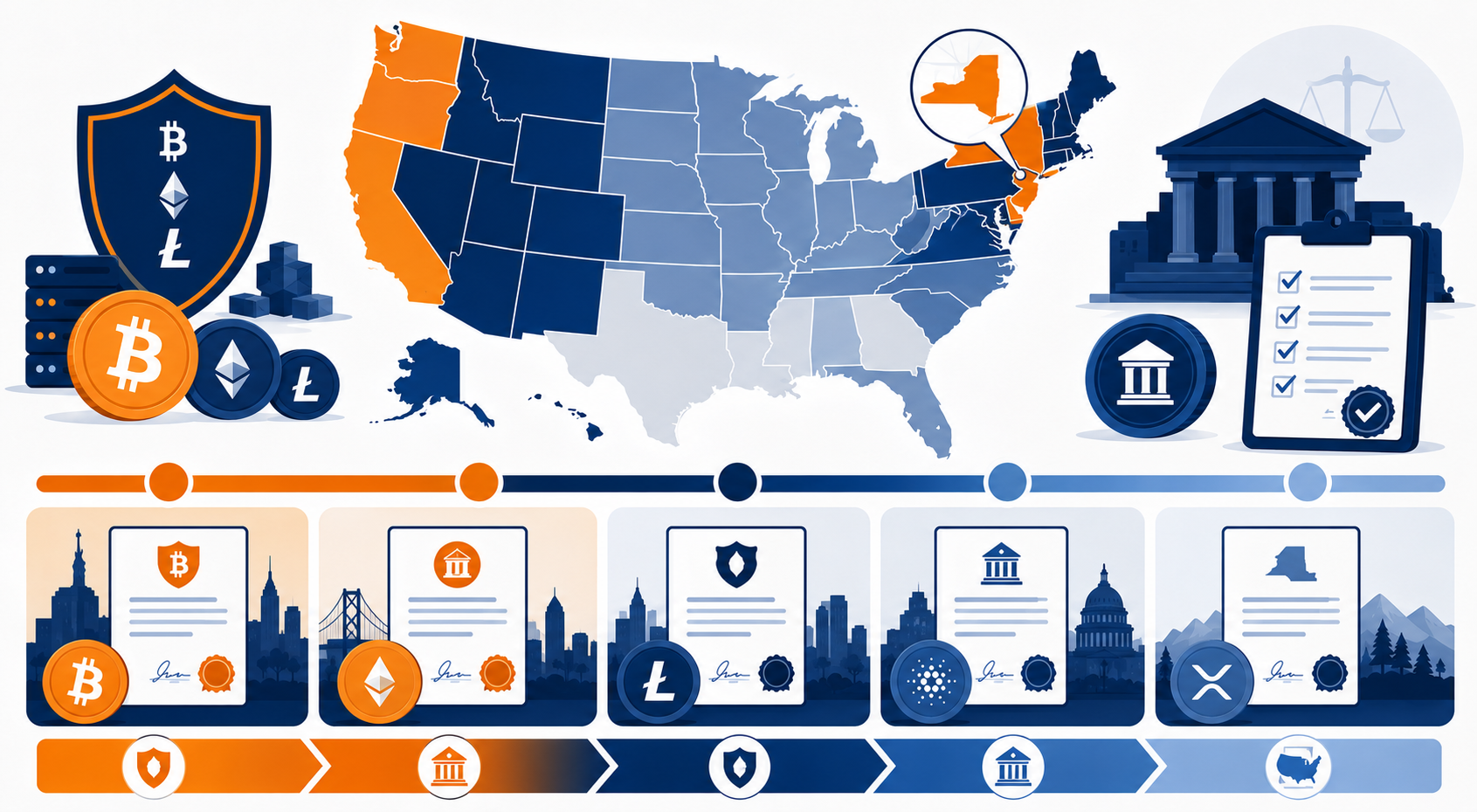
Getting a money transmitter license varies significantly by state. Here is what timelines, costs, and requirements actually look like across the U.S. — and how to build a realistic licensing strategy.
Money Transmitter License by State: Timeline, Cost, and Requirements
If you are building a fintech that moves money, one of the most common questions you will face is: how long does it take to get a money transmitter license — and how much does it cost?
The honest answer is that it depends entirely on which state you are applying in. There is no single national money transmitter license. Each state runs its own licensing regime with its own application requirements, processing timelines, capital requirements, and fee structures.
This article breaks down what money transmitter licensing actually looks like state by state — including typical timelines, cost ranges, and what makes some states significantly harder than others.
Important note: licensing requirements, fees, and processing times change regularly as states update their laws and regulations. Always verify current requirements directly with the relevant state regulator or through qualified licensing counsel before relying on any figures in this article.
Why There Is No Single National MTL
The United States does not have a unified national money transmitter licensing framework. FinCEN registration — the federal MSB registration requirement — is separate from and does not replace state licensing.
Each state has enacted its own money transmission law defining what activities require a license, what the licensing criteria are, and how licensees are supervised. This creates a patchwork of 49 different licensing regimes that fintechs must navigate individually.
Most states use the Nationwide Multistate Licensing System (NMLS) to manage applications, which streamlines some of the administrative work. But each state's substantive requirements — what you need to qualify, how much capital you must hold, what bond you must post — remain entirely state-specific.
What Determines How Long and How Much
Before looking at specific states, understanding what drives timeline and cost variation helps you set realistic expectations.
Timeline Drivers
Application completeness is the single biggest factor in processing time. Incomplete applications — missing financial statements, unsigned documents, unresponsive applicants — can add months to any state's timeline. Well-prepared applications move faster.
Examiner workload varies by state and by time of year. Some states have small licensing teams handling large volumes of applications. Periods of high application volume — common when regulatory changes prompt a wave of new applicants — extend processing times for everyone.
Background check complexity adds time when owners or executives have prior regulatory history, complex business relationships, or foreign connections that require additional verification.
State responsiveness to deficiency letters matters. When a state issues a deficiency notice requesting additional information, your response speed directly affects your timeline. Delays in responding extend the process by weeks or months.
Cost Drivers
Application fees are set by state statute and range from a few hundred dollars to several thousand per state. These are non-refundable regardless of outcome.
Surety bond amounts are typically the largest single cost variable. Most states require a surety bond as financial protection for consumers. Bond amounts vary based on state requirements and in many states on your projected or actual transaction volume — meaning the bond requirement grows as your business grows.
Net worth requirements set a minimum threshold for the financial strength of the applicant business. Meeting net worth requirements may require capitalizing your business before applying.
Professional fees for attorneys and licensing consultants who prepare and manage applications vary widely but are a real and significant cost for any multi-state licensing program.
State by State — What to Expect
The following information reflects general market experience and publicly available regulatory information as of the date of this article. Requirements and timelines change. Verify current requirements with state regulators before applying.
New York — Complex, Long, Essential
New York's Department of Financial Services (DFS) operates one of the most demanding money transmitter licensing regimes in the country. The standard money transmitter license involves detailed financial review, comprehensive background investigations of all principals, and a thorough examination of the applicant's compliance program.
For cryptocurrency businesses, the BitLicense is a separate and additional requirement from the DFS with its own distinct application requirements covering virtual currency activities, cybersecurity, consumer protection, and compliance programs.
Typical timeline: 12 to 24 months for standard applications. BitLicense applications have historically taken longer.
Key requirements include audited financial statements, detailed business plan, surety bond or approved substitute, and evidence of a functioning compliance program. New York is widely considered the most demanding state for fintech licensing and is often tackled separately from the rest of a national licensing program.
California — Comprehensive and Moderately Complex
California's Department of Financial Protection and Innovation (DFPI) licenses money transmitters under the Money Transmission Act. California has been active in interpreting its licensing requirements broadly and has issued guidance extending coverage to new fintech business models.
Typical timeline: 6 to 12 months for well-prepared applications.
Key requirements include a surety bond scaled to transaction volume, minimum net worth requirements, audited financial statements, and background investigations. California's DFPI has been proactive in fintech oversight and expects detailed compliance program documentation.
Texas — Structured and Manageable
Texas regulates money services businesses through its Money Services Bureau. Texas has a structured application process with clear requirements and a history of managing applications in a reasonable timeframe for prepared applicants.
Typical timeline: 3 to 9 months.
Key requirements include a surety bond, financial statements, background checks for principal owners and executives, and evidence of a written compliance program. Texas conducts regular examinations of licensees and expects active compliance programs.
Florida — Active Enforcement, Reasonable Timeline
Florida regulates money transmitters through the Office of Financial Regulation. Florida has been active in enforcement against unlicensed money transmission and is an important state for any fintech with significant Florida customer exposure.
Typical timeline: 3 to 6 months for complete applications.
Key requirements include a surety bond, minimum net worth, and background checks for all owners and controlling persons.
Washington State — Proactive on Fintech
Washington State's Department of Financial Institutions has been proactive in applying money transmitter licensing requirements to new fintech business models including digital wallets and certain cryptocurrency activities.
Typical timeline: 3 to 9 months.
Washington's regulators are knowledgeable about fintech and engage substantively with novel business model questions during the licensing process.
Illinois — Standard Requirements
Illinois licenses money transmitters under the Transmitters of Money Act through the Department of Financial and Professional Regulation.
Typical timeline: 3 to 9 months.
Key requirements include a surety bond, financial statements, background checks, and compliance program documentation.
Most Other States — 3 to 9 Months
The majority of states that use NMLS for money transmitter licensing process complete, well-prepared applications within 3 to 9 months. States with smaller licensing teams or higher application volumes may fall toward the longer end of this range. States with dedicated fintech licensing programs or more streamlined processes may move faster.
What Does It Actually Cost to Get Licensed?
Cost depends heavily on which states you are licensing in, your transaction volume, and whether you use outside counsel or a licensing consultant. The following ranges reflect general market experience — actual costs vary significantly.
Application Fees
State application fees typically range from $250 to $5,000 per state depending on jurisdiction. A 50-state licensing program would involve application fees in the range of $20,000 to $100,000 in total.
Surety Bonds
Surety bonds are typically the most significant direct licensing cost. Annual bond premiums — what you pay each year for the bond — are typically 1 to 3 percent of the required bond amount depending on your financial strength and credit profile.
Bond amounts vary dramatically by state. Some states require bonds of $25,000 to $100,000. Others scale bond requirements to transaction volume and can require bonds of $500,000 to $1,000,000 or more for higher-volume businesses.
Net Worth Requirements
Most states require minimum net worth — meaning your business must have sufficient equity on its balance sheet to qualify. Common minimum requirements range from $100,000 to $1,000,000 depending on the state and your business model. Meeting these requirements may require capitalizing your company specifically for licensing purposes.
Professional Fees
Legal and licensing consultant fees for preparing and managing multi-state applications vary widely. A comprehensive 30 to 50 state licensing program managed by outside counsel typically involves professional fees in the range of $100,000 to $300,000 or more depending on complexity and the speed required.
Total Cost Ranges
For a focused 10 to 15 state initial licensing program: total costs including fees, bonds, and professional support typically range from $100,000 to $400,000 depending on states chosen and business volume.
For a comprehensive 40 to 50 state national program: total costs can range from $500,000 to $2,000,000 or more over the full licensing buildout period.
These are meaningful numbers that require planning and capital allocation well in advance.
Which States Are Hardest — and Which Are Easier
Most Complex States
New York and California are consistently the most demanding states for money transmitter licensing — in terms of application requirements, documentation depth, regulator engagement, and processing time. Most fintechs building national licensing programs tackle these states separately from the rest of their portfolio.
New York's BitLicense adds an additional layer of complexity for cryptocurrency businesses that has no equivalent in most other states.
Moderately Complex States
Texas, Washington State, Illinois, and Florida represent moderately complex licensing jurisdictions — meaningful requirements and active oversight, but with structured processes that well-prepared applicants can navigate in a reasonable timeframe.
More Streamlined States
Many states in the Midwest and Mountain regions have money transmitter licensing requirements that are substantively straightforward and process applications efficiently. States like Wyoming have also enacted fintech-friendly legislation creating additional pathways for some business models.
Note that easier does not mean unimportant. A state with a streamlined application process still requires ongoing compliance obligations, annual renewals, and regulatory reporting once licensed.
Can Startups Get Money Transmitter Licenses?
Yes — but early-stage startups face specific challenges that established businesses do not.
Net worth requirements can be difficult to meet for pre-revenue companies. Audited financial statements — required by most states — are expensive and time-consuming to obtain for early-stage companies.
The practical path for most startups is to operate initially under sponsor bank coverage while building out the compliance infrastructure and financial profile needed to qualify for direct licensing. This is common and generally acceptable — but requires explicit agreement from the sponsor bank and has limitations on operational independence.
Do Crypto Companies Need Money Transmitter Licenses?
Cryptocurrency businesses that qualify as money transmitters — which includes most centralized exchanges, crypto payment processors, and digital asset custodians that accept and transmit value — are subject to state money transmitter licensing requirements in addition to FinCEN MSB registration.
Most states apply their existing money transmitter licensing requirements to crypto money transmitters. New York has a separate BitLicense regime specifically for virtual currency businesses. Wyoming and a small number of other states have enacted dedicated crypto-friendly licensing frameworks.
Crypto businesses should not assume that novelty of their technology affects their licensing obligations. The legal analysis focuses on the economic activity — whether the business accepts and transmits value — not the technology underlying it.
Building a Realistic Licensing Strategy
Given the costs, timelines, and complexity involved, a phased licensing strategy is the practical approach for most fintechs.
Phase 1 — Launch under sponsor bank coverage while applying for licenses in your top 5 to 10 priority states based on customer concentration.
Phase 2 — Expand licensing to 20 to 30 states as your first licenses are approved and your compliance infrastructure matures.
Phase 3 — Complete national coverage including New York and California as your business and compliance program reach the scale needed to support the most demanding requirements.
Throughout all phases, maintain a license management calendar tracking renewal dates, reporting deadlines, and examination cycles for every licensed state.
Frequently Asked Questions
How long does it take to get a money transmitter license in all 50 states?
A comprehensive 50-state licensing program typically takes 2 to 4 years from initial application to completion — primarily because New York, California, and a handful of other complex states have processing timelines of 12 to 24 months. The practical approach is to phase licensing over time rather than attempting all states simultaneously.
What is the fastest state to get a money transmitter license?
Processing times vary and change over time based on regulator staffing and application volume. Generally, smaller states with streamlined NMLS-based processes and lower application volumes tend to move faster. However, fast approval in an easy state should not be prioritized over getting licensed in the states where your actual customers are.
Do I need a money transmitter license if I only have a few customers?
State licensing requirements generally apply based on the activity being conducted — accepting and transmitting money — not the number of customers or transaction volume. Operating without a required license in a state exposes you to enforcement risk regardless of your customer count. Some states have de minimis thresholds, but these vary and should be verified with qualified counsel.
Can I operate while my license application is pending?
Generally no — not without some form of coverage or exemption. Most states require a license before conducting licensed activities. During the licensing period, many fintechs operate under sponsor bank coverage which provides a framework for lawful operation while independent licensing is pursued. The specific arrangement must be agreed to by your sponsor bank and documented in your program agreement.
How ComplyOne Helps
Navigating money transmitter licensing across dozens of states — determining which licenses you need, preparing applications, managing regulatory correspondence, and maintaining licenses once approved — is one of the most operationally demanding compliance undertakings a fintech faces.
ComplyOne works with fintechs to develop licensing strategies, prepare multi-state applications, and manage license portfolios as businesses grow — through advisory services, compliance technology, or both.
Talk to the ComplyOne team to get started.
The information in this article is for general educational purposes and does not constitute legal or regulatory advice. Consult a qualified compliance professional for guidance specific to your situation.