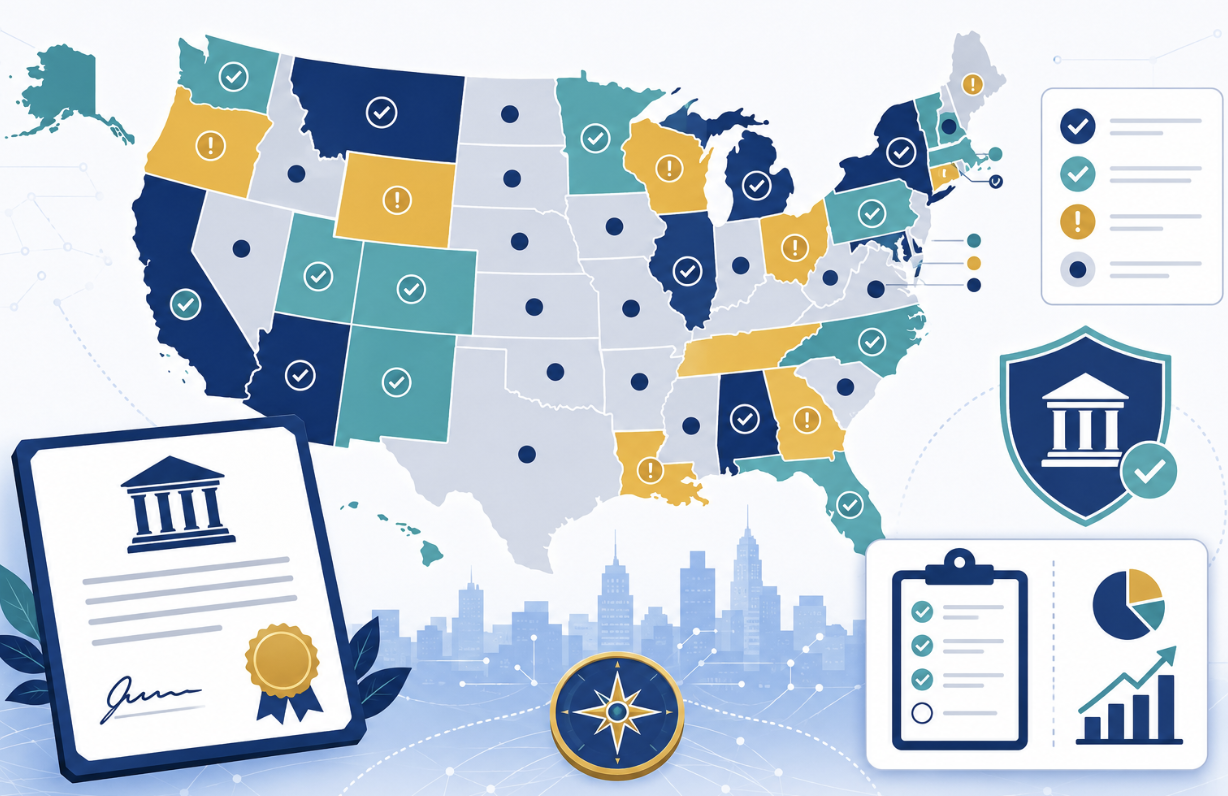
State licensing requirements for fintechs vary dramatically by jurisdiction. Here is a practical overview of the most important state licensing frameworks, what they require, and how to build a strategy that works for your business.
Fintech Licensing Requirements by State: What You Need to Know
State licensing is one of the most complex and resource-intensive compliance undertakings a fintech faces. Unlike federal requirements that apply uniformly across the country, state licensing requirements vary dramatically by jurisdiction — in how they define regulated activity, what they require for licensing, how long applications take, and what ongoing obligations licensees must meet.
Why State Licensing Exists Alongside Federal Requirements
Federal BSA requirements — including FinCEN MSB registration — apply at the national level but do not replace state licensing. State money transmitter licensing is a parallel, separate regulatory layer that most states require for businesses conducting money transmission within their jurisdiction.
State regulators examine licensed money transmitters, review their financial condition, and respond to consumer complaints. Federal registration alone does not give states visibility into or oversight of money transmission businesses operating within their borders.
Key State Licensing Frameworks
New York — Department of Financial Services
New York operates one of the most demanding money transmitter licensing regimes in the country. For traditional money transmitters, the NY DFS license requires extensive financial documentation, detailed business plans, background checks for all principals, a surety bond or approved alternative, and significant capital requirements.
For cryptocurrency businesses, New York's BitLicense is a separate additional requirement covering comprehensive compliance program documentation, cybersecurity program evidence, and consumer protection policies. The BitLicense is widely considered the most demanding crypto licensing regime in the U.S. New York application timelines of 12 to 18 months or longer are common.
California — Department of Financial Protection and Innovation
California's Money Transmission License is administered by the DFPI and covers businesses that sell or issue payment instruments, store value, or receive money for transmission. California requires a surety bond scaled to your transaction volume, minimum net worth, and audited financial statements.
Texas — Money Services Bureau
Texas licensing requires a surety bond, financial statements, background checks for principals, and a written compliance program. Texas has been proactive in examining licensed money services businesses.
Florida— Office of Financial Regulation
Florida's Money Transmitters Act covers businesses engaged in money transmission in Florida. Florida requires a surety bond, minimum net worth, and background checks for all owners and control persons.
Illinois — Department of Financial and Professional Regulation
Illinois regulates money transmitters under the Transmitters of Money Act requiring financial statements, a surety bond, background checks, and evidence of a compliance program.
Washington State — Department of Financial Institutions
Washington State has comprehensive money transmitter licensing requirements and has been proactive in applying those requirements to new business models including digital wallet providers and crypto companies.
States With Notable Fintech-Specific Frameworks
Wyoming
Wyoming has enacted fintech-friendly legislation including a special purpose depository institution charter for crypto companies and regulatory sandbox provisions, positioning itself as a favorable jurisdiction for blockchain and crypto businesses.
Arizona
Arizona operates a regulatory sandbox program that allows fintech companies to test innovative products and services with limited regulatory requirements for a defined period before full licensing is required.
Building Your State Licensing Strategy
Step 1 — Determine Which States Require a License
Not every state defines money transmission identically. Determining which states require a license for your specific product requires legal analysis — do not assume that because you are licensed in one state the same activity requires a license in every other state.
Step 2 — Prioritize by Customer Concentration
Apply first for licenses in states where you have or expect to have the most customers and transaction volume. Operating without a license in a state with significant customer exposure creates both regulatory risk and consumer harm risk.
Step 3 — Apply Through NMLS Where Available
Most states use the Nationwide Multistate Licensing System for money transmitter applications. NMLS allows you to submit information once and apply to multiple states, significantly reducing administrative burden.
Step 4 — Manage the Gap Between Launch and Licensing
State licensing takes time. Common approaches include operating under sponsor bank coverage for unlicensed states with explicit geographic restrictions, limiting product availability to licensed states, and applying for all required licenses as quickly as possible.
Step 5 — Build a License Management System
Once licensed, ongoing obligations must be managed — annual renewal filings, financial reporting, examination responses, and regulatory correspondence. A license management calendar tracking all renewal dates and reporting deadlines is essential.
Frequently Asked Questions
How do I know which states require a license for my fintech?
The specific states requiring a license depend on your business model, products, and how money flows through your platform. A legal analysis of your specific product against each state's money transmission law is the only reliable way to determine licensing requirements.
Can I apply for multiple state licenses simultaneously?
Yes. Using NMLS you can apply to multiple states simultaneously. The challenge is managing state-specific documentation requirements — some states require state-specific financial statements, bond language, or disclosure forms.
What happens if a state regulator contacts me and I am not licensed?
Immediately retain qualified legal counsel with state licensing expertise. Do not attempt to respond to regulatory inquiries about unlicensed activity without legal guidance. Depending on the state and duration of unlicensed operation, you may face enforcement action, cease and desist orders, or civil penalties.
How ComplyOne Helps
ComplyOne works with fintechs to determine state licensing requirements, develop licensing strategies, prepare and manage multi-state applications, and maintain license portfolios as businesses grow — through advisory services, licensing support, or compliance technology.
Talk to the ComplyOne team to get started.
The information in this article is for general educational purposes and does not constitute legal or regulatory advice. Consult a qualified compliance professional for guidance specific to your situation.