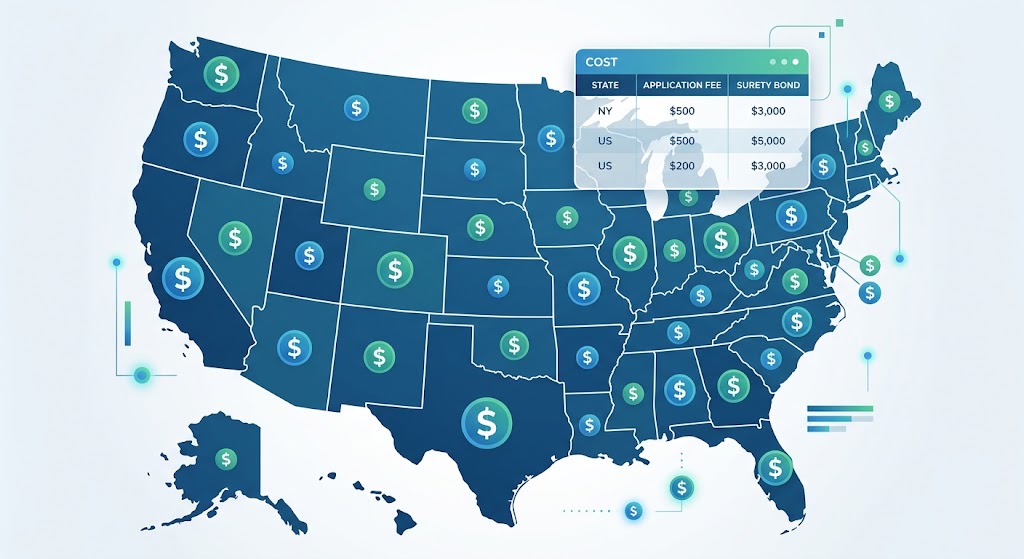
Money transmitter license fees vary significantly by state — from under $1,000 to over $5,000 in application fees alone, plus net worth and surety bond requirements that can reach six figures. This guide breaks down costs across key US states so you can budget accurately before you apply.
Money Transmitter License Fees by State: A Complete Cost Breakdown
Getting licensed as a money transmitter is a significant financial commitment — and costs vary dramatically by state. Application fees, surety bonds, and minimum net worth requirements can range from a few thousand dollars to well over half a million dollars depending on where you operate.
This guide breaks down the costs across key US states to help you plan your licensing budget. All figures are sourced from NMLS state license descriptions and individual state regulator websites. Verify current requirements directly on NMLS before filing — requirements change.
The Four Components of MTL Cost
Application fee — a one-time fee paid to the state regulator at submission. Non-refundable in most states even if your application is denied.
Annual renewal fee — paid yearly to maintain your license. Some states charge the same as the application fee; others charge less.
Minimum net worth — the tangible net worth your company must maintain on its balance sheet, verified through financial statements. This is not a fee — it is a qualification requirement.
Minimum surety bond — a financial guarantee posted with the state. You pay a bond premium to a surety company — typically 1–3% of the bond amount annually — not the full bond amount.
State-by-State Fee Overview
Source: NMLS state license descriptions and individual state regulator websites. This table covers key states where fintechs most commonly apply. Verify all current figures on NMLS before filing.
What Drives Cost Variation?
The biggest driver of total licensing cost is not the application fee — it is the net worth and surety bond requirements. Pennsylvania requires a $1,000,000 minimum surety bond. Virginia requires $1,000,000 in minimum net worth. Both have application fees under $2,000. Meanwhile, Arizona requires only $25,000 in net worth and $25,000 in bond — a fraction of the cost to qualify.
States with large financial services economies tend to set higher thresholds. States competing to attract financial services businesses tend to set lower ones. This directly affects which states fintechs target first in a multi-state licensing strategy.
Total First-Year Cost: What to Budget
State fees are only part of the picture. A realistic first-year budget for a single state license should also include:
- Legal and compliance consulting: $10,000–$50,000+ depending on state complexity and application readiness
- Audited or reviewed financial statements: $5,000–$15,000
- NMLS processing fees: approximately $100 per license application, plus per-individual fees for MU2 filers
- Fingerprinting: approximately $40–$75 per individual through NMLS-approved vendors
- Surety bond premium: 1–3% of the required bond amount annually
A realistic all-in first-year cost for a single state license — including professional fees — ranges from $20,000 to $100,000+. Multi-state programs cost more but leverage shared documentation through NMLS.
How to Look Up Current Fees on NMLS
- Go to the NMLS Resource Center
- Navigate to State Licensing Requirements
- Select your target state and the applicable license type (Money Transmitter or the state-specific equivalent)
- Review the current checklist — application fees, bond amounts, and net worth requirements are listed in the requirements section
NMLS updates state license descriptions when regulators change their requirements. Always pull the current checklist directly before filing.
Frequently Asked Questions
Do I pay the full surety bond amount upfront?
No. The bond amount is the coverage limit — the maximum a state can draw on to compensate harmed consumers. You pay a premium to a surety company, typically 1–3% of the bond amount per year. A $100,000 bond costs approximately $1,000–$3,000 annually in premium, depending on your company's financial profile and creditworthiness.
Are there NMLS fees on top of state application fees?
Yes. NMLS charges a processing fee per application — typically around $100 — in addition to the state fee. Budget this for each state and for each control person completing an MU2 form.
Why does Pennsylvania have a $1,000,000 bond requirement?
Pennsylvania sets its bond requirement based on the volume of outstanding payment obligations at any given time. The $1,000,000 floor is the minimum — the actual required bond amount may increase based on your transaction volume. Verify current requirements with the Pennsylvania Department of Banking before filing.
Do licensing fees change?
Yes — state legislatures and regulators update fee schedules periodically. Verify all current requirements on NMLS or directly with the state regulator before filing. Do not rely solely on any third-party guide, including this one.
Which states should I prioritize in a multi-state rollout?
Prioritize states where your customers are located, not just where licensing is cheapest. That said, states with lower net worth requirements and faster processing — Nevada and Arizona are common examples — are frequently targeted first by fintechs building a national license portfolio. See our guide on how to prioritize your state licensing applications.
This article is for informational purposes only and does not constitute legal or compliance advice. Licensing fees and requirements change. Verify all current requirements on NMLS and directly with each state regulator before filing.