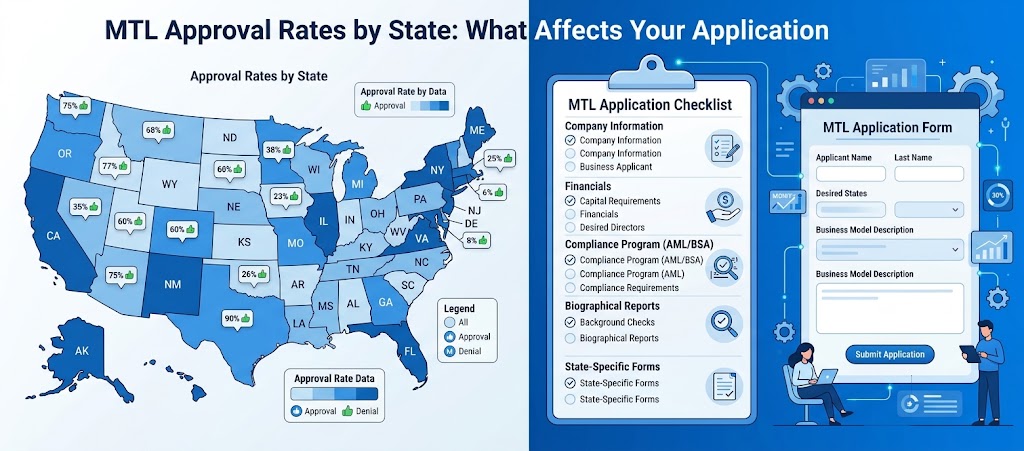
Not all money transmitter license applications are approved — and approval rates vary significantly by state. This guide explains what affects your application outcome and how to improve your odds.
MTL Approval Rates by State: What Affects Your Application
Applying for a money transmitter license (MTL) is a significant investment of time and money. Most applicants are surprised to discover that approval is far from guaranteed — and that even complete, well-prepared applications can be denied or face lengthy deficiency cycles that add months to the process.
While state regulators don't publish official approval rate statistics, practitioners working in the space consistently observe that approval rates and timelines vary dramatically across states, and that specific application deficiencies are responsible for the majority of denials and delays.
This guide explains what affects MTL application outcomes and how to prepare an application that gives you the best possible chance of approval.
Why Applications Are Denied or Delayed
State regulators deny MTL applications — or more commonly issue deficiency letters requiring additional information — for a range of reasons. The most common include:
Financial Deficiencies
The most frequent basis for application problems is insufficient financial strength. Issues include:
- Net worth below the state's minimum requirement
- Audited financial statements that are incomplete, prepared incorrectly, or not prepared by a CPA firm with relevant experience
- Insufficient permissible investments to cover outstanding transmission obligations
- Cash flow concerns suggesting the business cannot sustain operations during the licensing period
- Revenue projections that are not credibly supported
For early-stage companies, financial requirements are often the hardest to meet. See our guide on can startups get money transmitter licenses for strategies to address these challenges.
AML/BSA Program Deficiencies
Regulators review the AML/BSA compliance program submitted with the application. Deficiencies in this area include programs that are generic rather than tailored to the applicant's specific business model, programs that lack required elements (risk assessment, transaction monitoring, training, independent testing), designated compliance officers who lack experience or qualifications, and programs that are clearly not operational — they were written for the application but the company has no plan to actually implement them.
See our guide on AML compliance program requirements for what a strong AML program must include.
Background Check Issues
Officers, directors, and control persons are subject to background checks as part of the application. Criminal history — particularly financial crimes, fraud, or prior regulatory violations — can result in denial. Some states allow applicants to disclose prior issues proactively and provide context; others have bright-line rules that result in automatic denial for certain offenses.
Incomplete or Inconsistent Applications
Applications that are incomplete, that contain inconsistencies between sections (for example, a business plan that describes a different business model than the product description), or that omit required attachments trigger deficiency letters. Each deficiency letter adds weeks or months to the process.
Business Plan Weaknesses
The business plan is a critical component of the application. Regulators use it to assess whether the applicant understands the regulatory environment, has a viable and compliant business model, and can operate safely. See our guide on MTL business plan requirements for what regulators look for.
How State Selectivity Varies
States vary significantly in how demanding their review processes are:
High-Scrutiny States
New York, California, and Texas are among the most demanding states for MTL applications. These states have large regulatory staff, detailed application requirements, and thorough review processes. Deficiency rates are high, and even experienced applicants often go through multiple rounds of supplemental information requests. See our guides on getting an MTL in New York, California, and Texas.
Moderate-Scrutiny States
States like Florida, Illinois, Georgia, and Washington have thorough application processes but typically have more predictable timelines and clearer requirements. Deficiencies are still common but are often resolved more quickly.
Lower-Scrutiny States
States like Montana, Wyoming, Kansas, Nebraska, and Iowa are generally more accessible for MTL applicants — with lower financial requirements, simpler application processes, and faster processing. See our guides on easiest states to get an MTL and fastest states for MTL approval for more detail.
Starting with more accessible states and building a track record of licensed operations can help when applying in more demanding states later — regulators look at whether you're already licensed elsewhere as evidence of compliance maturity.
Factors That Strengthen Your Application
Experienced Compliance Leadership
Having a credentialed, experienced compliance officer — ideally with a CAMS designation or significant AML compliance background — materially strengthens an application. Regulators are more confident approving companies that demonstrate genuine compliance leadership rather than compliance-by-checkbox.
A Tailored, Operational AML Program
Submit an AML program that is clearly designed for your specific business — the products you offer, the customer types you serve, the payment corridors you use. Generic boilerplate programs get flagged. Programs that demonstrate you've actually thought through your specific risk exposures build regulator confidence.
Clean Background Checks Across All Control Persons
Proactively identify and address any background issues before applying. If there are prior legal or regulatory issues involving any control person, prepare a clear, factual narrative with context and evidence of resolution. Regulators generally respond better to proactive disclosure than to discovering issues during review.
Sufficient Capitalization
Apply in states where your financial position meets the requirements comfortably — not marginally. Applying for licenses you can barely qualify for creates problems at renewal when your financial position needs to be recertified.
A Complete, Consistent Application Package
Before submitting, audit your application against the state's specific checklist. Confirm that every required attachment is included, that descriptions of your business model are consistent across all sections, and that all NMLS data entry matches the documentation you've submitted. See our guide on how to apply for an MTL through NMLS.
Responding to Deficiency Letters
Receiving a deficiency letter is not a denial — it's an opportunity. How you respond matters. Best practices for deficiency responses include responding quickly (most states set response deadlines, and slow responses extend your timeline), addressing every item in the deficiency letter specifically and completely, not submitting a partial response with a promise to provide more later, and engaging with the examiner if you have questions about what they're looking for before submitting a response that misses the mark.
Frequently Asked Questions
Can a denied application be resubmitted?
Generally yes, but denials are rare compared to deficiency letters. If your application is formally denied, the denial order typically explains the basis. You can address those issues and reapply, but a denial on record may affect how regulators in other states view future applications. Avoiding a formal denial by responding thoroughly to deficiency letters is strongly preferable.
Does using a licensing consultant improve approval odds?
Working with compliance professionals who have state MTL application experience can meaningfully reduce deficiency rates by ensuring applications are complete and compliant before submission. The ROI on professional guidance is typically positive given the cost of deficiency cycles and delays. See our guide on how to choose an MTL consultant.
How long does a typical MTL application take?
Processing times range from a few months in faster states to well over a year in states like New York. See our guide on how long it takes to get an MTL for state-by-state processing time ranges.
Disclaimer: This article is for informational purposes only and does not constitute legal or compliance advice. MTL application requirements and processes vary by state and change over time. Always verify current requirements directly with NMLS and your state regulators, or consult a qualified compliance professional.
Talk to the ComplyOne team to get started.