Money transmitter license timelines vary dramatically by state. Here is what to realistically expect — state by state processing times, what causes delays, and how to move faster.
How Long Does It Take to Get a Money Transmitter License?
One of the first questions fintech founders ask when they realize they need state licensing is how long it is actually going to take. The honest answer is that it depends enormously on which states you are applying in.The range is wide. Some states process complete, well-prepared applications in 60 to 90 days. Others routinely take 12 to 18 months. Planning your product launch, your banking relationships, and your operational roadmap around licensing timelines requires understanding which category each state falls into.This article breaks down realistic money transmitter license timelines by state, explains what drives variation, and gives you practical strategies to move faster.
Important note: processing times change based on regulator staffing, application volumes, and state policy changes. The timelines below reflect general market experience as of the date of publication. Verify current expectations directly with state regulators or through qualified licensing counsel before making business decisions based on specific timelines.
Why MTL Timelines Vary So Dramatically
Before looking at specific states, understanding why timelines differ helps you set realistic expectations.
Application Completeness
The single biggest factor within your control. Incomplete applications — missing financial statements, unsigned documents, improperly formatted supporting materials — are returned or held pending deficiency responses. Each deficiency response cycle adds weeks or months to your timeline. A well-prepared, complete application at initial submission is the most reliable way to avoid delay.
Examiner Staffing and Application Volume
Some states have small licensing teams handling large volumes of applications. When application volume spikes — often when regulatory changes prompt waves of new applicants — review times extend for everyone in the queue.
Principal Background Complexity
Background investigations of all owners and key executives are required by most states. Principals with prior regulatory history, complex international business backgrounds, or ownership stakes in multiple regulated entities require more thorough investigation.
Your Responsiveness to Deficiency Notices
When states issue deficiency notices requesting additional information, your response speed directly determines your timeline. Applications where the applicant responds quickly and completely move faster.
Business Model Complexity
Novel or complex fintech business models — particularly those involving cryptocurrency, cross-border payments, or embedded finance — receive more detailed scrutiny than straightforward traditional money transmission models.
State by State Processing Times
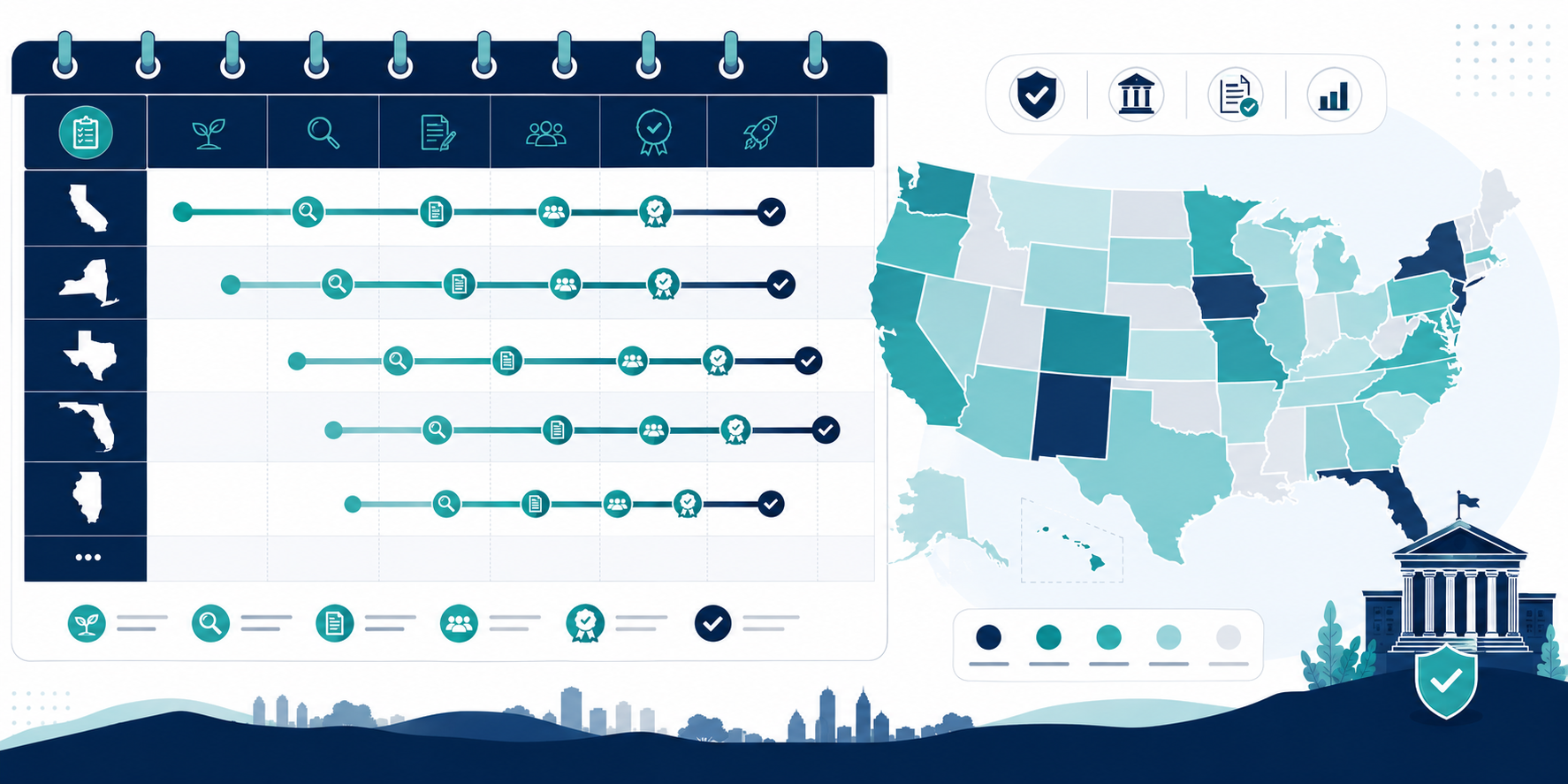
The following timelines reflect general market experience. Actual times vary based on the factors above.
New York — 12 to 24 Months
New York's Department of Financial Services operates one of the most rigorous licensing review processes in the country. The standard money transmitter license involves detailed financial analysis, comprehensive background investigations, and thorough review of the compliance program.
For cryptocurrency businesses, the BitLicense process adds additional complexity and has historically involved timelines of 18 months or longer. New York is widely approached as a separate, dedicated licensing effort rather than part of a standard multi-state application rollout.
California — 6 to 12 Months
California's Department of Financial Protection and Innovation processes money transmitter license applications with review timelines that have generally ranged from 6 to 12 months for well-prepared applications. California has been active in fintech oversight and engages substantively with applications involving new business models.
Texas — 3 to 9 Months
Texas regulates money services businesses through its Money Services Bureau. A well-prepared application submitted to Texas typically receives a response within 3 to 6 months, with total approval often achieved within 6 to 9 months.
Florida — 3 to 6 Months
Florida's Office of Financial Regulation has generally processed money transmitter applications within 3 to 6 months for complete applications.
Illinois — 4 to 8 Months
Illinois processes applications under the Transmitters of Money Act through the Department of Financial and Professional Regulation. Complete applications typically move within 4 to 8 months.
Washington State — 4 to 9 Months
Washington State's Department of Financial Institutions has been proactive in applying licensing requirements to new fintech models. Applications involving straightforward business models typically move within 4 to 6 months.
Most Other NMLS States — 3 to 6 Months
The majority of states that use NMLS for money transmitter licensing and have moderate application volumes typically process complete applications within 3 to 6 months.
What a Realistic Multi-State Timeline Looks Like
If you are pursuing a national licensing program — licenses in 30 to 50 states — the full buildout typically takes 2 to 4 years from initial application to completion. This is primarily driven by New York and California.
A realistic phased timeline for a well-resourced fintech pursuing national licensing:
Months 1 to 6 — Submit applications to 15 to 20 priority states simultaneously. Begin receiving approvals from faster states.
Months 6 to 12 — Continue receiving approvals from mid-tier states. Submit applications to remaining states. Submit New York and California applications.
Months 12 to 24 — Complete approvals from most states. Manage ongoing New York and California review processes.
Months 18 to 36 — Achieve New York and California approvals. Maintain all licenses with annual renewals and ongoing compliance obligations.
How to Move Faster
Prepare Thoroughly Before Submitting
The most impactful thing you can do is submit a complete, well-organized application the first time. Missing documents, formatting errors, and incomplete disclosures are the most common causes of delay. Have every required document ready before you submit to any state.
Use NMLS Effectively
Most states use the Nationwide Multistate Licensing System for MTL applications. NMLS allows you to input company information once and apply to multiple states from a single platform.
Respond to Deficiency Notices Immediately
When a state sends a deficiency notice, treat it as the highest priority. Every day you delay responding is a day your application sits idle.
Engage Experienced Licensing Counsel
Attorneys or licensing consultants with experience in your specific target states know exactly what regulators expect, what questions they typically ask, and how to present your application to minimize deficiencies.
Can You Operate While Waiting for Licenses?
Many fintechs launch and operate under sponsor bank coverage while pursuing direct state licensing. Under this arrangement your sponsor bank provides the regulatory umbrella for your operations in states where you are not yet independently licensed.
This arrangement requires your sponsor bank's explicit agreement and typically comes with restrictions on what you can do independently. It does not eliminate the obligation to obtain your own licenses — it provides a legitimate path to operating during the licensing period.
Frequently Asked Questions
What is the fastest state to get a money transmitter license?
Processing times change based on regulator staffing and application volumes, so no single state is consistently the fastest. Generally, smaller states with streamlined NMLS processes and moderate application volumes tend to move faster. Speed should not be the primary factor in deciding which states to apply to first — customer concentration and business need should drive that decision.
Can you get a money transmitter license in 30 days?
In most states, no. Even the fastest states typically require several months to complete background checks, review financial statements, and assess the application. Plan for a minimum of 60 to 90 days in the fastest states and much longer in most jurisdictions.
Does having a license in one state help get approved in others?
It can be a positive factor. Being an active, compliant licensee in other states demonstrates regulatory good standing and operational experience. Some states have formal or informal expedited processes for businesses already licensed in multiple jurisdictions.
What happens if my license application is denied?
License denials are relatively uncommon for applicants who have addressed potential disqualifying factors before applying. If an application is denied, experienced licensing counsel is critical in navigating the reapplication process.
How ComplyOne Helps
ComplyOne works with fintechs to develop state licensing strategies, prepare complete and well-organized applications, manage regulatory correspondence to minimize deficiency delays, and maintain license portfolios as businesses grow — through advisory services, compliance technology, or both.
Talk to the ComplyOne team to get started.
The information in this article is for general educational purposes and does not constitute legal or regulatory advice. Licensing timelines change frequently based on regulator staffing and policy. Verify current processing times directly with state regulators or qualified legal counsel before making business decisions.