AML typologies are documented patterns of money laundering behavior. Understanding them is essential for building effective transaction monitoring rules and recognizing red flags in your payment flows.
What Is AML Typology? Common Patterns Fintechs Must Know
Criminals who launder money don't invent new schemes every time — they follow patterns. The financial crimes industry has studied and catalogued those patterns extensively. These catalogued patterns are called AML typologies.
Understanding typologies is foundational to building an effective AML compliance program — because you can't monitor for what you don't understand.
What Is an AML Typology?
An AML typology is a documented pattern or method used to launder money or finance terrorism. Typologies describe how criminals move, layer, and integrate illicit funds — and they're published by organizations like the Financial Action Task Force (FATF), FinCEN, the Egmont Group, and national financial intelligence units.
For your fintech, typologies serve as the blueprint for your transaction monitoring rules and your AML red flags guidance. If your monitoring system isn't calibrated to detect known typologies, you have gaps — and regulators will find them.
The Three Stages of Money Laundering
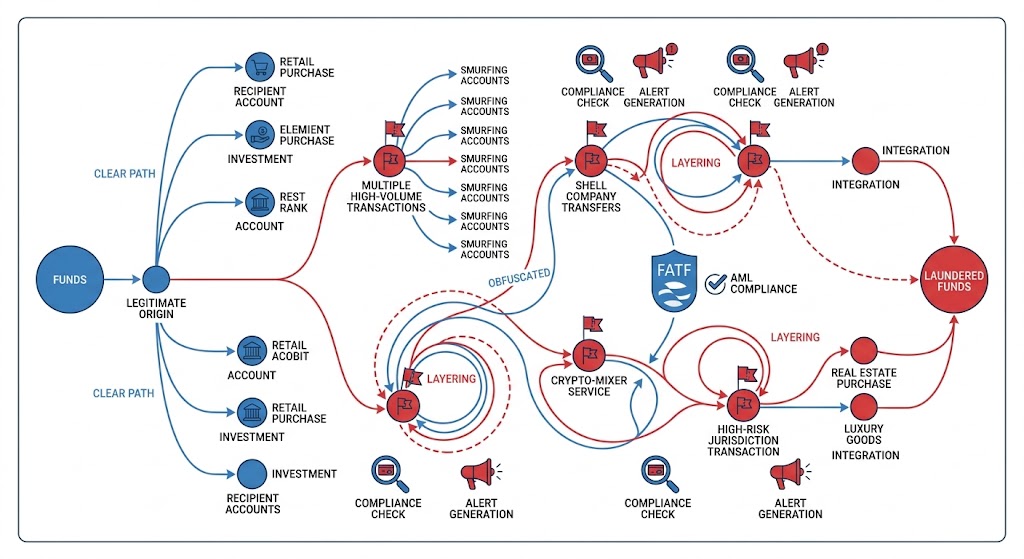
Most AML typologies operate across the three classic stages of money laundering:
- Placement: Introducing illicit cash into the financial system — typically the most vulnerable stage for detection
- Layering: Moving and transforming the funds through multiple transactions to obscure their origin
- Integration: Reintroducing the laundered funds into the legitimate economy as clean money
Common AML Typologies Relevant to Fintechs
Structuring (Smurfing)
Breaking large amounts of cash or funds into smaller transactions to stay below the $10,000 CTR threshold. In digital payments, this manifests as multiple sub-$10,000 transactions from a single source over a short window. See our guide on structuring for detection specifics.
Layering Through Multiple Transfers
Rapidly moving funds through a series of accounts — often across multiple institutions and jurisdictions — to create a complex audit trail. In a fintech context, this might look like funds received from one account being immediately disbursed to multiple other accounts.
Peer-to-Peer Payment Abuse
Using peer-to-peer platforms (including fintech apps) to rapidly move funds between multiple accounts in a pattern inconsistent with normal personal transactions. This is a significant typology concern for payment apps.
Account Takeover and Identity Fraud
Compromising legitimate customer accounts to launder funds — using real identity verification to establish an account, then using the account for illicit activity. This exploits your KYC controls by using authentic credentials.
Trade-Based Money Laundering (TBML)
Using international trade transactions — over- or under-invoicing, multiple invoicing, misrepresenting goods — to transfer value across borders. Relevant for fintechs with B2B payment products or cross-border transfer capabilities.
Virtual Asset Typologies
Using cryptocurrency to move funds: converting cash to crypto (placement), layering through multiple wallets and chains (layering), and converting back to fiat at an exchange (integration). Mixing services and privacy coins are used to obscure the chain of custody.
Mule Accounts
Recruiting individuals (often unwittingly) to receive and forward funds through their accounts. Mule accounts are a key typology in fraud and money laundering schemes. Indicators include accounts receiving large unexpected transfers followed immediately by outgoing wires to unknown beneficiaries.
Third-Party Payment Layering
Using third parties — friends, family members, or associates — to conduct transactions on behalf of the true owner of the funds, obscuring who is actually moving the money.
How to Use Typologies in Your Compliance Program
Typologies should directly inform:
- Transaction monitoring rules: Each major typology should map to at least one monitoring rule. If you have no rule designed to detect mule account activity, you have a gap.
- AML risk assessment: Products that enable known typologies carry higher inherent risk. A peer-to-peer payment product, for example, carries higher typology-based risk than a basic bank account.
- Staff training: Your compliance team and customer-facing staff should understand the typologies most relevant to your product set.
- SAR narratives: When filing a SAR, referencing the applicable typology in your narrative helps law enforcement contextualize the activity.
Where to Find Typology Guidance
FinCEN publishes financial trend analyses and advisories that describe current typologies affecting US financial institutions. FATF publishes comprehensive typology reports covering emerging and established patterns globally. Both are essential reading for compliance teams.
Frequently Asked Questions
Do all typologies apply to every fintech?
No. The typologies most relevant to your business depend on your product set. A crypto exchange faces different typology exposure than a B2B payment platform. Your AML risk assessment should identify which typologies apply to your specific business. Your transaction monitoring program should then be calibrated accordingly.
How often should I update my understanding of typologies?
At least annually. FinCEN and FATF regularly publish new typology reports and advisories as new patterns emerge. Your annual AML risk assessment should incorporate the latest published guidance.
How do typologies relate to CTR filing?
Structuring is a typology that directly relates to CTR filing avoidance. Other typologies may result in SAR filing obligations rather than CTR obligations. Understanding which typologies trigger which reporting requirements is essential.
This article is for educational purposes only and does not constitute legal or compliance advice. Regulations vary by jurisdiction and change frequently. Consult a qualified compliance professional or legal counsel for guidance specific to your business.