Currency Transaction Reports are a required BSA filing for cash transactions over $10,000. Here is what triggers a CTR, how to file one, key deadlines, and what structuring means for your compliance program.
What Is a Currency Transaction Report (CTR)? A Guide for Fintechs
The Currency Transaction Report is one of the foundational reporting requirements of the Bank Secrecy Act. Unlike Suspicious Activity Reports — which require compliance judgment and investigation before filing — CTRs are straightforward: when a cash transaction exceeds $10,000, a report must be filed. No judgment required.
Understanding CTR requirements is important for any fintech that touches cash — and understanding the structuring rules that surround CTRs is important for every fintech regardless of whether cash is involved.
What Is a Currency Transaction Report?
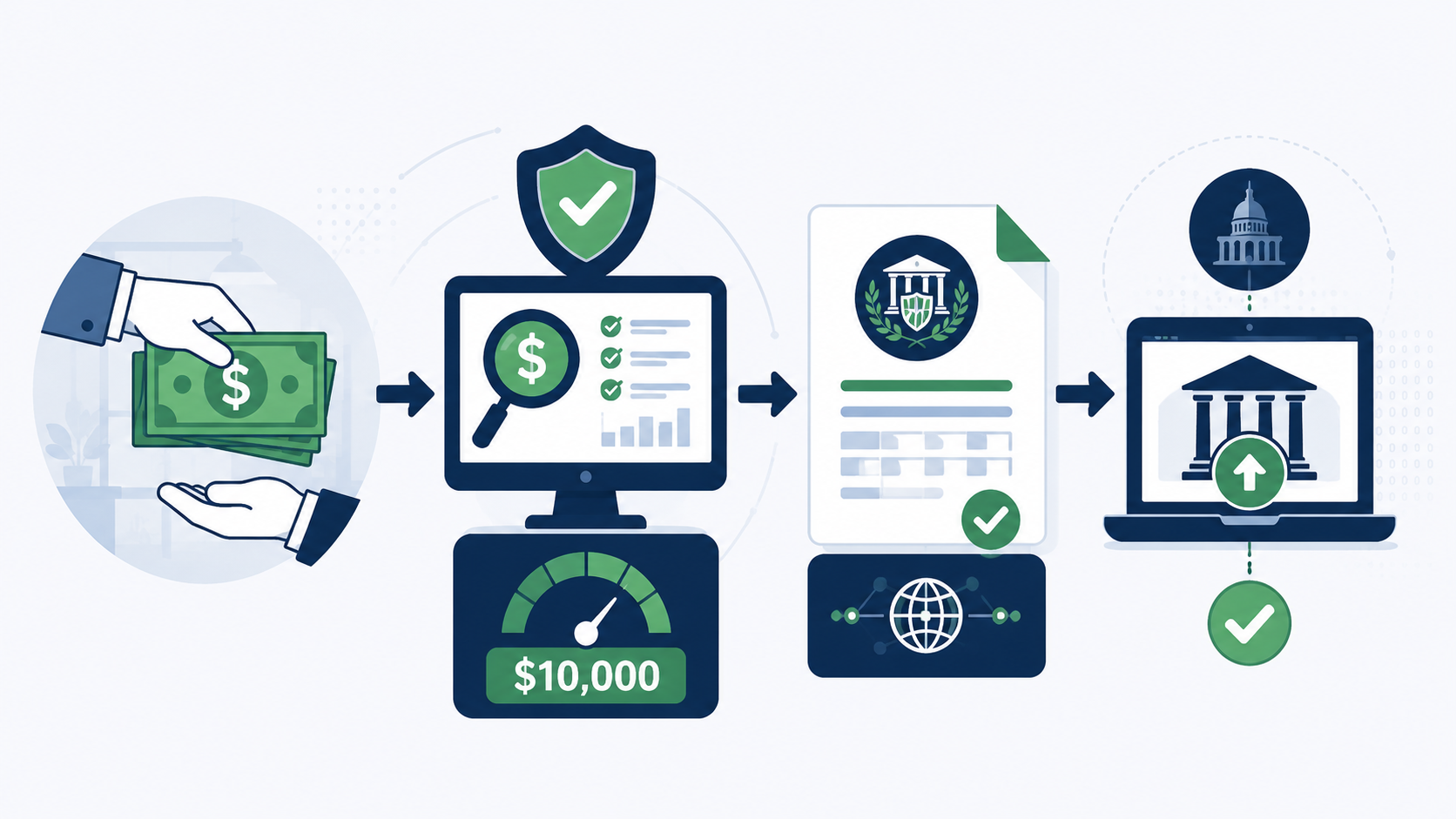
A Currency Transaction Report is a mandatory filing with FinCEN that documents cash transactions exceeding $10,000 conducted by or on behalf of the same person in a single business day.
CTRs are not filed because the transaction is suspicious. They are filed automatically based on dollar amount alone. The purpose is to give law enforcement a record of large cash movements that can be used in financial crime investigations including money laundering, tax evasion, and drug trafficking.
Who Is Required to File CTRs?
CTR filing requirements apply to financial institutions covered by the BSA including banks and credit unions, money services businesses that deal in currency, and other covered financial institutions that handle cash transactions.
For most digital-first fintechs that do not handle physical cash — platforms operating through ACH, card payments, wire transfers, or digital wallets — CTR requirements are generally not directly applicable. However, if your platform or any of your distribution channels involve cash acceptance, cash dispensing, or cash exchange, CTR requirements apply to those activities.
What Triggers a CTR Filing?
The $10,000 Threshold
A CTR must be filed when a person conducts a cash transaction — or multiple related cash transactions in a single business day — totaling more than $10,000. The threshold applies to currency — physical cash. It does not apply to electronic transfers, checks, or other non-cash payment instruments.
The Aggregation Rule
The $10,000 threshold applies to aggregated transactions — not just single transactions. If a person conducts multiple cash transactions in a single business day that together exceed $10,000, a CTR is required even if no individual transaction exceeded the threshold.
Your systems must be capable of identifying and aggregating multiple cash transactions by the same person within a single business day to determine whether the CTR threshold has been met.
Transactions On Behalf of Others
If a customer conducts a cash transaction on behalf of another person, the CTR must identify both the person conducting the transaction and the person on whose behalf it is conducted.
How to File a CTR
CTRs are filed electronically through FinCEN's BSA E-Filing System. The form requires information about the person or persons involved in the transaction, the financial institution conducting the transaction, the nature and amount of the transaction, and the date of the transaction.
CTRs must be filed within 15 calendar days of the transaction date. Missing the 15-day filing window is a BSA violation. CTR records must be retained for a minimum of five years.
CTR Exemptions
The BSA provides for exemptions from CTR filing for certain customers whose large cash transactions are expected and well-understood. Exempt persons include banks, government agencies, publicly traded companies and their subsidiaries, and certain businesses that regularly conduct large cash transactions in the ordinary course of business.
Exemptions must be documented and maintained. Exempt businesses must still be monitored and exemptions must be reviewed at least annually.
Structuring — The Most Important Related Concept
What Is Structuring?
Structuring is the practice of deliberately breaking up transactions specifically to avoid triggering the $10,000 CTR reporting threshold. A customer who makes multiple cash deposits of $9,500 on consecutive days instead of one $19,000 deposit is structuring.
Structuring is a federal crime under the BSA — independent of whether the underlying funds are from illegal sources. It is illegal to structure transactions to evade reporting requirements even if the money is entirely legitimate.
Why Structuring Matters for All Fintechs
Even if your fintech does not handle cash, structuring is relevant because the same pattern — deliberately breaking up transactions to avoid detection thresholds — applies to electronic transactions as well. Customers who structure electronic transactions to avoid monitoring thresholds are engaged in behavior that warrants a SAR filing.
Your transaction monitoring program must include rules designed to detect structuring patterns — transactions just below defined thresholds repeated at regular intervals or structured in patterns suggesting deliberate threshold avoidance.
CTR vs. SAR — Understanding the Difference
A CTR is filed automatically based on transaction amount — no judgment, no investigation, no suspicion required. It is a mechanical reporting requirement triggered by a dollar threshold.
A SAR is filed based on compliance judgment — it requires investigation, analysis, and a determination that activity is suspicious. It is not automatic and requires trained compliance decision-making.
A single transaction can trigger both. A $15,000 cash deposit that is also suspicious requires both a CTR for the dollar amount and potentially a SAR for the suspicious activity.
Frequently Asked Questions
Does my fintech need to file CTRs if we only process electronic payments?
If your fintech processes only electronic payments and does not accept or dispense physical cash, CTR filing requirements are generally not directly applicable. If your platform involves any cash handling through physical locations, ATMs, or cash acceptance networks, CTR requirements apply to those activities.
What happens if a CTR is filed late?
Filing a CTR after the 15-calendar-day deadline is a BSA violation. FinCEN can assess civil money penalties for late CTR filings. A pattern of late filings is a significant compliance program deficiency.
Is there a minimum dollar amount for CTR exemptions?
No. CTR exemptions are based on the customer's business type and regularity of large cash transactions — not a minimum dollar amount. An exempt business could conduct cash transactions of any amount without triggering CTR filings, but the exemption must be properly documented and the business must still be monitored for suspicious activity.
How ComplyOne Helps
ComplyOne helps fintechs understand their CTR obligations, implement monitoring rules needed to detect structuring patterns, and build the BSA reporting processes that satisfy FinCEN requirements — through advisory services, compliance technology, or both.
Talk to the ComplyOne team to get started.
The information in this article is for general educational purposes and does not constitute legal or regulatory advice. Consult a qualified compliance professional for guidance specific to your situation.