AML and KYC are related but distinct compliance requirements. This guide explains the difference, how they work together, and what each one requires from your fintech.
AML vs KYC — What Is the Difference?
"AML" and "KYC" are two of the most used terms in fintech compliance — and they're often treated as interchangeable, even though they're not.
Understanding the distinction matters for building a compliance program that actually covers what it needs to cover. Here's the plain-English breakdown.
What Is AML?
Anti-Money Laundering (AML) refers to the full set of laws, regulations, policies, and controls designed to detect and prevent money laundering and the financing of terrorism.
In the US, AML is governed primarily by the Bank Secrecy Act (BSA) and its implementing regulations. An AML compliance program covers:
- Customer identification and due diligence (which is where KYC comes in)
- Ongoing transaction monitoring
- Suspicious Activity Report (SAR) filing
- Currency Transaction Report (CTR) filing
- OFAC sanctions screening
- AML training for staff
- Independent testing and audits
- A designated compliance officer
AML is the umbrella. It's the complete program your fintech needs to comply with BSA requirements and fight financial crime.
What Is KYC?
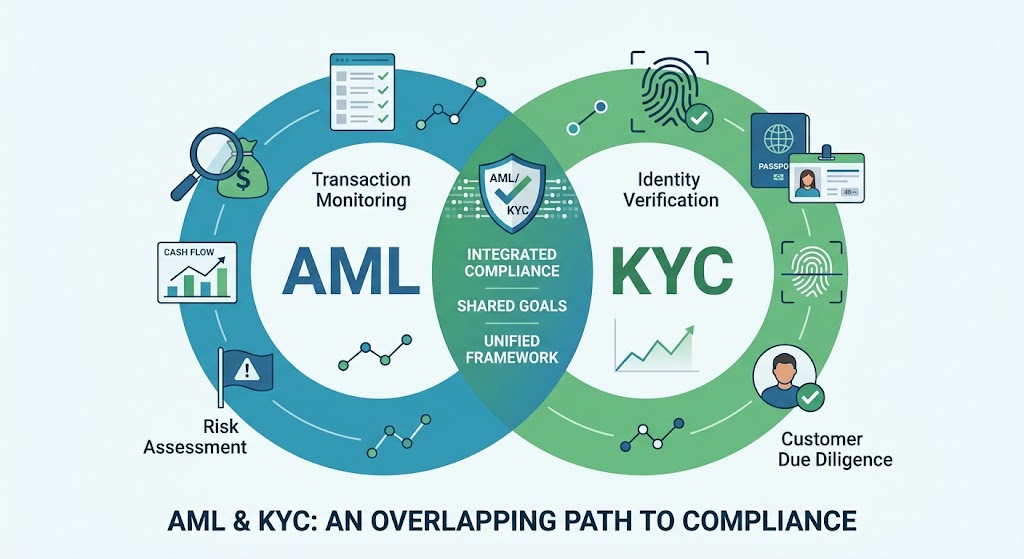
Know Your Customer (KYC) is a specific process — a component within AML — that involves verifying the identity of your customers before and during the financial relationship.
KYC includes:
- Customer Identification Program (CIP) — verifying identity at account opening (name, date of birth, address, ID number)
- Customer Due Diligence (CDD) — understanding the nature of the customer relationship, their expected activity, and their risk level
- Enhanced Due Diligence (EDD) — deeper investigation for high-risk customers such as PEPs or MSBs
- Ongoing monitoring — periodically reviewing and updating customer information
KYC is the foundation that AML is built on. You can't detect money laundering if you don't know who your customers are.
The Key Difference
The simplest way to think about it: KYC is part of AML. AML is not part of KYC.
How They Work Together
A practical example: a customer opens an account with your fintech.
- KYC kicks in at onboarding — you collect their identity information, verify their ID document, run sanctions and PEP screening, assess their risk level, and assign them a CDD profile.
- AML kicks in throughout the relationship — your transaction monitoring system watches their activity for red flags. If something unusual happens, your team investigates. If the investigation reveals suspicious activity, you file a SAR.
Neither works well without the other. Weak KYC means your transaction monitoring has no reliable baseline — you don't know what "normal" looks like for this customer. Weak transaction monitoring means your KYC data sits idle while financial crime happens in plain sight.
Why the Confusion Exists
In practice, many vendors market "KYC software" or "AML software" interchangeably. Some products do both. Many compliance job descriptions list "KYC/AML" as a combined requirement.
The overlap is real — but so is the distinction. When regulators examine your program, they'll look at both independently:
- Is your KYC/CIP program complete and properly executed?
- Is your broader AML program — transaction monitoring, SAR filing, training, testing — fully operational?
Confusing the two can lead to compliance gaps: a fintech with a great KYC onboarding flow but no transaction monitoring, or one with strong monitoring rules but sloppy customer identity verification.
What Do Fintechs Need for Both?
For KYC:
- Written CIP and CDD policies
- Document verification process (with a KYC provider or in-house)
- Risk scoring methodology
- EDD procedures for high-risk customers
- Record retention (5 years minimum)
For AML:
- All of the above, plus:
- Transaction monitoring rules and alerts
- SAR filing process (policies, FinCEN E-Filing access, narrative templates)
- OFAC sanctions screening at onboarding and ongoing
- CTR filing capability (if you handle cash)
- Annual AML training for all relevant staff
- Independent annual review of the AML program
- Designated BSA/AML compliance officer
Frequently Asked Questions
Can I have a KYC program without a full AML program?
KYC is not a standalone compliance program — it's a component of AML. If your fintech is subject to BSA requirements, you need the full AML program. KYC alone is not sufficient.
Does every fintech need AML compliance?
Any fintech that qualifies as a Money Services Business (MSB), operates under a sponsor bank, or is otherwise subject to BSA requirements needs a full AML compliance program. If you're unsure whether BSA applies to your business model, consult a compliance professional.
Is KYB the same as KYC?
KYB (Know Your Business) is the business-entity equivalent of KYC — it applies the same due diligence principles to corporate customers instead of individuals. KYB involves verifying the business itself, its ownership, and its beneficial owners.
What does "KYC/AML compliant" mean when a vendor says it?
It typically means the vendor's product helps you fulfill both KYC and AML obligations. Evaluate specifically what functions it covers: identity verification only, or also transaction monitoring, SAR workflows, sanctions screening, and reporting?
This article is for educational purposes only and does not constitute legal or compliance advice. Regulations vary by jurisdiction and change frequently. Consult a qualified compliance professional or legal counsel for guidance specific to your business.