FinCEN 314(a) requests enable law enforcement to ask financial institutions to search their records for accounts linked to suspected criminals. This guide explains how 314(a) works, what fintechs must do, and how to build a response process.
What Is a FinCEN 314(a) Request? A Guide for Fintechs
Law enforcement fighting money laundering and terrorism financing has a powerful tool: the ability to ask financial institutions across the country to search their records for accounts linked to named suspects.
That tool is the FinCEN 314(a) program. Here's how it works and what your fintech needs to do.
What Is FinCEN 314(a)?
Section 314(a) of the USA PATRIOT Act authorizes the US Treasury Department (through FinCEN) to facilitate information sharing between law enforcement and financial institutions. It allows federal law enforcement agencies — including the FBI, DEA, and Secret Service — to request that financial institutions search their records for accounts or transactions involving named subjects under investigation for money laundering or terrorism financing.
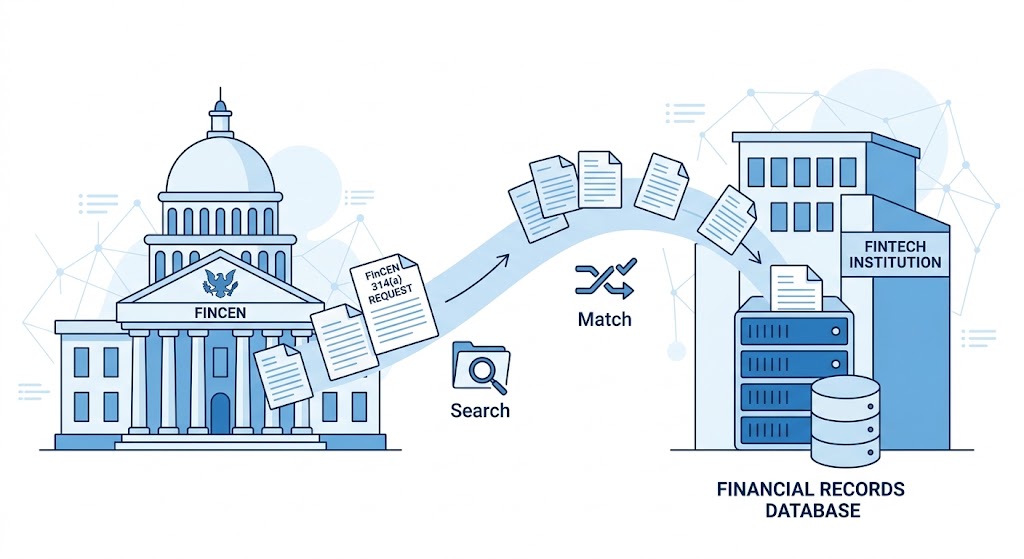
FinCEN acts as the intermediary: law enforcement submits names of subjects to FinCEN, FinCEN issues a 314(a) request to all covered financial institutions, and those institutions search their records and report any matches back to FinCEN (which shares them with the requesting law enforcement agency).
Who Receives 314(a) Requests?
314(a) requests go to all covered financial institutions registered with FinCEN, including:
- Banks and credit unions
- Money services businesses (MSBs)
- Broker-dealers
- Mutual funds
- Certain insurance companies and futures commission merchants
If your fintech is registered as an MSB with FinCEN, you are a covered financial institution and you will receive 314(a) requests.
How Does the 314(a) Process Work?
Step 1: Law Enforcement Submits Names
A federal law enforcement agency opens an investigation involving suspected money laundering or terrorism financing. They submit the subject's name and identifying information to FinCEN, certifying that the investigation is legitimate.
Step 2: FinCEN Issues the Request
FinCEN transmits the 314(a) request to all covered financial institutions via a secure portal. Requests are typically issued biweekly. Each request contains a list of names and, where available, account numbers, Social Security Numbers, and dates of birth.
Step 3: Financial Institution Searches Its Records
Upon receiving a 314(a) request, covered institutions must search their records for accounts or transactions matching the subjects listed in the request. The search must cover:
- Current accounts — accounts currently open at your institution
- Transactions in the past 12 months — for any accounts, safe deposit boxes, or wire transfers involving the listed subjects
The search must be completed within two weeks of receiving the request.
Step 4: Report Matches to FinCEN
If your search identifies a match — a current or former account, or a transaction — you must report that match to FinCEN through the secure 314(a) portal. Do not contact the subject or tip them off.
Step 5: Continue to Monitor
If you report a match, FinCEN may follow up with additional requests. You should also consider whether the match warrants a SAR filing — particularly if you have suspicious activity information beyond the simple account match.
What If There Is No Match?
If you search your records and find no matches, you are not required to respond to FinCEN. Silence means no match found. You only respond when you identify a positive hit.
Key Compliance Requirements
- Receive and search every request — failure to process a 314(a) request is a BSA compliance deficiency
- Respond within two weeks — the two-week response window is firm
- Maintain confidentiality — the subject of a 314(a) request must not be informed (tipping-off prohibition applies)
- Retain records — keep records of each 314(a) request received and your search results for at least five years
- Designate a point of contact — register a contact with FinCEN to receive 314(a) transmissions
Building a 314(a) Response Process
For fintechs, a functioning 314(a) process requires:
- FinCEN portal access — register for and maintain access to FinCEN's 314(a) secure portal
- Designated 314(a) contact — an individual in your compliance team who monitors the portal
- Search procedure — a documented process for running names against your customer and transaction database
- Match reporting procedure — how to submit a match report to FinCEN when one is found
- SAR evaluation — a process for determining whether a 314(a) match should also trigger a SAR filing
- Record retention — logging of every request received and your search result
314(a) vs. 314(b): What's the Difference?
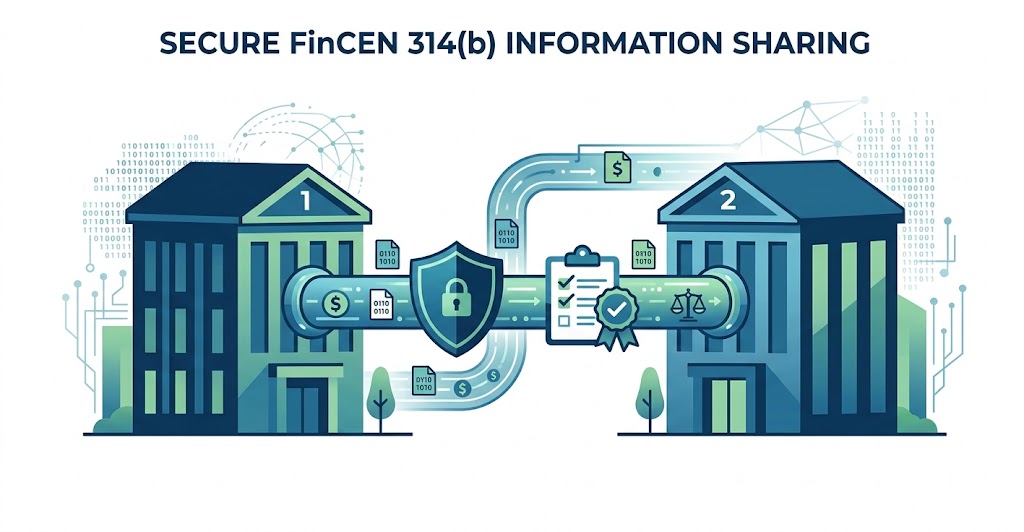
The 314(a) program is mandatory. The 314(b) program — voluntary information sharing between financial institutions — is covered in a separate guide.
Frequently Asked Questions
Can I search for 314(a) subjects in my customer database using automated tools?
Yes — and you should. Manual name searches are error-prone and slow. Most compliance teams build or configure an automated name-matching process that can run 314(a) lists against their full customer and transaction database within hours.
What happens if I miss a 314(a) request or respond late?
Missing or failing to properly respond to a 314(a) request is a BSA compliance deficiency that could be cited in an examination. If you realize you've missed one, search retroactively and document that you've corrected the process.
Does a 314(a) match automatically require a SAR?
No — a 314(a) match tells you law enforcement is investigating this person. If your search reveals a current account or recent transactions, evaluate whether those transactions give you independent grounds for a SAR filing. The SAR decision should be based on your own suspicious activity analysis, not solely on the 314(a) match.
This article is for educational purposes only and does not constitute legal or compliance advice. Regulations vary by jurisdiction and change frequently. Consult a qualified compliance professional or legal counsel for guidance specific to your business.