Structuring — breaking up transactions to avoid the $10,000 CTR threshold — is a federal crime. This guide explains what structuring is, how to detect it in your payment flows, and what your fintech must do when you find it.
What Is a Structuring Violation? How Fintechs Can Detect It
Structuring is one of the most common financial crimes that fintechs encounter — and one of the most important to detect. It's not just suspicious; it's a federal crime in its own right, regardless of whether the underlying money is from a criminal source.
What Is Structuring?
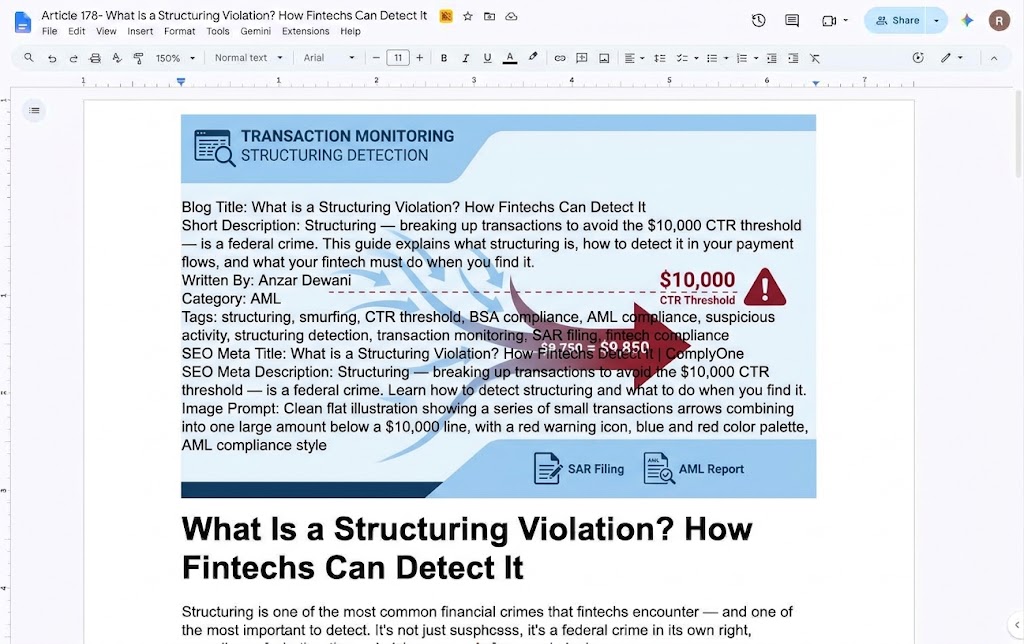
Structuring — sometimes called "smurfing" — is the practice of deliberately breaking up financial transactions into smaller amounts specifically to avoid triggering the $10,000 Currency Transaction Report (CTR) threshold.
Under the Bank Secrecy Act, financial institutions are required to file a Currency Transaction Report (CTR) for cash transactions exceeding $10,000. Structuring is the deliberate circumvention of this requirement — making two $5,000 deposits instead of one $10,000 deposit, for example, specifically to avoid the report.
Critically: structuring is a federal crime under 31 U.S.C. § 5324 regardless of whether the underlying funds are clean or dirty. A customer who structures transactions using legitimate money is still committing a federal crime.
What Does Structuring Look Like?
Structuring patterns in payment flows:
- Multiple deposits of $9,000, $9,500, or $9,800 — amounts just below the $10,000 CTR threshold
- Multiple transactions on the same day at the same or different locations totaling more than $10,000
- A series of transactions occurring just before and just after a significant threshold amount
- Transactions from multiple individuals (smurfs) depositing amounts that together total a suspicious sum
- A customer who previously made large transactions suddenly shifts to multiple sub-$10,000 transactions
What Is "Willful" Structuring?
The criminal offense requires that the structuring be willful — meaning the customer must know that the CTR reporting requirement exists and deliberately act to evade it. However, in practice, courts have found that knowledge of the reporting requirement can be inferred from circumstances, particularly when the pattern of transactions is consistent only with an intent to evade reporting.
How Fintechs Can Detect Structuring
Your transaction monitoring system should include structuring-specific detection rules:
Rule-Based Detection
- Sub-threshold clustering: Flag multiple transactions within a defined lookback period (24 hours, 3 days, 7 days) that collectively exceed $10,000 but individually fall below it
- Round-number clustering: Flag repeated transactions ending in 000 or 500 in the $7,000–$9,999 range
- Velocity rules: Flag accounts with an unusual frequency of sub-$10,000 transactions
- Multi-channel aggregation: Aggregate transactions across all channels (mobile, ACH, wire, in-person) for the same customer
Behavioral Detection
- Compare current patterns to historical baseline — a sudden shift from infrequent large deposits to frequent small deposits is a red flag
- Look for coordinated activity across multiple accounts that appear to be related
What Must Your Fintech Do When You Detect Structuring?
- Document the alert: Record what transaction pattern triggered the review
- Investigate: Review the customer's full transaction history, account profile, and stated purpose of account
- Assess for SAR filing: If after investigation the structuring pattern cannot be explained by a legitimate purpose, file a SAR. Structuring is an explicit BSA violation and a common SAR trigger.
- Consider account action: Depending on the severity and the customer's response, you may restrict the account, file a SAR without contacting the customer, or take other remedial action
- Never tip off the customer: If you file a SAR, you cannot disclose that fact to the customer. This is strictly prohibited under the SAR tipping-off prohibition.
Structuring in a Digital Payments Context
Structuring was originally a cash crime. In the digital payments world, it shows up in ACH batches, digital wallet loads, peer-to-peer transfers, and cryptocurrency transactions. The pattern is the same — deliberate fragmentation to avoid thresholds — even when no physical cash is involved. Your AML red flags monitoring should cover all transaction channels.
Frequently Asked Questions
Is it structuring if the customer doesn't know about CTR requirements?
Technically, structuring requires knowledge of the reporting requirement and deliberate intent to circumvent it. However, courts and regulators look at the pattern of transactions — a consistent pattern of sub-threshold transactions strongly suggests awareness.
What is the CTR threshold for digital transactions?
The $10,000 CTR threshold applies to cash transactions. Most digital transactions are not subject to CTR requirements — but structuring detection still applies if a customer appears to be deliberately keeping transactions below any reporting threshold.
Can a customer be convicted of structuring even if the money is legitimate?
Yes. The Supreme Court has held that structuring is a crime regardless of whether the underlying funds are from a lawful source.
This article is for educational purposes only and does not constitute legal or compliance advice. Regulations vary by jurisdiction and change frequently. Consult a qualified compliance professional or legal counsel for guidance specific to your business.