The GENIUS Act is accelerating the question nobody in fintech wants to answer too early: if stablecoin issuers and non-bank fintechs get direct access to Federal Reserve payment rails, what happens to the sponsor bank relationships that currently underpin most of the industry?
If Fintechs Get Direct Fed Access, What Happens to the Sponsor Bank Model?
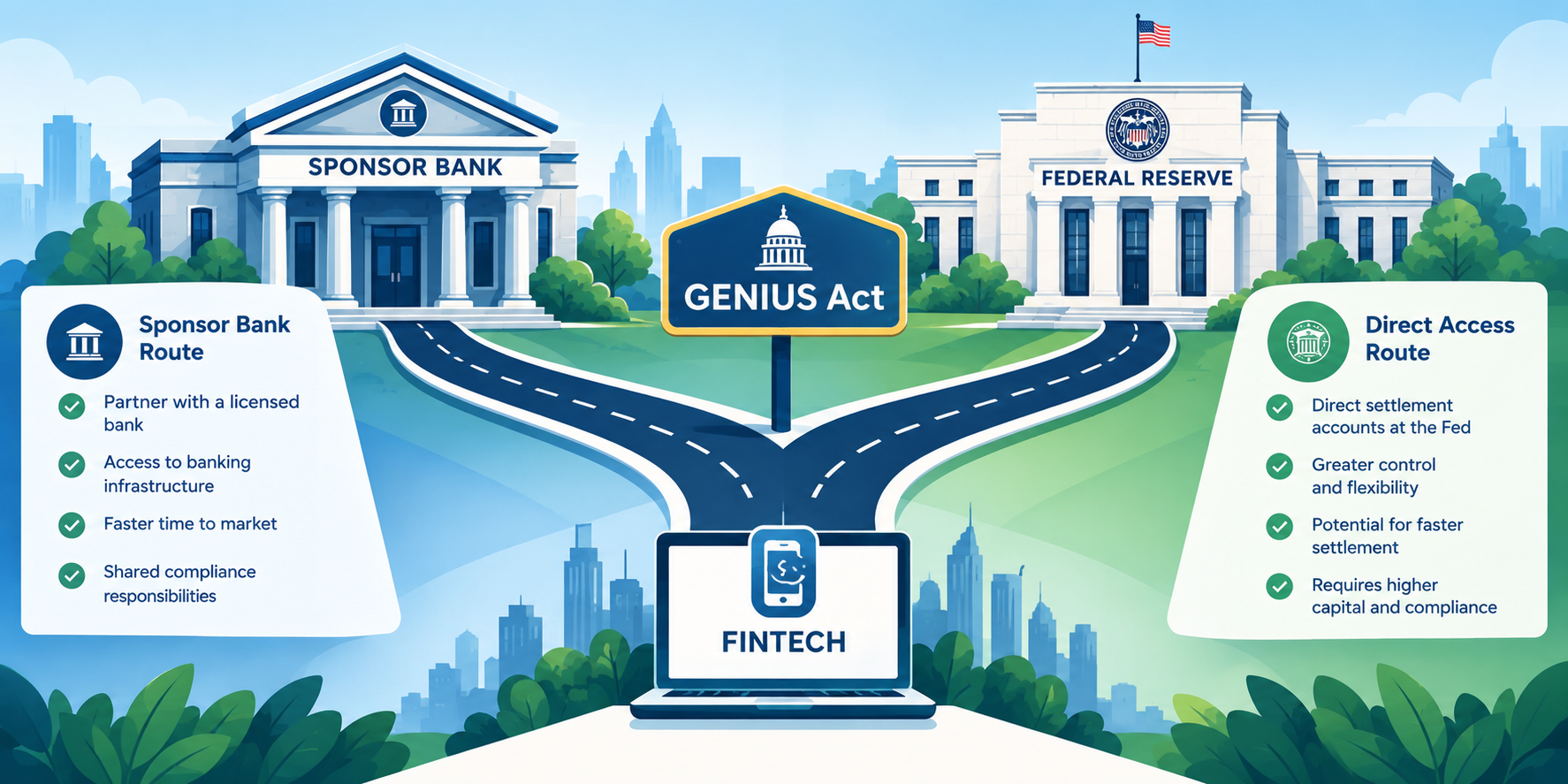
For the past decade, most fintechs that wanted to move money had one path: partner with a bank. The sponsor bank provided the charter, the Fed account, and access to payment rails — ACH, FedWire, RTP — that non-bank companies cannot access directly. The fintech built the product; the bank provided the regulated infrastructure. This is the Banking-as-a-Service (BaaS) model.
The GENIUS Act, signed into law on July 18, 2025, is opening a new question: what happens to that model if regulated non-bank entities get meaningful access to Federal Reserve payment infrastructure?
The answer is not simple — and it matters for every fintech currently building on a sponsor bank relationship.
What the GENIUS Act Actually Does
The Guiding and Establishing National Innovation for U.S. Stablecoins (GENIUS) Act is the first comprehensive federal legislation governing payment stablecoins. Before the Act, stablecoin issuers operated in a fragmented regulatory environment with no clear federal framework. The Act changes that by:
- Defining "payment stablecoins" and establishing who can issue them
- Creating two licensing pathways: federal (OCC-supervised) and state (with federal oversight backstop)
- Establishing reserve and liquidity requirements for stablecoin issuers
- Setting AML/BSA compliance obligations for stablecoin issuers
- Opening a pathway for non-bank entities to become Permitted Payment Stablecoin Issuers (PPSIs)
The Act does not directly grant stablecoin issuers Federal Reserve accounts. It explicitly states that nothing in the Act expands or contracts legal eligibility to receive services from a Federal Reserve bank. However, as OCC, FDIC, and Treasury all finalized implementing rules in early-to-mid 2026, the regulatory infrastructure for non-bank payment entities to operate at scale has become significantly clearer.
The Sponsor Bank Model Today
To understand what might change, it helps to be specific about what sponsor banks provide today.
Sponsor bank relationships give fintechs access to:
- Payment rails — ACH, FedWire, RTP, and card networks that require bank membership
- FDIC insurance — allowing fintech customers' deposits to be insured up to applicable limits
- Banking charter — the legal authority to accept deposits, issue cards, and provide regulated financial services
- Correspondent relationships — bank-to-bank connections needed for clearing and settlement
In exchange, fintechs accept compliance obligations imposed by the sponsor bank — including the sponsor bank's BaaS compliance requirements — and share economics with the bank through interchange, float income, or direct fees.
What "Direct Fed Access" Would Actually Mean
Federal Reserve master accounts — the accounts that give financial institutions direct access to Fed payment systems — are not currently available to non-bank fintechs or stablecoin issuers as a class. The Federal Reserve has historically limited master account access to insured depository institutions and certain other federally chartered entities.
The question raised by the GENIUS Act framework is whether a new class of regulated non-bank payment entities — PPSIs and similar federally supervised non-banks — might eventually qualify for master account access. The GENIUS Act itself does not resolve this. What it does is establish the regulatory infrastructure that would make such entities legible to the Fed as supervised counterparties.
Separately, the Federal Reserve has been working on its own policies around master account access for novel entities, including a 2022 guidelines document. The GENIUS Act creates entities that fit squarely within the "novel entity" category those guidelines were designed to address.
Three Scenarios for the Sponsor Bank Model
Scenario 1: The Model Evolves but Persists
In this scenario, stablecoin issuers and a small number of well-capitalized non-bank fintechs obtain some form of expanded payment access — but the sponsor bank model persists because most fintechs cannot meet the capital, compliance, and operational requirements to operate independently. The banks' value proposition shifts from "only path to rails" to "fastest path to rails with the least regulatory overhead."
This scenario is most likely for early-stage fintechs and those with lower transaction volumes, for whom the capital requirements of operating independently exceed the economics of a bank partnership.
Scenario 2: Vertical Disintegration for Large Fintechs
High-volume fintechs — payment processors, large consumer apps, crypto exchanges — find that the economics of direct Fed access become favorable at their scale. They exit sponsor bank relationships and operate under their own charters or PPSI licenses. The sponsor bank model survives for smaller players but the largest fintechs move off it.
This scenario accelerates competition between fintechs and banks at the infrastructure layer, not just the product layer.
Scenario 3: BaaS Becomes Compliance Infrastructure, Not Rail Access
Banks reposition their BaaS offerings from "we provide the rails you can't access" to "we provide the compliance infrastructure you don't want to build." Under this model, even fintechs with theoretical access to direct payment rails continue to use bank partnerships for the compliance, examination, and relationship infrastructure that banking provides — but the nature of the partnership changes fundamentally.
This scenario produces the most durable evolution of the BaaS model — one where banks compete on compliance and risk management capability rather than on exclusive rail access.
What This Means for Fintechs Building Today
For a fintech operating on a sponsor bank relationship in 2026, the actionable implications are:
Your Contract Terms Matter More Than Before
As the regulatory landscape shifts, sponsor bank relationships are under more scrutiny — from regulators who are increasing oversight of BaaS arrangements, and from the banks themselves as they manage concentration risk. Review your bank partnership agreements, particularly exclusivity provisions, termination clauses, and compliance responsibility allocations.
Understand Where Your Regulatory Coverage Comes From
Know exactly which of your regulated activities are covered by your bank partner's charter and which require your own licenses. As the GENIUS Act framework matures, the boundaries between what requires a bank charter and what can be done under a non-bank framework may shift. See our guide to embedded finance compliance for a current overview.
Build Compliance Infrastructure You Own
Regardless of which scenario plays out, fintechs that have built robust, internally owned AML/BSA compliance programs — including documented policies, risk assessments, and monitoring — will be better positioned to transition to more independent operating models if and when they become viable. Outsourcing your compliance to your bank partner creates a dependency that limits your optionality.
Watch the Fed's Master Account Policy
The Federal Reserve's evolving position on master account access for novel entities is the single most important regulatory development to monitor. Its resolution will determine whether Scenario 1, 2, or 3 plays out — and on what timeline.
The GENIUS Act as a Signal, Not Just a Statute
Whatever its ultimate regulatory scope, the GENIUS Act signals something important: the U.S. policy direction is moving toward a more competitive payment infrastructure — one where non-bank entities have a legitimate federal pathway to provide regulated payment services at scale. That trajectory does not reverse easily.
For fintechs, the question is not whether the sponsor bank model will eventually be disrupted — some version of it will be. The question is whether your company is building toward a future where you have options, or building into a dependency that you have no plan to exit.
For more on open banking and the broader structural shifts in financial services regulation, see our related guides.
This article is for informational purposes only and does not constitute legal or regulatory advice. The regulatory landscape discussed here is evolving rapidly. Consult qualified legal counsel before making strategic or compliance decisions based on this material.
Talk to the ComplyOne team to get started.