Payment platforms and fintechs processing third-party transactions face IRS 1099-K reporting obligations. This guide covers the thresholds, timing, and compliance requirements.
IRS 1099-K Reporting Requirements for Fintechs and Payment Platforms
If your fintech or payment platform processes payments on behalf of third parties — merchants, sellers, gig workers, or service providers — you likely have IRS 1099-K reporting obligations. These requirements apply to a wide range of businesses: payment processors, peer-to-peer payment apps, gig economy platforms, marketplaces, and any other entity that qualifies as a Third-Party Settlement Organization (TPSO) or Payment Settlement Entity (PSE) under IRS rules.
This guide covers what 1099-K reporting requires, which companies must file, and the compliance steps your platform needs to have in place.
What Is the 1099-K Form?
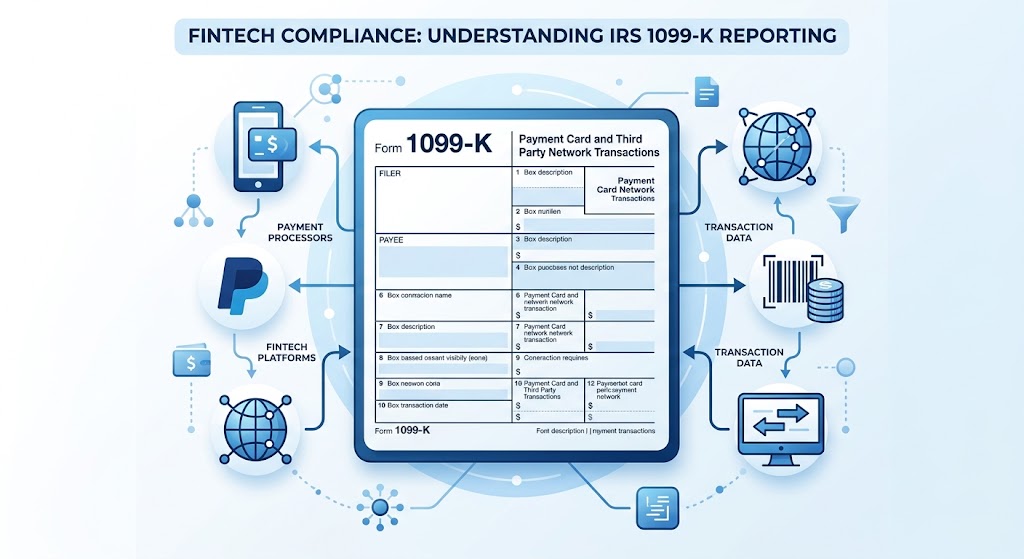
Form 1099-K is an IRS information return used to report payment card and third-party network transactions. It is filed by the entity that processes or settles payments on behalf of payees — not by the payee themselves. The payee receives a copy of the 1099-K and uses it to reconcile their own tax reporting.
The form was created to improve income reporting compliance among merchants and other payees who receive payments through payment networks rather than traditional payroll or invoicing arrangements.
Who Must File 1099-K?
Two categories of entities are required to file Form 1099-K:
Payment Settlement Entities (PSEs)
A PSE is any entity that has a contractual obligation to settle payment card transactions. This includes companies that process credit card, debit card, or prepaid card payments on behalf of merchants. Traditional card processors fall squarely into this category.
Third-Party Settlement Organizations (TPSOs)
A TPSO is an entity that provides a payment network through which buyers and sellers settle transactions. Examples include:
- Online marketplaces (e-commerce platforms that process payments between buyers and sellers)
- Peer-to-peer payment apps used for business transactions
- Gig economy platforms that distribute payments to workers
- Any platform where a central entity settles funds between parties
This is the category that catches most fintech companies. If your platform sits in the middle of a payment flow between a payer and a payee, you may qualify as a TPSO. See our guide on when a marketplace needs a money transmitter license for related analysis on how payment flows affect licensing obligations.
What Are the Current Reporting Thresholds?
The 1099-K reporting threshold has been the subject of significant regulatory change. The American Rescue Plan Act of 2021 reduced the TPSO reporting threshold from $20,000 and 200 transactions to a flat $600 with no transaction minimum — a change that would have significantly expanded filing obligations for platforms processing smaller transactions.
However, the IRS has delayed implementation of the $600 threshold multiple times. For the most current threshold in effect for your filing year, check directly with the IRS at irs.gov or consult a qualified tax advisor, as this threshold may have changed after this article was written. Do not rely solely on this guide for threshold compliance — always verify with current IRS guidance.
For PSEs (payment card processors), the reporting threshold is different: they must file for every payee that receives any amount through payment card transactions, with no dollar minimum.
Key Compliance Deadlines
1099-K forms must be provided to payees and filed with the IRS by specific deadlines each year:
- Payee copies: January 31 of the year following the calendar year being reported
- IRS paper filing: February 28 of the year following the calendar year being reported
- IRS electronic filing: March 31 of the year following the calendar year being reported
Electronic filing is required if you file 10 or more information returns (down from 250, effective tax year 2023 and later). Most fintech platforms will be required to file electronically through the IRS FIRE system or an approved third-party transmitter.
What Information Is Reported on 1099-K?
Each 1099-K filed must include:
- The payee's name, address, and TIN (Tax Identification Number — SSN or EIN)
- The filer's (your company's) name, address, and EIN
- Gross payment amount processed during the calendar year
- Number of transactions (for TPSOs)
- Monthly breakdown of payment amounts
- Account number identifying the payee in your system
Note that 1099-K reports gross transaction volume — it does not net out refunds, fees, chargebacks, or other adjustments. This can cause payees to receive a 1099-K that is higher than their actual net income, which is why payee communication and documentation are important parts of your compliance program.
TIN Collection and Backup Withholding
To file accurate 1099-K forms, you need a valid TIN for each payee. This typically means collecting a completed IRS Form W-9 from each merchant, seller, or service provider on your platform before processing any payments above threshold.
If a payee fails to provide a valid TIN, or if the IRS notifies you that a TIN is incorrect, you are required to begin backup withholding — currently at a rate of 24% — on future payments to that payee. Backup withholding is remitted directly to the IRS on behalf of the payee.
Implementing a robust TIN collection process — including validation against IRS records through the TIN Matching program — is a critical compliance requirement that platforms often underestimate.
State 1099-K Reporting Requirements
Many states have their own 1099-K reporting requirements that may differ from federal requirements, including lower thresholds or different deadlines. Your platform must comply with the requirements of every state in which you have reportable payees. State requirements vary significantly — review the requirements for each applicable state or work with a tax compliance provider that manages state-level reporting.
Common Compliance Pitfalls for Fintechs
- Missing or invalid TINs — Not collecting W-9s from payees upfront creates backup withholding obligations and can result in IRS penalties for incorrect reporting
- Not distinguishing between personal and business payments — P2P platforms need procedures to distinguish business transactions subject to reporting from personal, non-commercial transfers
- Incorrect gross amount reporting — 1099-K must reflect gross amounts, not net. Reporting net amounts is incorrect
- Missing the TPSO classification — Companies that facilitate payments between third parties often don't realize they qualify as a TPSO and have filing obligations
- Failing to communicate with payees — Payees who receive 1099-Ks showing more than they expected — due to gross reporting — need clear documentation explaining the difference. Poor communication leads to disputes and regulatory complaints
IRS Penalties for Non-Compliance
Failure to file accurate 1099-K forms or provide copies to payees on time can result in IRS penalties. Penalties vary based on how late the filing is and whether the failure was intentional. For current penalty amounts, review IRS Publication 1586 or consult a qualified tax advisor.
Frequently Asked Questions
Does my platform need to file 1099-K if we only process payments between consumers (not businesses)?
It depends on the nature of the transactions. Pure personal, non-commercial transactions — splitting a dinner bill, for example — are generally not subject to 1099-K reporting. However, if your platform is used for business transactions where the payee is receiving income for goods or services, those transactions may be reportable regardless of whether the payee is a formal business entity. Consult a tax advisor to evaluate your specific payment flows.
We use a third-party payment processor. Does that relieve us of 1099-K obligations?
Not necessarily. Whether you or your payment processor is responsible for 1099-K filing depends on who has the direct settlement relationship with payees and who qualifies as the TPSO under IRS rules. If your platform is the entity with the contractual relationship with payees, you may still be the filer even if you use a processor for the underlying transaction execution. Review this carefully with legal and tax counsel.
What is the difference between a 1099-K and a 1099-NEC?
Form 1099-K reports payments processed through payment networks, based on the volume of transactions you settle on a payee's behalf. Form 1099-NEC is used to report direct nonemployee compensation payments of $600 or more made directly to a contractor or service provider. The two forms can overlap — a payee might receive both from different payers for the same calendar year. Platforms should understand which form applies to their specific payment structure.
Disclaimer: This article is for informational purposes only and does not constitute tax or legal advice. IRS reporting thresholds, deadlines, and requirements are subject to change. Always verify current IRS requirements directly at irs.gov and consult a qualified tax advisor for guidance specific to your company's situation.
Talk to the ComplyOne team to get started.