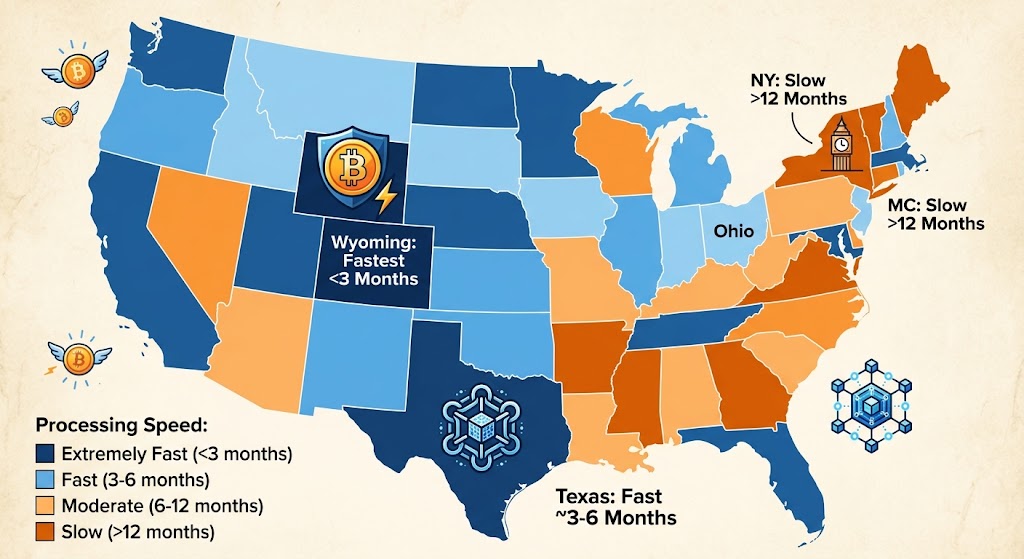
Which states approve crypto and digital asset licenses fastest? This guide compares processing times, requirements, and fintech-friendliness across key US states for crypto companies.
Fastest States for Crypto Licensing: A State-by-State Comparison
For crypto companies and digital asset fintechs, getting licensed in the right states quickly is a competitive necessity. State licensing timelines for crypto businesses vary enormously — from a few months in crypto-progressive states to 18+ months in jurisdictions with intensive review processes. Choosing your first licensing states strategically can mean the difference between serving customers within a year or waiting two years to launch.
This guide breaks down which states approve crypto licenses fastest, which states have the most accessible requirements, and how to think about building your licensing roadmap as a crypto company. See our companion guide on cryptocurrency licensing requirements by state for a comprehensive overview.
How Crypto Licensing Works in the US
There is no single federal "crypto license" in the United States. Crypto companies that engage in money transmission — including most exchanges, wallet providers, and payment platforms — must obtain state money transmitter licenses (MTLs) or equivalent licenses in each state where they operate. Additionally, New York has its own digital asset-specific license, the BitLicense.
Federal FinCEN registration as a money services business (MSB) is also required, but this is separate from state licensing and does not substitute for state MTLs. See our guide on how to register as an MSB with FinCEN.
Some states explicitly exempt certain crypto activities from their money transmission laws; others apply their MTL requirements broadly to any platform handling fiat currency. A small number of states have no money transmission law at all. See our guide on states without crypto license requirements for details.
States With the Fastest Crypto Licensing Timelines
Wyoming — The Clear Leader
Wyoming has made a deliberate, sustained effort to become the most crypto-friendly regulatory environment in the United States. It was the first state to create a special purpose depository institution (SPDI) charter for crypto-native banks, and its Division of Banking is experienced with digital asset business models. For money transmitter licensing, Wyoming processes applications efficiently with regulators who understand crypto business models without extended back-and-forth.
Wyoming's net worth and bond requirements for crypto MTLs are also competitive relative to other states. For crypto-native companies, Wyoming is the consensus choice for a first license. Wyoming MTL guide.
Montana — Practical and Efficient
Montana has a lower volume of crypto license applications than major hubs, which translates to faster processing. Its Division of Banking and Financial Institutions is accessible and its requirements are straightforward for companies with complete applications. Montana is a common early licensing state for crypto companies building their initial portfolio. Montana MTL guide.
Nebraska and Kansas — Midwest Efficiency
Nebraska and Kansas consistently process MTL applications quickly relative to more complex states. Neither has created specialized crypto licensing regimes, which means crypto companies file under the same MTL framework as other money transmitters — a practical approach that avoids the extended back-and-forth that dedicated crypto licensing sometimes creates. Nebraska and Kansas MTL guides.
Nevada — Growing Crypto Hub
Nevada has positioned itself as a financial technology hub and its regulators have experience processing crypto company applications. Processing times are reasonable for well-prepared submissions, and Nevada's overall regulatory environment is generally considered business-friendly. Nevada MTL guide.
States With Slower or More Complex Crypto Licensing
New York — Most Complex
New York's BitLicense is the most demanding state-level crypto license in the US. The application requires extensive documentation, significant financial disclosures, a comprehensive compliance program, and direct engagement with the NYDFS. Processing times for BitLicense applications have historically ranged from 12 to 24+ months for complex applicants. New York is essential for any crypto company with meaningful US customer volume, but it should rarely be your first application. See also our guide on BitLicense vs. money transmitter license.
California — High Bar, High Volume
California's DFPI processes a high volume of crypto company applications and has elevated financial requirements. Processing timelines for crypto companies in California often run 6–12 months for complete applications. Essential for any company with material California customer activity. California MTL guide.
Hawaii — Historically Restrictive
Hawaii has historically been one of the most restrictive states for crypto companies. HRS Chapter 489D's provisions on digital currency transmission and Hawaii's regulatory approach have caused some crypto exchanges to simply exclude Hawaii customers rather than pursue licensure. If you do pursue a Hawaii crypto license, expect a thorough review process. Hawaii guide.
Building Your Crypto Licensing Strategy
The most effective approach for crypto companies is to file in faster, lower-barrier states first while building the compliance infrastructure and regulatory track record needed for harder states. A typical sequencing might look like:
- Phase 1: Wyoming, Montana, Nebraska, Kansas — establish your first licenses quickly
- Phase 2: Nevada, Colorado, Arizona, Texas — mid-complexity states with significant market size
- Phase 3: California, Florida, New York — high-bar, high-value markets that require more resources and time
This sequence is not universal — if you have significant California or New York customers before you start licensing, those states must be prioritized regardless of complexity. See our guides on fintech licensing strategy and how to get a crypto license in the US.
What Affects Your Crypto License Processing Time
Beyond state-specific timelines, your processing time depends heavily on application quality. The factors that most commonly delay crypto company applications are incomplete business plan disclosures about blockchain activities, inadequate crypto-specific AML/BSA controls (particularly around transaction monitoring and blockchain analytics), weak responses to questions about wallet custody and asset segregation, and slow background check completion for control persons.
See our guides on crypto AML compliance and crypto KYC requirements for what regulators look for in your compliance program.
Frequently Asked Questions
Do I need a license in every state to operate a crypto exchange?
Yes — if your exchange transmits fiat currency or is otherwise classified as a money transmitter in a given state, you need a license there. The number of states where a license is required varies based on your business model. A small number of states have no MTL requirement for certain crypto activities. See states without crypto license requirements.
Is FinCEN registration enough instead of state licenses?
No. Federal FinCEN registration as an MSB is a separate federal requirement. It does not substitute for state money transmitter licenses, and you need both.
What is the difference between a BitLicense and a money transmitter license?
The BitLicense is a New York-specific digital asset license administered by NYDFS. A money transmitter license is the standard state license covering money transmission activities, including crypto, in most other states. See our guide on BitLicense vs. money transmitter license.
How long does it take to get licensed in all 50 states?
For crypto companies pursuing comprehensive US coverage, a full 50-state licensing program typically takes 2–3 years from start to completion, given the variation in processing times and the resource requirements for complex states. Most companies prioritize the highest-volume markets first. See our guide on how long MTL licensing takes.
Disclaimer: This article is for informational purposes only and does not constitute legal or compliance advice. Crypto licensing requirements and processing timelines change frequently. Always verify current requirements with each state regulator and consult a qualified compliance professional before beginning any licensing program.
Talk to the ComplyOne team to get started.