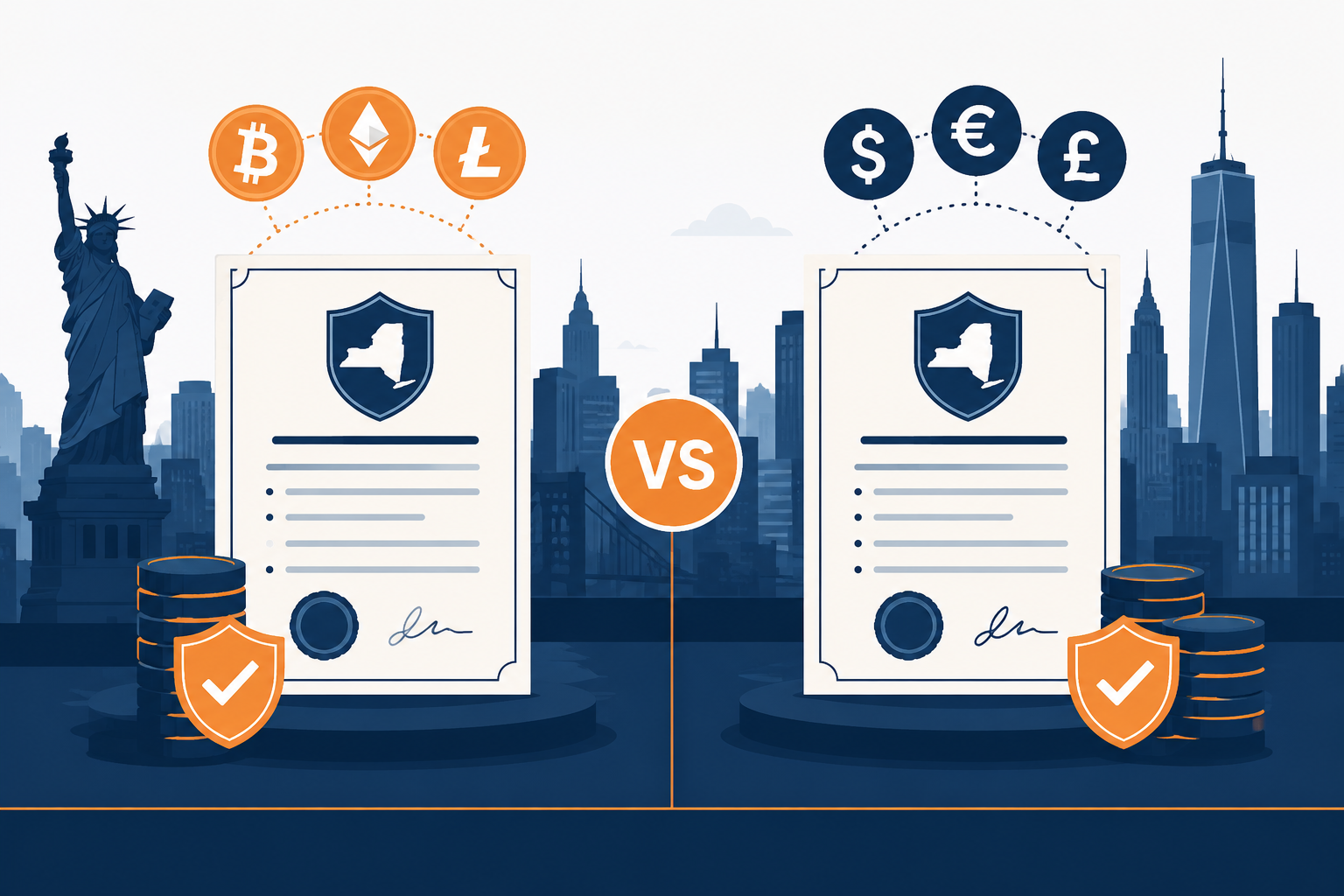
New York requires both a BitLicense for crypto activities and a money transmitter license for fiat activities. Here is how the two licenses differ, which crypto businesses need which, and how to navigate New York's dual licensing requirements.
BitLicense vs Money Transmitter License: Key Differences Explained
New York is the most demanding licensing jurisdiction in the United States for financial services companies — and for cryptocurrency businesses operating in New York, the complexity is compounded by the existence of two separate licensing frameworks that may both apply.
The BitLicense and the money transmitter license are different licenses, issued under different regulations, covering different activities, with different requirements and different application processes. Understanding which one you need — and whether you need both — is essential for any crypto business serving New York customers.
What Is a Money Transmitter License?
A money transmitter license is a general financial license issued by New York's Department of Financial Services under the New York Banking Law. It authorizes a business to transmit money — receiving fiat currency from one party and transmitting it to another.
Money transmitter licenses cover fiat currency activities — U.S. dollars and other traditional currencies. They do not specifically address virtual currency.
What Is the BitLicense?
The BitLicense is a virtual currency business activity license created by the New York DFS under 23 NYCRR 200 — the DFS's virtual currency regulation. It was established in 2015 as the first dedicated cryptocurrency business license in any U.S. state.
The BitLicense covers virtual currency business activity — which includes receiving virtual currency for transmission or transmitting virtual currency, storing, holding, or maintaining custody or control of virtual currency on behalf of others, buying and selling virtual currency as a customer business, performing exchange services as a customer business, and controlling, administering, or issuing a virtual currency. For a step-by-step guide, see our article on how to get a BitLicense.
The Key Differences
What Activities They Cover
The money transmitter license covers fiat currency transmission. The BitLicense covers virtual currency business activity. These are distinct license categories covering distinct activities.
The Application Requirements
Both licenses require substantial documentation but the BitLicense is notably more comprehensive. In addition to the standard money transmitter application requirements — business information, financial statements, surety bonds, compliance program documentation, and principal background information — the BitLicense requires detailed cybersecurity program documentation, consumer protection policies specific to virtual currency, and detailed disclosure of virtual currency business activities.
Application Timeline
Both licenses involve long processing timelines in New York, but the BitLicense has historically required longer processing times — often 18 months to 3 years — compared to the standard money transmitter license which typically runs 12 to 18 months for complete applications. Learn more about how long licensing takes.
Capital Requirements
The DFS has discretion to set capital requirements for BitLicense holders based on the specific business model. Capital requirements for money transmitters are also significant but are set under a different statutory framework.
Net Worth Requirements
Both licenses have net worth requirements but the specific amounts and how they are calculated differ between the two frameworks.
Which License Does a Crypto Business Need?
A crypto business operating in New York that engages only in virtual currency business activity — and does not accept or transmit fiat currency on behalf of customers — typically needs only a BitLicense.
A crypto business that also transmits fiat currency — for example a crypto exchange that accepts fiat currency deposits and processes fiat withdrawals — may need both a BitLicense for its virtual currency activities and a money transmitter license for its fiat currency activities.
The specific determination of which license or licenses your business needs depends on the detailed facts of your business model and should be confirmed with qualified legal counsel before applying. For broader context on cryptocurrency licensing requirements by state, see our state-by-state guide. For AML requirements, see our guide on AML compliance for crypto.
Alternative — Limited Purpose Trust Company
New York also offers a Limited Purpose Trust Company charter as an alternative to the BitLicense for certain crypto businesses — particularly custodians and exchanges that want the regulatory framework and credibility of a bank charter. This is a more intensive path requiring full bank charter compliance.
Frequently Asked Questions
Can a company hold both a BitLicense and a money transmitter license?
Yes. If your crypto business engages in both virtual currency business activity and fiat money transmission, you may need both licenses. Companies in this situation must satisfy the requirements of each license independently and maintain compliance with both regulatory frameworks.
Is the BitLicense required for non-U.S. crypto companies serving New York residents?
Yes. The BitLicense requirement applies to any business engaged in virtual currency business activity involving New York or New York residents — regardless of where the business is physically located. Geographic location of the business does not eliminate the licensing obligation if New York residents are being served.
What happens to my BitLicense application while I am waiting for approval?
The DFS has historically allowed businesses that have submitted complete BitLicense applications to continue operating under an informal no-action position while their applications are under review. This position should be confirmed with qualified counsel before relying on it.
How ComplyOne Helps
ComplyOne works with cryptocurrency businesses navigating New York's licensing requirements — including BitLicense applications, compliance program development, and cybersecurity documentation — through advisory services, compliance technology, or both.
Talk to the ComplyOne team to get started.
The information in this article is for general educational purposes and does not constitute legal or regulatory advice. New York licensing requirements are subject to change through DFS regulation. Consult qualified legal counsel with DFS experience before making licensing decisions.