Compliance as a Service allows fintechs to outsource specific compliance functions to specialized providers. Here is what CaaS covers, when it makes sense, and how to evaluate providers.
What Is Compliance as a Service (CaaS)? A Fintech Guide
Compliance as a Service is a model where fintechs outsource some or all of their compliance functions to specialized external providers rather than building and staffing those functions in-house. As fintech compliance requirements have grown more complex and the cost of dedicated compliance talent has increased, CaaS has become an increasingly common approach — particularly for early-stage and growth-stage companies.
What CaaS Covers
Compliance as a Service is not a single defined service — it is a broad category that encompasses a range of outsourced compliance support models.
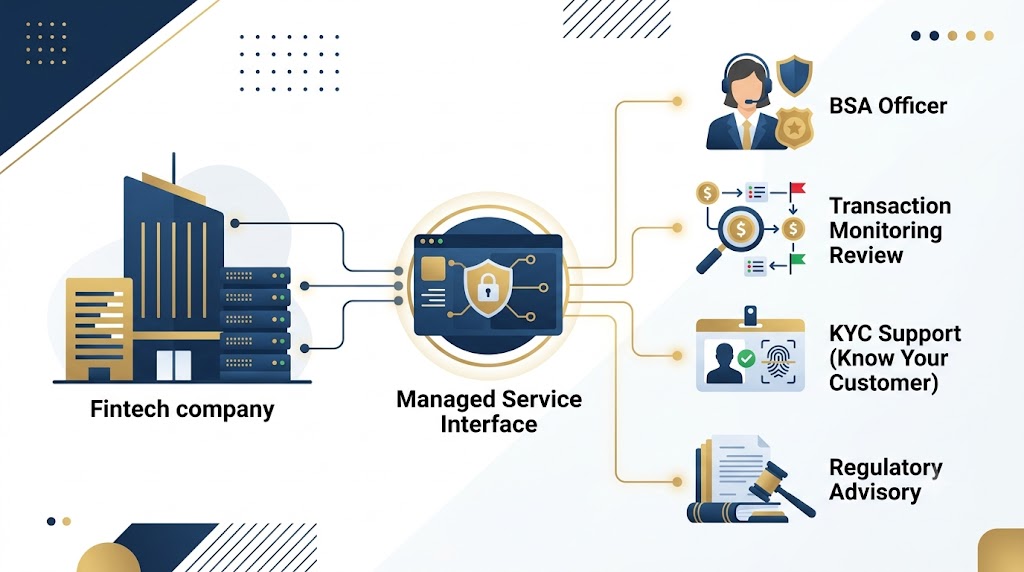
BSA Officer as a Service — the most common CaaS arrangement. An experienced compliance professional or compliance firm serves as the named BSA Officer for the fintech, overseeing the AML program, making SAR filing decisions, representing the compliance program to sponsor banks and regulators, and managing the ongoing BSA compliance function.
Transaction monitoring review services — compliance analysts provided by an external firm review monitoring alerts, conduct investigations, and make initial filing recommendations. This is valuable when alert volumes exceed internal capacity.
KYC operations support — external compliance staff handle KYC exception review, EDD investigations, and manual review cases that require human judgment.
Compliance advisory services — ongoing regulatory guidance, policy review, and compliance program support on a retainer basis.
Independent testing — annual AML program review conducted by the provider as an independent assessment.
When CaaS Makes Sense
CaaS is most valuable in specific situations.
Early-stage fintechs that need experienced compliance leadership before they have the revenue to support a full-time senior hire. An outsourced BSA Officer delivers equivalent expertise at a fraction of the cost of a full-time Chief Compliance Officer. For a deeper look at what a BSA Officer costs, see our guide on what is a BSA Officer.
Growing fintechs whose alert volumes or KYC exception volumes temporarily exceed internal capacity. Scaling compliance operations up and down through outsourcing is more cost-effective than hiring and firing internal staff.
Fintechs entering new markets or launching new products that require compliance expertise they do not have in-house. Short-term advisory engagement is more efficient than hiring.
Fintechs that need a specific function — like independent testing — that must be provided by someone external to the compliance function by definition.
What CaaS Does Not Replace
CaaS is not a compliance exemption. Using an outsourced BSA Officer does not eliminate your BSA compliance obligations — it provides experienced leadership to fulfill those obligations. Your institution remains legally responsible for the compliance program regardless of how it is staffed.
CaaS arrangements must be structured to ensure the outsourced provider has genuine authority, genuine access to needed systems and data, and genuine accountability for the functions they perform — not just nominal designation without operational substance.
Evaluating CaaS Providers
When evaluating compliance service providers, key factors include relevant expertise in your specific business type — a provider experienced with crypto businesses provides different value than one experienced primarily with traditional banks, regulatory credibility — whether the provider has demonstrated professional credentials and a track record that would satisfy sponsor bank and regulatory scrutiny, availability and responsiveness — the provider must be genuinely accessible during compliance events not just during scheduled check-ins, and clear scope definition — what specific functions the provider performs and what remains with internal staff.
Understanding fintech compliance costs broadly will help you benchmark CaaS pricing against building in-house.
Frequently Asked Questions
Is an outsourced BSA Officer acceptable to FinCEN and state regulators?
Yes. FinCEN and state regulators do not require the BSA Officer to be a direct employee. What regulators evaluate is whether the person is genuinely performing the function — with real authority, real access, and real accountability — regardless of their employment relationship with the institution.
How ComplyOne Helps
ComplyOne provides Compliance as a Service to fintechs at every stage — from outsourced BSA Officer services through full compliance program management — through advisory services, compliance technology, or both.
Talk to the ComplyOne team to get started.
The information in this article is for general educational purposes and does not constitute legal or regulatory advice. Consult a qualified compliance professional for guidance specific to your situation.