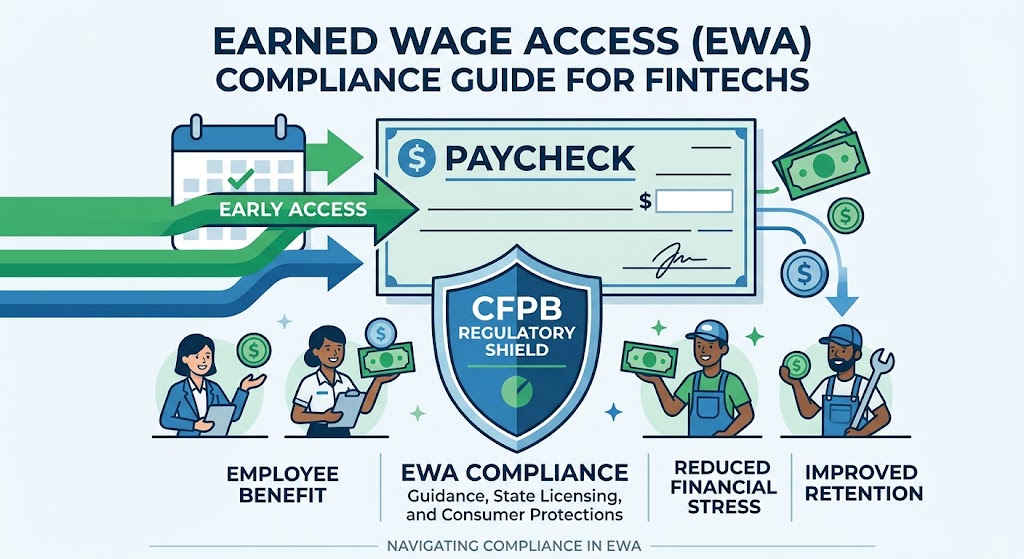
Earned wage access products — which allow workers to access earned wages before payday — are subject to evolving federal and state regulation. This guide explains the EWA compliance landscape, including CFPB guidance, state licensing requirements, and key consumer protection obligations.
Earned Wage Access (EWA) Compliance: A Guide for Fintechs
Earned Wage Access (EWA) — also called on-demand pay or pay-on-demand — allows workers to access wages they have already earned before their regular payday. EWA products have grown rapidly, offered both by employer-integrated platforms and by direct-to-consumer fintech apps. With that growth has come significant regulatory scrutiny: the CFPB has issued guidance on EWA products, several states have enacted EWA-specific laws, and questions about whether EWA constitutes credit continue to drive the compliance landscape for EWA fintechs.
The Two Models of EWA
EWA products generally fall into two categories, which have different regulatory implications:
- Employer-integrated EWA: The fintech partners with an employer; workers access verified accrued wages through the employer's payroll data. The advance is typically recovered through payroll deduction at the next pay cycle. Because the fintech has visibility into actual earned wages, repayment risk is lower.
- Direct-to-consumer (DTC) EWA: The fintech offers wage advances directly to consumers without an employer integration, typically using bank account transaction data to estimate earnings. The consumer repays the advance via ACH on payday. DTC EWA carries more regulatory risk because the advance is not verified against actual earned wages.
The CFPB's Position on EWA
The CFPB has issued advisory opinions and guidance on EWA products. In 2024, the CFPB issued an interpretive rule concluding that certain earned wage access products constitute "credit" under the Truth in Lending Act and are therefore subject to Regulation Z's disclosure requirements — including APR disclosures and other credit terms. This position applies primarily to EWA products that charge mandatory fees or that function similarly to credit products.
The CFPB's position is significant because it would require EWA providers to make APR disclosures — and the effective APRs on EWA products, when fees are annualized on small short-term advances, can be very high. EWA fintechs should monitor CFPB guidance closely at consumerfinance.gov, as this area of regulation continues to evolve.
State Regulation of EWA
Several states have enacted EWA-specific legislation creating a third category between unregulated and traditional lending:
- California: EWA providers must register with the DFPI and comply with California's EWA disclosure and consumer protection requirements
- Nevada: Has enacted EWA-specific licensing requirements
- Missouri, Kansas, Wisconsin, and others have enacted EWA laws that create a separate regulatory framework distinct from traditional consumer lending
Many other states are actively considering EWA legislation. EWA fintechs operating nationally must monitor state legislative developments and may need state-specific licenses or registrations in addition to any federal compliance obligations.
Does EWA Require a Money Transmitter License?
Whether an EWA product requires a money transmitter license depends on the product structure and the specific state's definition of "money transmission." In some states, the transmission of funds from the EWA provider to the consumer's bank account may constitute money transmission requiring licensure. EWA fintechs should conduct a state-by-state analysis of money transmission licensing requirements as part of their compliance program.
Consumer Protection Requirements for EWA
Regardless of specific licensing requirements, EWA fintechs face consumer protection obligations including:
- Clear fee disclosures: All fees — including express delivery fees, tip prompts, and membership fees — must be clearly disclosed so consumers can assess the true cost of the product
- No mandatory repayment from non-payroll sources: Most state EWA laws and best practices require that repayment not be taken from a consumer's bank account via ACH without explicit authorization
- No credit reporting: Most EWA frameworks treat EWA as distinct from credit and do not report to credit bureaus, but this varies by product design
- UDAAP compliance: Marketing claims about free or low-cost access must accurately reflect total costs including all fees
Frequently Asked Questions
Is EWA considered a loan?
This is the central regulatory question for EWA. The CFPB has said certain EWA products are credit subject to TILA/Reg Z. Some state legislatures have explicitly excluded EWA from their lending laws if the product meets certain criteria (employer-integrated, no mandatory fees, no interest). The answer is product-specific and jurisdiction-specific — EWA fintechs should not assume EWA is categorically exempt from lending law.
What fees are allowed for EWA products?
This varies by state and product design. Many EWA providers charge a voluntary tip or an express delivery fee for faster fund availability. State laws vary on which fees are permissible. Where the CFPB's Reg Z analysis applies, all fees must be disclosed as part of the finance charge and reflected in an APR calculation.
Can a direct-to-consumer EWA fintech operate without a license?
Not necessarily. DTC EWA fintechs are at higher regulatory risk than employer-integrated models and may need state lending licenses, money transmitter licenses, or state-specific EWA registrations depending on their product structure and the states they operate in. A state-by-state licensing analysis is essential before launch.
How should EWA fintechs handle the CFPB's Reg Z position?
EWA fintechs should consult qualified legal counsel to assess whether their specific product triggers Reg Z, and if so, implement the required disclosures — including APR calculations. Given the ongoing regulatory development in this area, EWA fintechs should also build monitoring processes to track CFPB guidance and state legislative changes.
This article is for educational purposes only and does not constitute legal or compliance advice. EWA regulation is rapidly evolving at both federal and state levels. Consult qualified legal counsel for guidance specific to your product and markets.