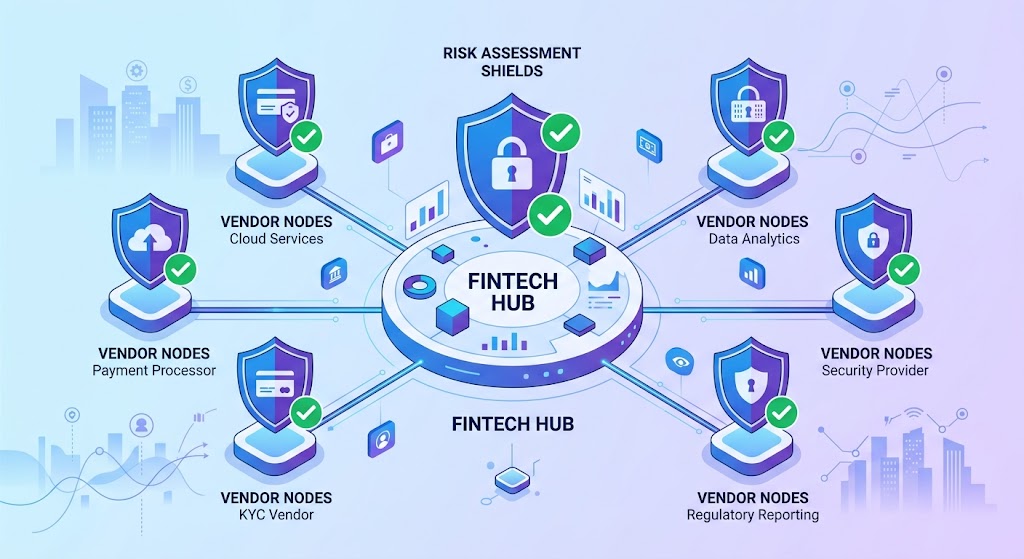
Fintechs depend on a wide network of third-party vendors — from cloud providers to payment processors to KYC vendors. Regulators hold fintechs responsible for the compliance of their vendors. This guide explains what a robust third-party risk management (TPRM) program requires.
Third-Party Risk Management for Fintechs: A Compliance Guide
Fintechs are highly dependent on third-party vendors. Cloud infrastructure, payment processing, KYC and identity verification, fraud detection, customer communications, data analytics — virtually every critical function in a modern fintech involves at least one third-party service provider. This vendor dependency creates significant regulatory risk: federal and state regulators have made clear that fintechs are responsible for the compliance of their third parties, not just their own operations. Third-party risk management (TPRM) is a foundational compliance requirement for any fintech seeking to scale responsibly.
The Regulatory Framework for Third-Party Risk Management
Multiple regulators have issued guidance on third-party risk management for financial services firms:
- CFPB: The CFPB has stated that a covered person can be held responsible for the actions of its service providers under UDAAP. The CFPB's compliance management guidance emphasizes that covered persons must oversee service providers and include compliance requirements in vendor contracts.
- OCC, FDIC, and Federal Reserve: In 2023, these banking regulators jointly issued updated interagency guidance on third-party relationships, replacing earlier guidance from each agency. The joint guidance applies to banks but establishes standards that fintechs working with bank partners should understand.
- FinCEN: Under the Bank Secrecy Act, fintechs cannot delegate their AML compliance obligations to third parties — the licensee remains responsible even when specific functions are outsourced.
- State regulators: Money transmitter license regulations in most states require that licensees maintain oversight of their agents and service providers.
Components of a Fintech TPRM Program
A comprehensive third-party risk management program includes several phases:
1. Vendor Inventory and Risk Tiering
The foundation of TPRM is knowing who your vendors are and what risk they pose. Fintechs should maintain a complete inventory of all third-party relationships and classify each vendor by risk tier based on factors such as:
- Access to customer data or financial systems
- Criticality to business operations (what happens if the vendor fails?)
- Regulatory obligations the vendor performs on the fintech's behalf (AML screening, KYC, payment processing)
- Concentration risk (is this the only vendor for a critical function?)
High-risk, critical vendors receive more intensive due diligence and ongoing monitoring than low-risk vendors.
2. Pre-Onboarding Due Diligence
Before engaging a new vendor, fintechs should conduct due diligence proportionate to the vendor's risk tier. For high-risk vendors, due diligence typically includes:
- Review of the vendor's compliance and security certifications (SOC 2, ISO 27001, PCI DSS)
- Review of the vendor's regulatory examination history and any enforcement actions
- Assessment of the vendor's financial stability
- Review of the vendor's AML and sanctions compliance program (if relevant)
- Business continuity and disaster recovery assessment
- Subcontractor and fourth-party risk assessment
3. Contract Requirements
Vendor contracts for high-risk relationships should include:
- Compliance obligations — requiring the vendor to comply with applicable laws and regulations
- Audit rights — the fintech's right to audit the vendor's compliance
- Data protection requirements — specifying how customer data is protected and what happens in the event of a breach
- Subcontracting restrictions — requiring prior approval for subcontractors
- Termination rights — the right to terminate for cause if the vendor fails to meet compliance standards
- Regulatory cooperation — requiring the vendor to cooperate with regulatory examiners
4. Ongoing Monitoring
TPRM is not a one-time exercise. Fintechs must continuously monitor their vendor relationships, including:
- Annual re-assessment of high-risk vendors
- Monitoring of vendor compliance certifications for renewal and any lapses
- Tracking regulatory actions or public enforcement actions against vendors
- Reviewing vendor performance against SLAs and compliance metrics
- Maintaining awareness of vendor financial health
5. Exit Planning and Business Continuity
Fintechs must plan for vendor failure or termination. For each critical vendor, the fintech should have a documented exit strategy — including how service continuity will be maintained, how data will be retrieved or migrated, and the transition timeline. Regulators expect that fintechs can continue to serve consumers even if a critical vendor relationship ends unexpectedly.
TPRM for BaaS and Sponsor Bank Relationships
For fintechs that operate on a banking-as-a-service (BaaS) model, the sponsor bank relationship is a critical third-party relationship that carries its own regulatory dynamics. The sponsor bank is responsible for its own regulatory compliance — but the fintech must also satisfy the bank's compliance requirements as a condition of the partnership. Regulators have increasingly scrutinized BaaS relationships, particularly in cases where fintechs have caused regulatory problems for their sponsor banks. Fintechs should understand their sponsor bank's compliance expectations and ensure their own program meets those standards.
Frequently Asked Questions
Am I responsible for my vendor's compliance failures?
Yes — at least as a regulatory matter. The CFPB has stated that covered persons are responsible for their service providers' UDAAP violations. FinCEN holds licensees responsible for AML compliance even when specific functions are outsourced. State regulators hold licensees responsible for the actions of their agents. A vendor's compliance failure can expose the fintech to regulatory action even if the fintech was not directly involved in the violation.
What is fourth-party risk?
Fourth-party risk refers to the risk posed by your vendors' vendors — the subcontractors and service providers that your critical vendors rely on. A cloud provider outage, for example, can cascade through multiple levels of the supply chain. Sophisticated TPRM programs assess not just direct vendor relationships but also key subcontractor dependencies.
What is a SOC 2 report and why does it matter for vendor due diligence?
A System and Organization Controls 2 (SOC 2) report is an audit report from an independent auditor assessing a vendor's controls related to security, availability, processing integrity, confidentiality, and privacy. A SOC 2 Type II report covers a period of time (usually six to twelve months) and provides evidence that the vendor's controls were operating effectively. Requesting SOC 2 reports from critical vendors is a standard component of fintech due diligence.
How often should we re-assess our vendors?
High-risk vendors should be re-assessed at least annually. Lower-risk vendors may be assessed less frequently. Re-assessment should also be triggered by material changes — such as a vendor's change in ownership, a reported security incident, a public regulatory action against the vendor, or a significant change in the services the vendor provides.
This article is for educational purposes only and does not constitute legal or compliance advice. Regulatory guidance on third-party risk management is subject to change. Consult qualified legal and compliance counsel for guidance specific to your fintech's vendor relationships and regulatory obligations.