Every BSA/AML program requires a designated compliance officer. Here is what a BSA Officer actually does, whether your fintech needs a full-time hire or can outsource the role, and what it costs.
What Is a BSA Officer? Do You Need One and What Do They Cost?
Every BSA/AML program is legally required to have a designated compliance officer — a named individual who is accountable for overseeing the program. This requirement applies whether your fintech is three people or three hundred. And it applies before you process your first customer transaction — not after you have figured everything else out.
For early-stage fintechs, the BSA Officer question often comes with a follow-up: do we really need to hire someone for this role, or can a founder do it? And what does it actually cost — either way?
This article answers all of it.
What a BSA Officer Actually Does
The BSA Officer role is not a paperwork role. It is an operational function with specific responsibilities that are required to run continuously as long as your business is operating.
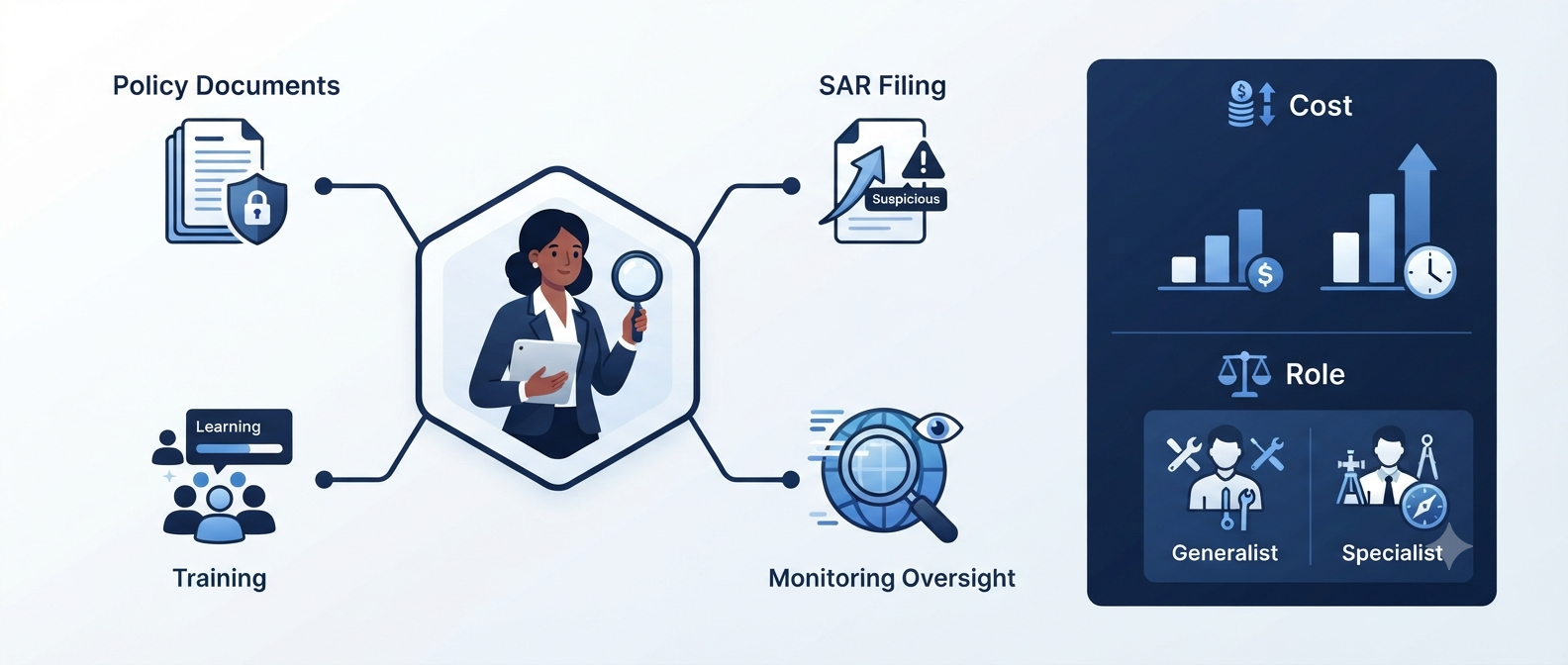
The core responsibilities of a BSA Officer include owning and maintaining the AML compliance program — keeping the risk assessment current, keeping policies accurate and approved, and keeping controls operational. Overseeing transaction monitoring — ensuring rules are calibrated correctly, alerts are reviewed within SLA, and the SAR filing process is functioning. Making SAR filing decisions — the BSA Officer is typically the final authority on whether a SAR is filed. Coordinating and overseeing the annual independent AML review. Running the AML training program — ensuring all required staff receive role-appropriate training at required intervals. Serving as the primary point of contact for your sponsor bank compliance team, state regulators, and FinCEN. Reporting to senior management on the state of the compliance program — including significant findings, emerging risks, and resource needs.
The BSA Officer is also specifically accountable in the event of a regulatory examination or enforcement action. Regulators look at who holds the role, whether they have the authority to perform it, and whether the program they oversee is actually functional.
Do You Need a BSA Officer?
Yes — every fintech with BSA compliance obligations needs a designated BSA Officer. This is not optional. FinCEN's four-pillar BSA/AML program requirement explicitly includes a designated compliance officer as one of the four required elements.
The question is not whether you need a BSA Officer. The question is who fills the role and how.
Option 1 — Founder as BSA Officer
At pre-launch and early stage, a founder serving as BSA Officer is common, generally acceptable to regulators and sponsor banks, and often the only practical option before the business has the revenue to support a dedicated compliance hire.
This works when the founder has invested in developing sufficient AML knowledge — through CAMS certification preparation, formal compliance training, or work experience — to genuinely understand what the role requires. It stops working when the compliance function demands more time and expertise than the founder can provide alongside their other responsibilities.
Signs the founder-as-BSA-Officer arrangement has run its course include alert backlogs building up because there is not enough time to review them, sponsor bank reviews consistently identifying compliance gaps, the business adding new products or geographies that require compliance analysis the founder cannot provide, and the founder spending more than 20 percent of their time on compliance.
Option 2 — Dedicated Internal BSA Officer Hire
A dedicated compliance professional serving as BSA Officer is the right structure for most fintechs once transaction volumes, customer counts, and compliance program complexity have grown beyond what a founder can manage alongside other responsibilities.
What to look for in a BSA Officer hire: prior BSA/AML experience at a financial institution, MSB, or fintech — ideally including experience building compliance programs from scratch; CAMS certification or active pursuit of it; specific experience with your business type — payments, crypto, lending — if available; and strong written communication skills for SAR narratives, policy documentation, and regulatory correspondence.
BSA Officer salary ranges vary by market and experience level. Entry-level compliance officers with 2 to 4 years of experience typically command $80,000 to $120,000 in base salary. Mid-level BSA Officers with 5 to 10 years of experience typically command $120,000 to $175,000. Senior compliance officers and CCOs with deep experience and track records at regulated institutions typically command $175,000 to $250,000 or more.
Option 3 — Outsourced or Fractional BSA Officer
An outsourced BSA Officer — a qualified compliance professional or firm that serves in the BSA Officer role on an outsourced basis — is a common and regulatorily acceptable approach for early-stage and growth-stage fintechs that need experienced compliance leadership without the cost or commitment of a full-time hire.
Under this arrangement, the outsourced BSA Officer is named in your compliance documentation, participates in sponsor bank reviews, oversees the compliance program, makes SAR filing decisions, and provides the compliance expertise the role requires — at a fraction of the cost of a full-time hire.
Regulators and sponsor banks generally accept outsourced BSA Officer arrangements provided the outsourced officer has genuine authority, is accessible and responsive, and is demonstrably performing the substantive functions of the role — not just lending their name to documentation.
Outsourced BSA Officer services typically cost between $3,000 and $20,000 per month depending on the complexity of the program and the scope of services required. This compares favorably to a full-time senior compliance officer costing $12,000 to $20,000 per month in fully-loaded compensation. See our overview of compliance costs for more context.
Option 4 — Hybrid Approach
Many fintechs use a hybrid approach — an outsourced or fractional BSA Officer for the expertise and accountability the role requires, combined with an internal compliance analyst or operations hire for the day-to-day execution of monitoring reviews, KYC exceptions, and SAR investigations.
This structure gives you experienced compliance leadership at a manageable cost while building internal compliance capability that scales with the business.
What to Ask When Hiring or Outsourcing
For an internal hire: What BSA/AML experience do they have? Have they built a compliance program from scratch or only maintained an existing one? Do they have CAMS certification? Can they provide references from prior BSA Officer roles? What is their approach to building the program in the first 90 days?
For an outsourced provider: Do they have experience with your specific business type? Will they be the named BSA Officer in your program documentation or will they simply advise someone who holds the title? How do they handle SAR filing decisions — will they make the decision or simply advise? What is their availability and response time? What is included in the monthly fee and what is billed separately?
Frequently Asked Questions
Can a lawyer serve as the BSA Officer?
A lawyer can serve as BSA Officer if they have genuine AML expertise — not just legal expertise. General legal counsel without specific AML compliance experience does not satisfy the knowledge requirements for the BSA Officer role. The role requires operational compliance expertise — understanding transaction monitoring, SAR filing, risk assessment, and KYC — not just legal knowledge.
Does the BSA Officer have to be a full-time employee?
No. FinCEN does not require the BSA Officer to be a full-time employee or a direct employee of the company. The key requirements are that the person is named, has genuine authority, has access to the systems and data needed to perform the role, and is actually performing the functions of the role. An outsourced or fractional BSA Officer can satisfy these requirements.
What happens if the BSA Officer leaves?
The departure of your BSA Officer creates an immediate compliance gap — your AML program is required to have a designated compliance officer at all times. When your BSA Officer leaves, designate an interim replacement immediately — even if that interim replacement is a founder or senior executive — and begin the process of identifying a permanent replacement or outsourced provider. Document the transition.
How ComplyOne Helps
ComplyOne provides outsourced BSA Officer services for fintechs that need experienced compliance leadership without a full-time hire — serving as the named BSA Officer, overseeing the AML compliance program, making SAR filing decisions, and supporting sponsor bank and regulatory interactions. We also help fintechs evaluate and hire their first dedicated compliance professional as their business grows.
Talk to the ComplyOne team to learn more.
The information in this article is for general educational purposes and does not constitute legal or regulatory advice. Consult a qualified compliance professional for guidance specific to your situation.