Enhanced Due Diligence services help fintechs investigate and verify high-risk customers. Here is what EDD services cover, when you need them, and how to build an EDD capability internally or through outside providers.
Enhanced Due Diligence Services: What Fintechs Need to Know
Enhanced Due Diligence is a regulatory requirement for high-risk customers — but executing EDD correctly requires capabilities, data access, and investigative expertise that many early-stage fintechs do not have in-house. EDD services fill that gap — providing the data, technology, and expertise needed to conduct thorough EDD investigations that satisfy regulatory expectations.
This article covers what EDD services are, what they provide, and how to determine what level of EDD capability your compliance program needs.
What EDD Services Cover
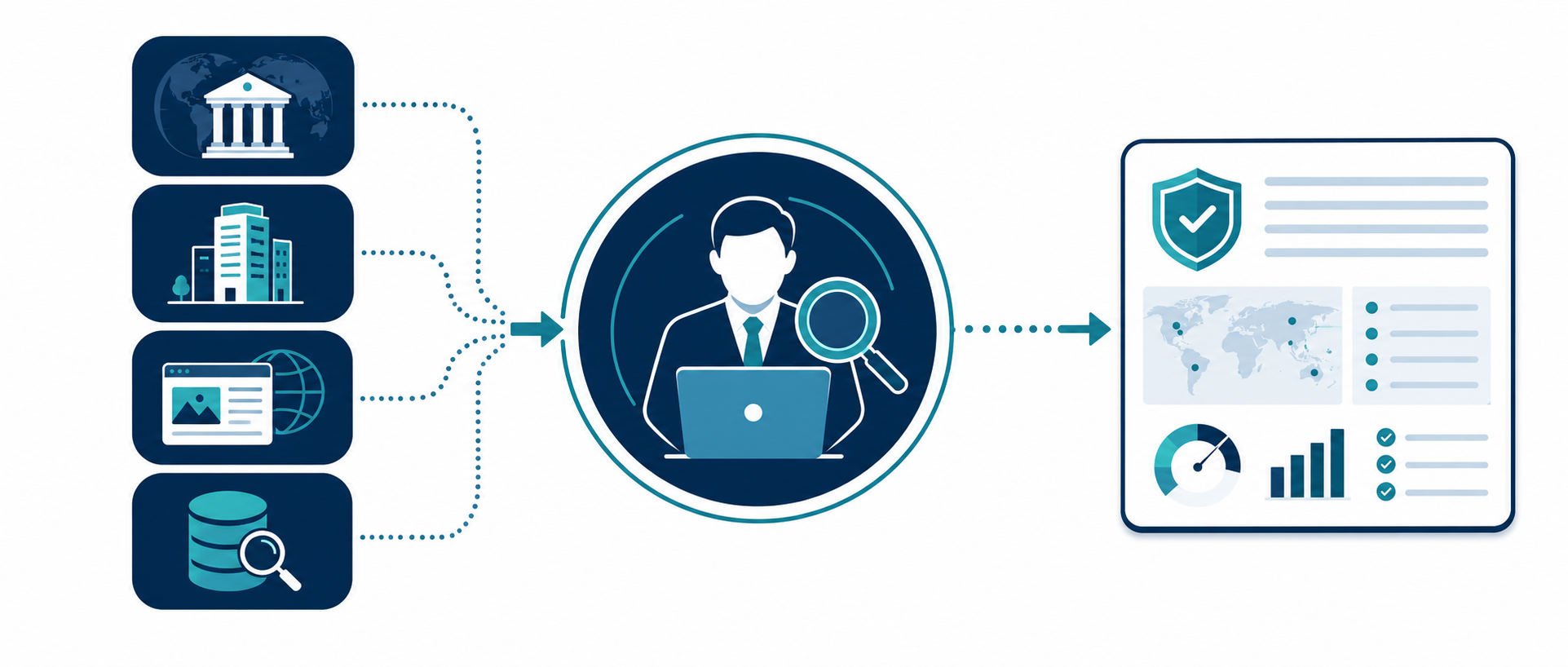
EDD services can be understood as falling into two categories: data and technology platforms that provide access to information needed for EDD investigations, and advisory and investigative services that provide human expertise to conduct and document EDD reviews.
EDD Data and Technology Platforms
These platforms provide access to the data sources needed to conduct EDD investigations efficiently and comprehensively. Core capabilities include:
PEP databases — comprehensive, regularly updated databases of politically exposed persons including senior government officials, their family members, and close associates across global jurisdictions.
Adverse media screening — access to news databases and media monitoring tools that identify negative reporting about customers or their associated parties in financial crime, regulatory violations, fraud, corruption, or other relevant areas.
Corporate registry data — access to business registration data, corporate filings, and ownership records across multiple jurisdictions to support beneficial ownership verification for business customers.
Sanctions and watchlist databases — comprehensive, current OFAC SDN List and global sanctions list data with fuzzy matching capability.
UBO (Ultimate Beneficial Owner) research tools — tools that help trace ownership chains through multiple corporate layers to identify ultimate beneficial owners.
Source of funds and source of wealth databases — access to financial and public record data that helps verify or investigate stated sources of funds and wealth.
EDD Advisory and Investigative Services
These services provide human expertise and investigative capacity for complex EDD situations. They include:
Complex ownership structure analysis — expert investigation and documentation of corporate ownership chains through multiple jurisdictions and entity types.
Source of wealth investigation — research and verification of high-net-worth customer wealth sources, often involving multiple data sources and in some cases interviews or document requests.
PEP risk assessment — expert assessment of the specific risk presented by a PEP customer based on their position, jurisdiction, and the specific nature of their political role.
Due diligence report preparation — documented investigative reports suitable for compliance file retention and examiner review.
When Fintechs Need EDD Services
Early-stage fintechs with limited EDD volumes can often conduct EDD investigations using a combination of commercial PEP databases, adverse media screening, and web-based corporate registry research — augmented by manual investigation by compliance staff.
As a fintech's customer base grows and as it serves more complex customer types — high-net-worth individuals, international business customers, customers from higher-risk jurisdictions — the volume and complexity of EDD investigations increases. At this point, purpose-built EDD data platforms become essential for efficiency.
When EDD investigations involve particularly complex situations — multi-layered offshore structures, high-net-worth customers with complex wealth, PEPs from high-risk jurisdictions — engaging specialized EDD investigative services provides expertise and documentation quality that in-house investigation may not be able to match.
Building EDD Capability: Build vs. Buy
Most early-stage fintechs access EDD capabilities through a combination of technology platforms and, for complex cases, outside service providers rather than building everything in-house.
Core technology investments for EDD capability include a KYC platform with integrated PEP and adverse media screening, access to corporate registry data for KYB investigations, and OFAC sanctions screening with comprehensive database coverage.
For complex EDD investigations, engaging specialized EDD service providers on an as-needed basis is typically more cost-effective than building in-house investigative capacity until EDD volumes justify dedicated staff. For a complete list of what to collect in each EDD investigation, see the EDD checklist.
What to Look for in an EDD Service Provider
If you are selecting an EDD data platform or advisory service provider, evaluate coverage — what jurisdictions and data sources are included, how frequently data is updated, and what the false positive rate looks like for your specific customer types. Also evaluate integration — how the platform connects to your existing KYC and compliance infrastructure. Evaluate documentation quality — what audit trail the platform produces for each investigation, and whether that documentation meets examination standards. And evaluate the ability to handle complex cases — whether the provider has expertise in the specific types of EDD investigations your program requires.
Frequently Asked Questions
Can EDD services replace my compliance team's judgment?
No. EDD services provide data and expertise that supports your compliance team's judgment — they do not replace it. The decision to onboard a high-risk customer, and the documentation of that decision, remains the responsibility of your compliance program and ultimately your BSA Officer. EDD services make that decision-making more informed and better documented.
How much do EDD services cost?
EDD service costs vary significantly based on the scope and complexity of the services. Technology platform subscriptions typically range from hundreds to several thousand dollars per month depending on data coverage and volume. Per-investigation advisory services for complex EDD cases typically range from $1,000 to $10,000 or more depending on complexity. For high-volume EDD programs, enterprise pricing with volume discounts is typically available.
Does using an EDD service satisfy my EDD compliance obligations?
Using an EDD service supports your compliance program — it does not satisfy your compliance obligations on its own. Your program must document what EDD was conducted, what information was obtained, what conclusions were reached, and what approval was obtained. The EDD service provides the tools and data — your compliance program provides the process and accountability.
How ComplyOne Helps
ComplyOne helps fintechs build EDD programs with the right combination of technology, process, and advisory support — from selecting and implementing EDD data platforms to designing investigation workflows to conducting complex EDD investigations for high-risk customers.
Talk to the ComplyOne team to get started.
The information in this article is for general educational purposes and does not constitute legal or regulatory advice. Consult a qualified compliance professional for guidance specific to your situation.