Enhanced Due Diligence in banking is the deeper level of scrutiny applied to high-risk customers. Here is what EDD means in practice, how it differs from standard KYC, and real examples of when it applies.
Enhanced Due Diligence in Banking: Definition, Process, and Examples
Enhanced Due Diligence — commonly abbreviated as EDD — is a term that appears across banking and financial services compliance, but its practical meaning is often unclear to people encountering it for the first time. What exactly is enhanced about it? What triggers it? What does it actually look like in practice?
This article answers all of those questions with specific examples of when and how EDD is applied.
The Definition of Enhanced Due Diligence
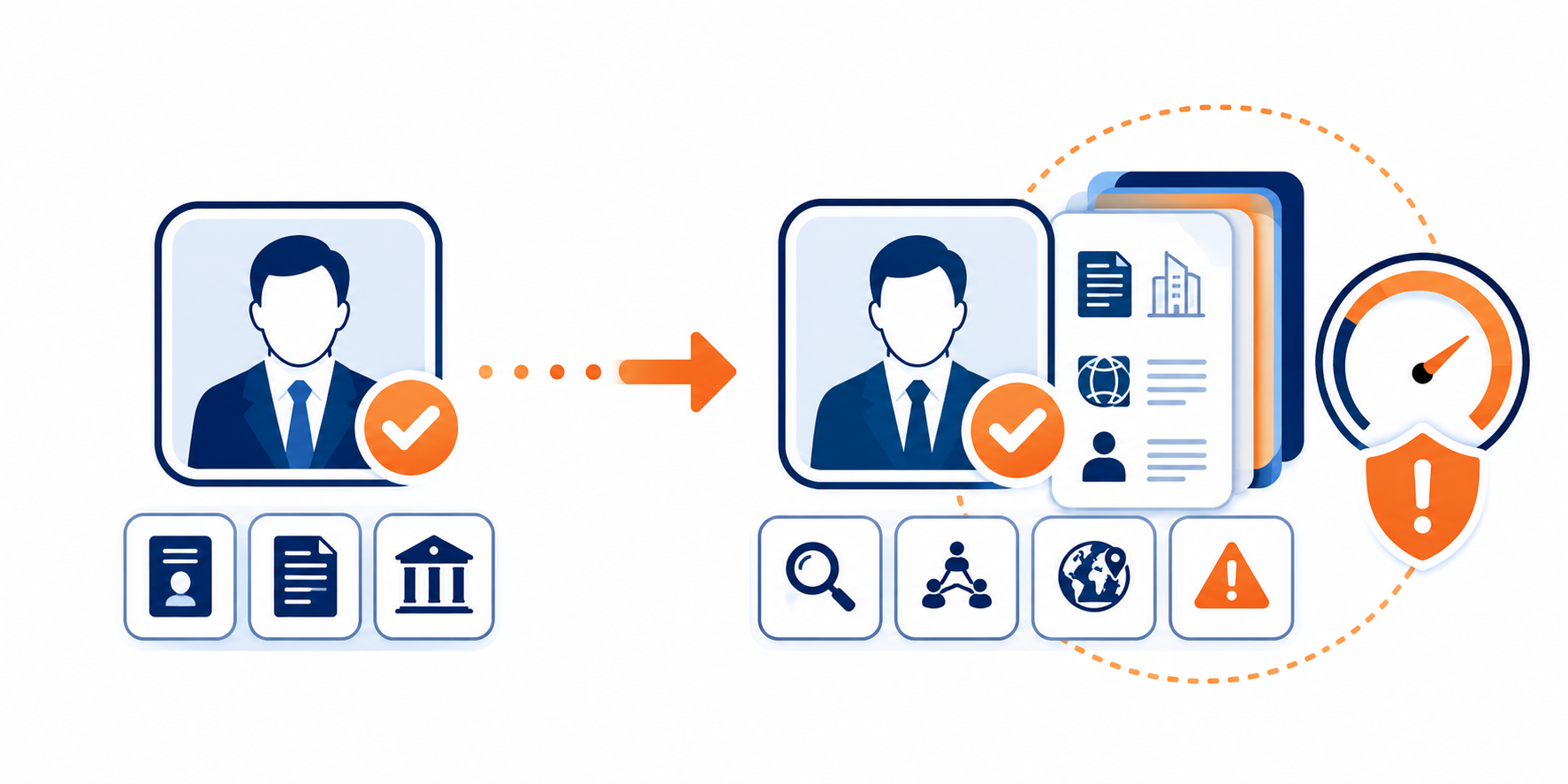
Enhanced Due Diligence is a level of customer scrutiny that goes beyond standard KYC and Customer Due Diligence requirements. It is applied to customers who present elevated money laundering, financial crime, or regulatory risk — where the standard level of verification and monitoring is not sufficient given the risk factors present.
EDD is not a single specific process but a principle: higher risk requires higher scrutiny. What EDD looks like in practice depends on the specific risk factors triggering it and the policies your institution has established for addressing those factors.
How EDD Differs From Standard KYC and CDD
Standard KYC involves collecting and verifying the basic identity information required by your Customer Identification Program — name, date of birth, address, and identification number — and conducting standard Customer Due Diligence — assigning a risk rating, documenting the expected account purpose, and setting up ongoing monitoring.
EDD goes further in several dimensions.
More documentation — EDD requires additional documents beyond standard identity verification. Depending on the risk trigger, this may include source of funds evidence, source of wealth documentation, corporate structure charts, or reference information.
Deeper verification — EDD involves more thorough verification of the information provided, not just collection. For high-risk business structures, this may mean tracing ownership through multiple corporate layers. For high-net-worth individuals, this may mean verifying the specific origin of funds against documentation.
Senior approval — EDD customers typically require approval from a senior compliance officer or the BSA Officer before the account is opened, rather than the standard analyst-level decision.
Enhanced monitoring — EDD customers are monitored more intensively — with lower alert thresholds, more frequent compliance review, and closer attention to activity patterns.
More frequent periodic review — while standard CDD reviews for low-risk customers may occur every 3 to 5 years, EDD customers are typically reviewed annually or more frequently. For a complete list of what EDD documentation to collect, see the EDD checklist.
Real Examples of When EDD Applies
Example 1 — A Foreign Government Minister
A customer applying for an account identifies themselves as a senior minister in a foreign government. This customer is a Politically Exposed Person — a category that automatically triggers EDD regardless of expected account activity.
EDD for this customer would involve collecting and verifying the specific government position held and the jurisdiction, conducting enhanced adverse media screening for the customer and their immediate family members, requiring source of funds documentation for any significant deposits, obtaining senior management approval before opening the account, setting up enhanced transaction monitoring for the account, and scheduling annual EDD reviews.
Example 2 — A Cannabis Industry Business
A business customer seeking payment processing services discloses that it is a licensed cannabis retailer. Cannabis is a federally illegal substance in the United States despite state-level legalization, making cannabis businesses a high-risk industry category.
EDD for this business would involve collecting and verifying state cannabis licenses and any applicable federal permits, obtaining enhanced documentation of the business structure and ownership, verifying that all transactions relate to legitimate cannabis retail activity, setting enhanced monitoring parameters calibrated to the specific transaction patterns expected for cannabis retail, and scheduling more frequent periodic KYB reviews.
Example 3 — A Holding Company With Offshore Subsidiaries
A business customer seeking an account is a Delaware LLC owned by a Cayman Islands holding company, which is in turn owned by a trust. This multi-layered structure makes beneficial ownership difficult to establish and is a common structure used to obscure the true owners of assets.
EDD for this business would involve a comprehensive ownership tracing exercise documenting every layer of the structure and the identity of each entity, identification and verification of the ultimate beneficial owners through the full ownership chain, collecting corporate formation documents for each entity in the chain, requesting explanation of the business rationale for the specific corporate structure, and senior compliance officer review and approval of the decision to onboard.
Example 4 — A Customer From a FATF Grey List Country
An individual customer who is a resident of a country recently added to the FATF grey list opens an account for what they describe as personal use. The grey list designation signals that the customer's country of residence has identified deficiencies in its AML framework.
EDD for this customer would involve enhanced verification of the customer's identity using additional government-issued documentation, collection of source of funds information for significant transactions, enhanced monitoring of account activity given the geographic risk, and more frequent periodic CDD reviews than would apply to a lower-risk customer.
Frequently Asked Questions
Does EDD mean the customer is automatically rejected?
No. EDD means the customer receives more thorough scrutiny before and during the relationship — not automatic rejection. Most customers who trigger EDD are entirely legitimate and have perfectly lawful purposes for their financial activities. The decision to onboard a customer who triggers EDD should be based on the outcome of the EDD investigation, not the mere fact that they triggered it.
What does EDD stand for?
EDD stands for Enhanced Due Diligence. The term is used interchangeably with Enhanced Customer Due Diligence (ECDD) in some regulatory frameworks.
How long does an EDD investigation take?
The time required for an EDD investigation depends on the complexity of the customer's situation. A straightforward PEP investigation may take 1 to 2 days. An investigation involving complex multi-layered corporate structures with offshore components may take a week or more. Factor EDD investigation timelines into your onboarding process for customers who are likely to trigger EDD.
How ComplyOne Helps
ComplyOne helps fintechs build EDD programs that meet regulatory requirements and handle the full range of EDD scenarios their businesses encounter — through advisory services, compliance technology, or both.
Talk to the ComplyOne team to get started.
The information in this article is for general educational purposes and does not constitute legal or regulatory advice. Consult a qualified compliance professional for guidance specific to your situation.