Prepaid card companies face AML obligations as MSBs plus CFPB consumer protection requirements. Here is what AML compliance requires for prepaid card issuers and program managers.
AML Compliance for Prepaid Card Companies: What You Need to Know
Prepaid card companies — including issuers of general purpose reloadable cards, program managers, and stored value product companies — occupy a specific position in the U.S. regulatory framework. They qualify as Money Services Businesses under the BSA as issuers or sellers of stored value, and they are subject to CFPB consumer protection requirements under the Prepaid Account Rule.
MSB Classification for Prepaid Card Companies
Prepaid card issuers and program managers qualify as MSBs under FinCEN's regulations through the stored value category. This classification triggers FinCEN MSB registration requirements, full BSA/AML compliance obligations, and in many cases state money transmitter licensing requirements.
The specific MSB activities that apply depend on whether the company is the issuer of the prepaid card or a program manager acting on behalf of an issuer. Issuers qualify as issuers of stored value. Program managers may qualify under multiple categories depending on their specific role.
AML Program Requirements
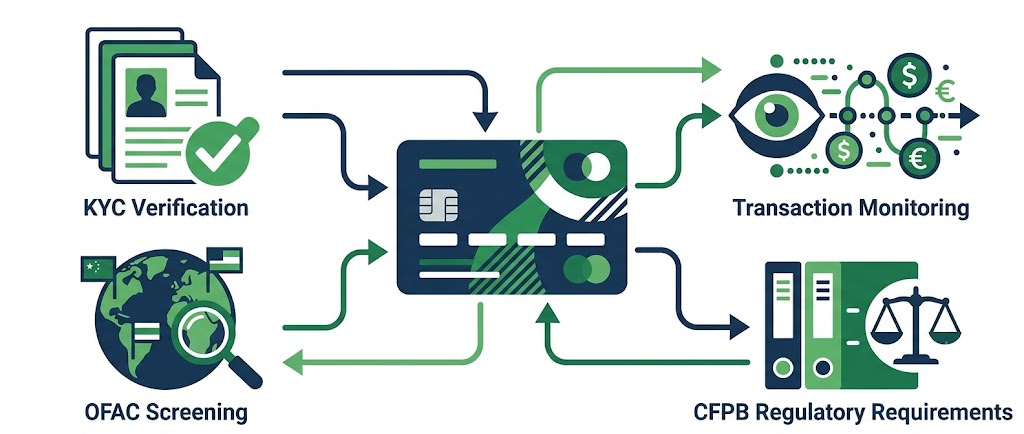
A compliant prepaid card AML program covers all five BSA pillars — internal controls, designated compliance officer, ongoing training, independent testing, and CDD — implemented specifically for the prepaid card business model.
Transaction monitoring for prepaid cards must address the specific risk patterns associated with stored value products — structuring through multiple load transactions, rapid depletion of card balances, coordinated activity across multiple cards linked to a common source, and unusual geographic patterns in card usage.
KYC requirements for prepaid cards depend on the card type. Non-reloadable cards below certain value thresholds may have lighter KYC requirements. General purpose reloadable cards that allow significant value storage and transfer require full KYC consistent with BSA requirements.
CFPB Prepaid Account Rule
In addition to BSA compliance, prepaid card companies are subject to the CFPB's Prepaid Account Rule, which requires specific pre-account-opening fee disclosures in a standardized format, error resolution procedures satisfying Regulation E requirements, account history access for cardholders, and specific requirements for cards that include credit features.
State Licensing
Prepaid card companies that qualify as MSBs through money transmission or stored value activities typically need state money transmitter licenses in states where they serve customers. Some states have specific stored value licensing frameworks separate from general money transmitter licensing.
Frequently Asked Questions
Do gift cards need BSA compliance programs?
Single-merchant gift cards — cards that can only be used at one retailer — are generally not subject to BSA/MSB requirements because they are not general purpose stored value. General purpose prepaid cards usable at multiple merchants are MSBs subject to BSA requirements.
Who is responsible for BSA compliance in a prepaid card program — the issuer or the program manager?
This depends on the specific structure of the arrangement. In bank-issued prepaid programs, the issuing bank has primary BSA responsibility. Program managers operating under a bank's license typically have compliance obligations defined in their program agreement with the bank. Program managers operating independently as MSBs have independent BSA obligations.
How ComplyOne Helps
ComplyOne helps prepaid card companies build AML compliance programs that satisfy both BSA requirements and CFPB consumer protection obligations — through advisory services, compliance technology, or both.
Talk to the ComplyOne team to get started.
The information in this article is for general educational purposes and does not constitute legal or regulatory advice. Consult a qualified compliance professional for guidance specific to your situation.