Earned wage access companies face evolving AML compliance questions as regulators determine whether EWA products are loans or money transmission. Here is the current compliance picture for EWA fintechs.
AML Compliance for Earned Wage Access Companies
Earned wage access — also called on-demand pay or wage advance — allows workers to access their earned wages before their regular payday. EWA has grown rapidly as an employee benefit offered directly by employers or through third-party platforms. The AML compliance obligations for EWA companies are evolving as regulators continue to assess how these products should be classified under existing legal frameworks.
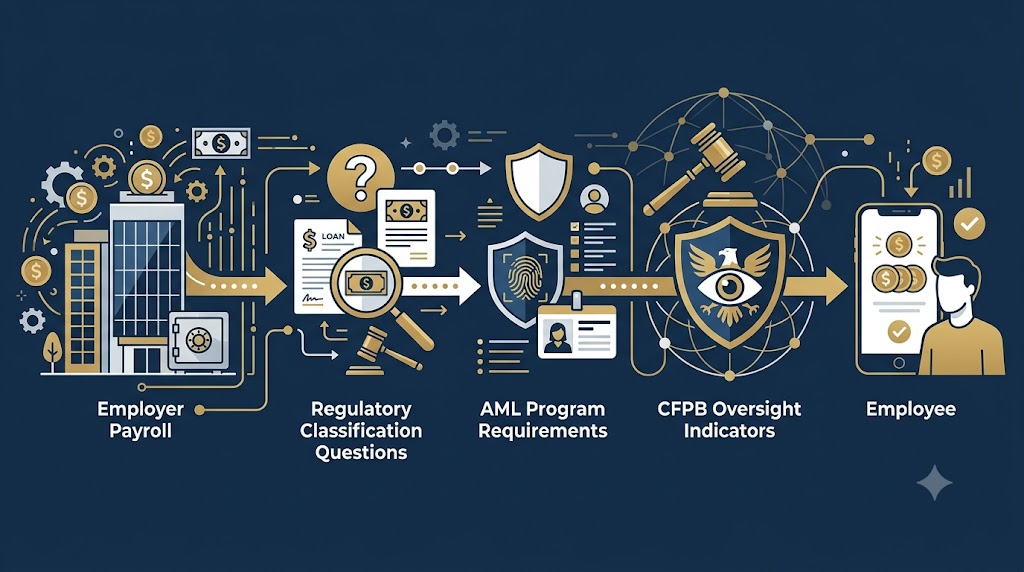
The Regulatory Classification Question
The most important compliance question for EWA companies is how their product is legally classified — as money transmission, as consumer credit, or as something else entirely.
EWA products vary significantly in structure. Employer-integrated EWA — where the employer facilitates the advance and deducts it from the next paycheck — has been viewed differently from third-party EWA — where a fintech company provides advances based on verified pay data and collects repayment through ACH or payroll deduction.
Some states have determined that certain EWA products constitute money transmission subject to money transmitter licensing requirements. Others have found them to be consumer credit products subject to lending licensing requirements. Several states have enacted EWA-specific legislation creating tailored frameworks.
The CFPB has been examining EWA products and has issued guidance finding that some EWA products are consumer credit subject to Regulation Z. The regulatory landscape continues to evolve.
BSA/AML Compliance for EWA Money Transmitters
EWA companies that qualify as money transmitters — typically those that receive employer payroll funds and transmit portions to employees — must implement full BSA compliance programs including FinCEN MSB registration, a written AML program covering all five pillars, and all standard BSA requirements.
Transaction monitoring for EWA platforms must address the specific risk patterns relevant to payroll advance products — unusual frequency of advance requests, advance amounts inconsistent with documented wage levels, and patterns suggesting identity fraud or account takeover.
Consumer Protection Compliance for EWA
Regardless of whether an EWA product constitutes money transmission, consumer-facing EWA products are subject to CFPB oversight. CFPB guidance finding that some EWA products are consumer credit subject to Regulation Z means those products must provide standardized credit disclosures including APR information.
State-by-State Complexity
EWA companies face significant state-by-state variation in how their products are regulated. California, Nevada, Connecticut, and other states have enacted or are considering EWA-specific legislation. Companies operating nationally must track and comply with state-specific requirements that differ from the federal framework.
Frequently Asked Questions
Does an EWA company need a money transmitter license?
It depends on the specific structure of the EWA product and the laws of each state where the company operates. Some states require money transmitter licenses for EWA products. Others treat them as consumer credit products requiring lending licenses. Others have created EWA-specific frameworks. Legal analysis of each state's applicable law is required.
How ComplyOne Helps
ComplyOne helps EWA companies navigate their specific compliance obligations in the evolving regulatory landscape — from BSA/AML analysis through state licensing and CFPB compliance — through advisory services, compliance technology, or both.
Talk to the ComplyOne team to get started.
The information in this article is for general educational purposes and does not constitute legal or regulatory advice. EWA regulatory requirements are evolving rapidly. Consult qualified legal counsel for guidance specific to your EWA product.