Cross-border payments carry elevated AML risk due to geographic exposure, sanctions complexity, and the difficulty of verifying foreign counterparties. Here is what cross-border payment AML compliance requires.
AML Compliance for Cross-Border Payments: What Fintechs Need to Know
Cross-border payments carry elevated AML risk compared to domestic-only transactions for several reasons. The counterparties involved are geographically dispersed and may be harder to verify. The geographic risk of the destination country may be elevated. The correspondent banking relationships involved create additional compliance complexity. And the potential for sanctions violations is higher because the range of sanctioned countries and individuals intersects more frequently with international payment flows.
Why Cross-Border Payments Carry Elevated AML Risk
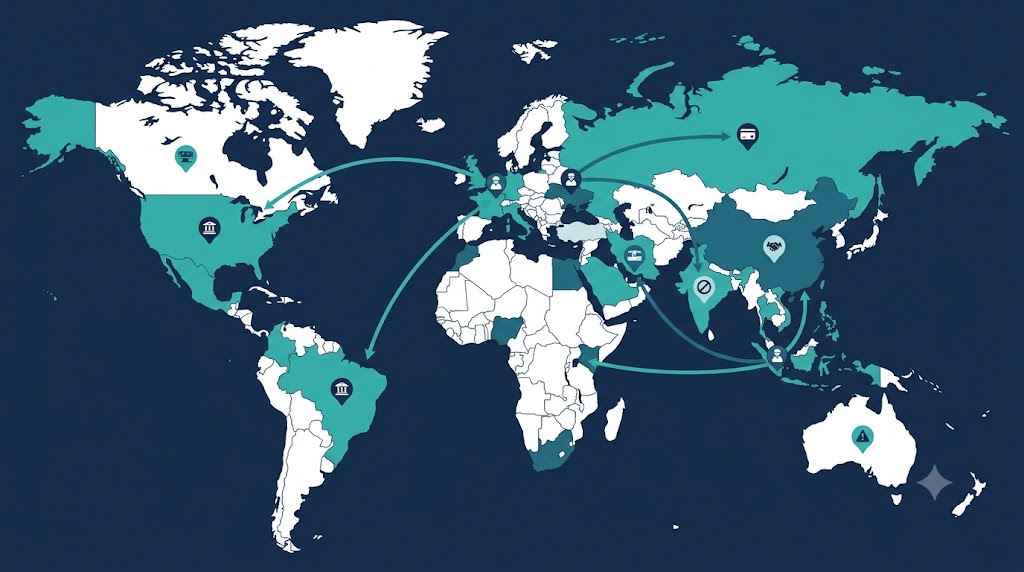
Geographic exposure is the primary driver of elevated cross-border AML risk. Every cross-border payment involves a destination country — and that country's risk profile, sanctions status, and FATF assessment directly affect the AML risk of the transaction.
Counterparty verification is more challenging internationally. While domestic counterparties can often be verified through U.S. identity databases, international counterparties may require different verification approaches with less reliable data sources.
The volume and variety of international payment corridors creates monitoring complexity. A fintech serving 50 different destination countries has 50 different risk profiles to understand and monitor.
OFAC Compliance for Cross-Border Payments
Every cross-border payment must be screened against OFAC's SDN List for both the originator and the beneficiary. OFAC sanctions screening is also required at the geographic level — payments to or from OFAC-sanctioned countries are generally prohibited regardless of whether the specific individuals appear on the SDN List.
Real-time transaction-level screening is standard practice for cross-border payments. Beneficiary screening at the time of payment initiation — before the payment is executed — is essential because detected sanctions violations cannot typically be reversed after execution.
Correspondent Banking and Counterpart Compliance
For cross-border payments that route through correspondent banking relationships, the financial institutions involved in the payment chain each have their own compliance obligations. Your compliance program must address the risk that your correspondent banking partners may themselves create compliance exposure — and should include due diligence on the correspondent banking relationships used to process your cross-border payments.
The Travel Rule for Cross-Border Payments
For cross-border transfers of $3,000 or more, the BSA's Travel Rule requires collecting and transmitting originator and beneficiary information. For fintechs processing international payments, this means maintaining the information infrastructure to satisfy Travel Rule obligations and ensuring that information is transmitted appropriately when required.
Geographic Risk Assessment
Your AML risk assessment should specifically address the countries and corridors your cross-border payment business serves. Key factors to assess for each destination include FATF assessment status, OFAC sanctions program applicability, corruption and financial crime risk indicators, and reliability of identity verification data.
Higher-risk corridors require enhanced controls — potentially including enhanced due diligence for all customers using those corridors, additional transaction monitoring scrutiny for payments to high-risk destinations, and in some cases corridor restrictions.
Frequently Asked Questions
Does my fintech need special licenses for cross-border payments?
Cross-border payment businesses typically need money transmitter licenses in U.S. states where they serve customers — the same licenses as domestic money transmitters. International activities may also trigger compliance requirements in destination countries, which varies by jurisdiction.
How does OFAC screening work for cross-border payments?
OFAC screening for cross-border payments covers both the sending customer and the receiving beneficiary and their respective countries. For payments to or from sanctioned countries, the transaction cannot proceed regardless of whether the specific individuals appear on the SDN List. Real-time screening before payment execution is the standard approach.
How ComplyOne Helps
ComplyOne helps fintechs build AML compliance programs designed for cross-border payment operations — from geographic risk assessment through OFAC compliance and Travel Rule implementation. See also our overview of AML compliance for payments companies — through advisory services, compliance technology, or both.
Talk to the ComplyOne team to get started.
The information in this article is for general educational purposes and does not constitute legal or regulatory advice. Consult a qualified compliance professional for guidance specific to your situation.