Bank AML compliance and fintech AML compliance share the same legal foundation but differ in scope, oversight intensity, and organizational scale. Here is how the two frameworks compare.
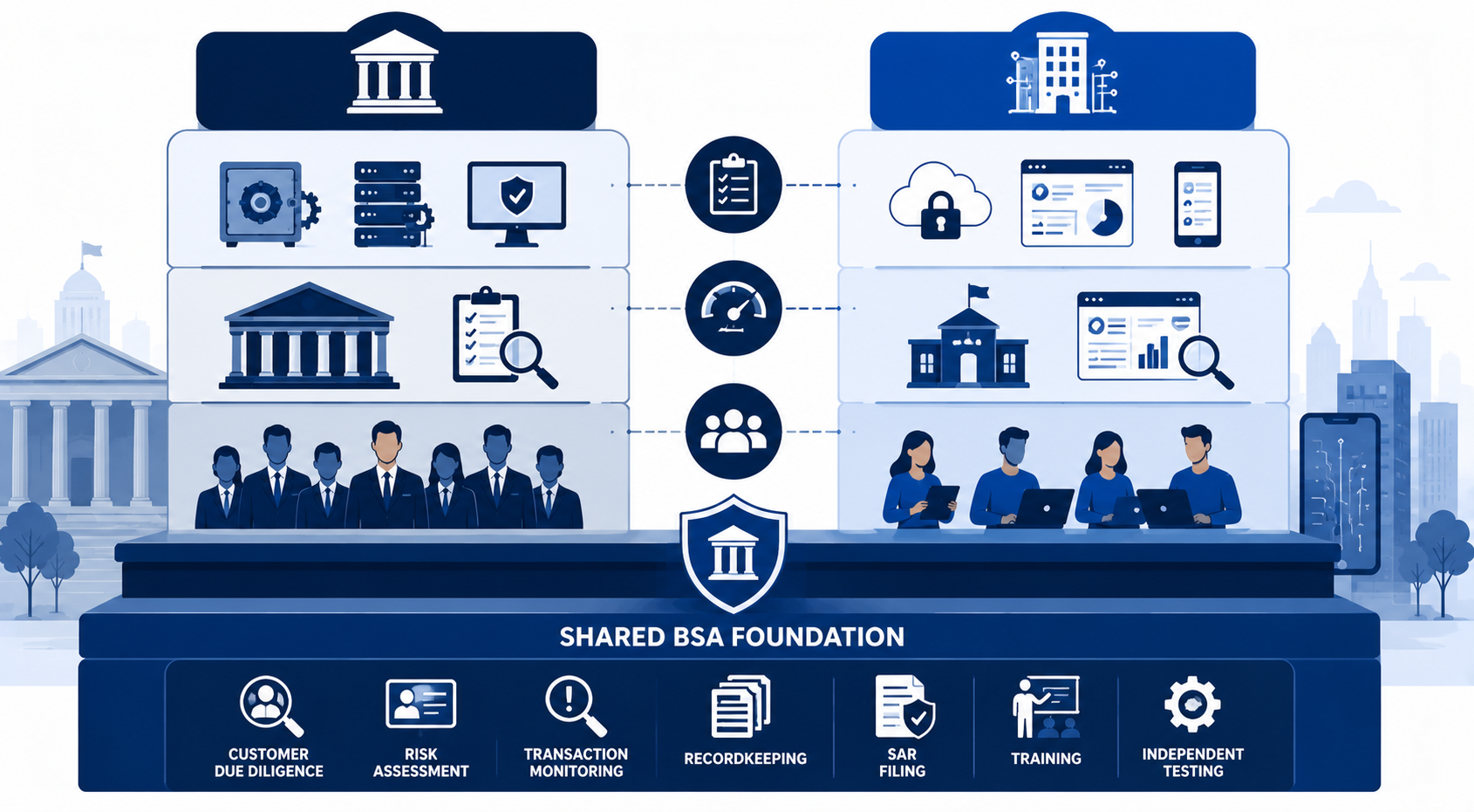
A clean professional flat-design illustration of a side-by-side comparison of bank AML compliance and fintech AML compliance — showing shared BSA foundation at the base with different compliance infrastructure, oversight intensity, and organizational scale above. Dark blue, navy, and white color palette. No text. Wide horizontal format. Bank vs fintech AML compliance comparison educational aesthetic.
AML Compliance for Banks: How It Differs from Fintech
Bank AML compliance and fintech AML compliance share the same legal foundation — both are governed by the Bank Secrecy Act and administered by FinCEN. But in practice, the compliance environments look quite different in terms of regulatory oversight intensity, organizational scale, and the specific compliance challenges each faces.
The Shared Legal Foundation
Both banks and fintechs that qualify as covered financial institutions must maintain BSA/AML programs covering all five required pillars — internal controls, a designated compliance officer, ongoing employee training, independent testing, and customer due diligence.
Both must file SARs when detecting suspicious activity, file CTRs for applicable cash transactions, maintain required records for five years, and implement Customer Identification Programs. Understanding BSA compliance as a shared foundation is the starting point for understanding where banks and fintechs diverge.
How Bank AML Compliance Differs from Fintech
Regulatory Oversight Intensity
Banks are examined by federal banking regulators — the OCC, FDIC, Federal Reserve, or state banking departments — on a regular cycle typically annual for larger banks. These examinations are comprehensive, staffed by dedicated bank examiners, and cover the full scope of BSA compliance in detail.
Fintechs operating as MSBs are examined by FinCEN directly, which has a smaller examination force, and indirectly through their sponsor banks' examination processes. The frequency and depth of examination can vary significantly.
Organizational Scale
Large banks have dedicated AML departments with hundreds of analysts, specialized functions for different aspects of the program, and sophisticated technology infrastructure built over decades. The scale of resources is dramatically different.
Fintechs — particularly early-stage and growth-stage companies — typically have much leaner compliance functions, often with a single BSA Officer and a small team or outsourced support. The same five-pillar program that a major bank implements with 500 people must be implemented by a fintech with 3.
Customer Base Characteristics
Banks have established customer relationships often spanning decades, significant customer history, and deep visibility into customer behavior patterns. Fintechs often serve newer customers with limited transaction history, digital-native customers who expect frictionless experiences, and in many cases underserved populations with limited traditional financial history.
Specific Risk Profiles
Banks face AML risks associated with their specific products — correspondent banking, commercial real estate, private banking for high-net-worth clients — that differ from typical fintech risk profiles. Fintechs face risks more commonly associated with their digital delivery channels, peer-to-peer transaction structures, and in many cases higher-risk customer demographics.
What Fintechs Can Learn From Bank AML Practices
Banks have developed sophisticated practices in several areas that fintechs can adapt for their scale. Risk-tiered monitoring — applying greater scrutiny to higher-risk customers and transactions — is a bank practice that translates well to fintech contexts. Documentation discipline — maintaining complete, retrievable compliance records as a matter of course — is an area where bank practices exceed most fintech programs. Governance structures — formal compliance committee oversight, regular board reporting, and defined escalation procedures — are bank practices that growing fintechs should adopt.
Frequently Asked Questions
Are BSA compliance standards the same for banks and fintechs?
The legal standard is the same — all covered institutions must have adequate BSA/AML programs meeting the five required pillars. The practical standard for "adequate" is calibrated to the institution's size, complexity, and risk profile. A small fintech with simple operations is not expected to have the same program architecture as a large bank with complex global operations.
How ComplyOne Helps
ComplyOne helps fintechs build AML programs appropriate for their scale and business model — drawing on best practices from bank-level compliance while making them practical for fintech organizations — through advisory services, compliance technology, or both.
Talk to the ComplyOne team to get started.
The information in this article is for general educational purposes and does not constitute legal or regulatory advice. Consult a qualified compliance professional for guidance specific to your situation.