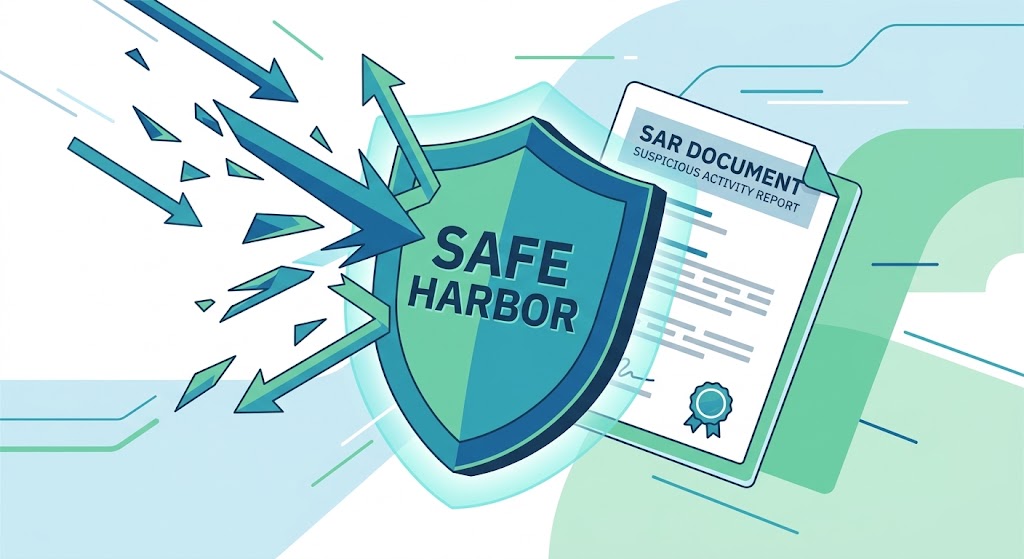
The SAR safe harbor protects financial institutions from civil liability when they file Suspicious Activity Reports in good faith. This guide explains how the protection works, what it covers, and how to preserve it.
SAR Safe Harbor — What Fintechs Need to Know
One of the most important — and least understood — protections in AML compliance is the SAR safe harbor. It protects your fintech from civil liability when you file a Suspicious Activity Report in good faith. Without it, institutions would face an impossible choice: file a SAR and risk getting sued by the subject, or don't file and risk regulatory action.
The safe harbor resolves that dilemma. Here's what it covers and how to preserve it.
What Is the SAR Safe Harbor?
The SAR safe harbor is a statutory protection found in 31 U.S.C. § 5318(g)(3). It provides that a financial institution — and its directors, officers, employees, and agents — are not liable to any person under any law or regulation of the United States, any state or political subdivision, or any territory or possession of the United States, for:
- Filing a SAR with FinCEN or appropriate regulators, or
- Failing to notify the subject of a SAR that a SAR was filed
In plain English: if you file a SAR in good faith and the SAR subject sues you for it, you are legally protected. And if a customer demands to know whether you've reported them to FinCEN, you are legally protected for not telling them.
What Does "Good Faith" Mean?
The safe harbor applies to SARs filed in good faith. Good faith means:
- You had a reasonable basis for suspicion — based on the facts available at the time of filing
- You followed your institution's SAR procedures in making the filing decision
- The filing was not made for an improper purpose (for example, to harass a customer or retaliate for a dispute)
You don't need to be certain that a crime occurred — you need a reasonable, documented basis for suspicion. The BSA's standard is "knows, suspects, or has reason to suspect" — not "has proof."
What the Safe Harbor Does NOT Cover
The safe harbor is not absolute. It does not protect against:
- Bad faith filings — SARs filed maliciously, in retaliation, or for purposes unrelated to legitimate AML compliance
- Disclosing the SAR itself — if you show a SAR to an unauthorized person (not a regulator or law enforcement), you lose the protection and may violate the tipping-off prohibition
- Other types of liability — the safe harbor is specific to SAR-related civil claims; it does not protect your institution from other legal exposure
The SAR Tipping-Off Prohibition
The safe harbor works in tandem with the tipping-off prohibition. Under the BSA, you cannot disclose to the subject of a SAR — or to any unauthorized person — that a SAR was filed or is being considered.
This prohibition applies even if the customer directly asks: "Did you report me to FinCEN?" The answer is legally and professionally required to be: "I'm not able to discuss any reports we may or may not have filed."
Violating the tipping-off prohibition exposes your institution and the individuals involved to criminal penalties — up to $250,000 in fines and five years imprisonment for willful violations. It also destroys the safe harbor protection.
How to Preserve the Safe Harbor
To maintain safe harbor protection:
- Document your SAR decision-making process: Keep records of the facts that triggered the review, the investigation conducted, the conclusion reached, and the filing decision
- Follow your written SAR procedures: Decisions should be made in accordance with your institution's documented policies
- Limit access to SAR information: Only individuals who need to know about a SAR should be informed — keep the list narrow
- Train all staff on the tipping-off prohibition: Customer-facing staff especially must know not to discuss SARs with customers
- Mark SAR documents as confidential: Any documents related to a SAR decision should be clearly marked and protected from disclosure
The "When in Doubt, File" Principle
Given the safe harbor, the practical advice for compliance teams facing a close call is: when in doubt, file. The safe harbor protects good-faith filings even if they turn out to be unfounded. The risk of not filing when you should have — regulatory enforcement, reputational damage, potential criminal liability for willful failures — significantly outweighs the risk of filing when the situation was ambiguous.
See our guide on how to file a SAR for the complete filing process.
Frequently Asked Questions
Does the safe harbor apply to all financial institutions?
The federal SAR safe harbor applies to all financial institutions subject to SAR filing requirements under the BSA. Many states also have their own safe harbor provisions for state-level reporting requirements.
Can a customer sue me just for filing a SAR?
With the safe harbor in place, a good-faith SAR filing is not actionable in civil court. Courts have consistently enforced the safe harbor protection. The customer would need to prove you acted in bad faith — which is a very high bar.
What if I filed a SAR but later found out it was a mistake?
Filing a SAR that turns out to be unfounded does not expose you to liability as long as the filing was made in good faith based on the information available at the time. There is no mechanism to "withdraw" a filed SAR — but you are not penalized for good-faith filings that prove to be incorrect.
This article is for educational purposes only and does not constitute legal or compliance advice. Regulations vary by jurisdiction and change frequently. Consult a qualified compliance professional or legal counsel for guidance specific to your business.