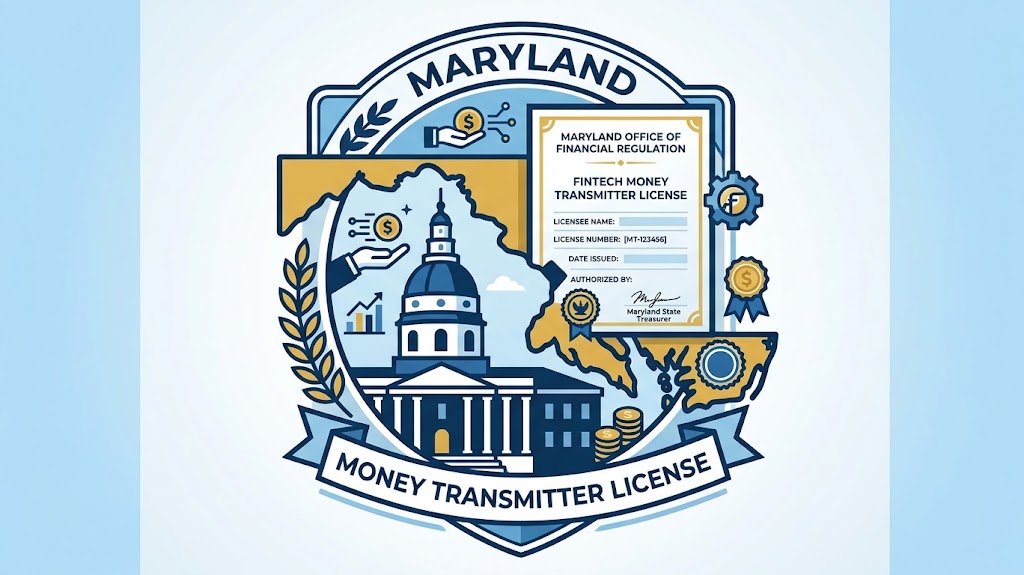
Maryland requires a Money Transmitter license from the Office of Financial Regulation for fintechs transmitting money in the state. This guide covers the requirements, NMLS application process, and ongoing compliance obligations under the Maryland Money Transmission Act.
How to Get a Money Transmitter License in Maryland
Maryland's proximity to Washington, D.C. and its dense population of financial services and government-adjacent technology companies make it a strategically important state for fintechs expanding in the Mid-Atlantic corridor. If your company transmits money in Maryland, you must be licensed before operating.
Does My Fintech Need a Maryland Money Transmitter License?
Under the Maryland Money Transmission Act (Maryland Code, Financial Institutions Article, Title 12, Subtitle 4), any person or entity engaged in money transmission must hold a license issued by the Maryland Office of Financial Regulation (OFR).
Money transmission in Maryland includes receiving money or monetary value for the purpose of transmitting it to another location or person, by any means including wire transfer, ACH, electronic funds transfer, or stored value instruments. Companies offering peer-to-peer payments, digital wallets, cross-border remittances, or business payment services to Maryland customers generally require this license.
Exempt entities include federally insured depository institutions and other specifically regulated financial institutions under Maryland law. Most fintech payment companies that are not banks require this license.
Key Requirements at a Glance
Fee and financial requirements change periodically. Always verify current amounts on NMLS or at the Maryland OFR website before filing.
What You Will Need to Apply
Business Documentation
- Certificate of good standing from your state of formation
- Articles of incorporation or organization
- Organizational chart showing full ownership structure, including all entities and individuals with significant ownership or control
- Audited financial statements — typically two to three years, or from inception for newer companies
- Business plan describing your money transmission activities, products offered, and projected Maryland transaction volumes
- Description of all products and services involving money transmission in Maryland
Individual Background Checks
All principals, officers, directors, and individuals with control over the applicant must complete MU2 forms in NMLS and submit fingerprints for criminal background checks through an NMLS-approved vendor. The Maryland OFR reviews character and fitness as part of its application review process.
Surety Bond
A surety bond naming the State of Maryland as obligee is required. The OFR sets the required bond amount — verify the current requirement on NMLS before obtaining your bond. The bond must remain in force for the life of your license.
Net Worth Documentation
Applicants must demonstrate the required minimum tangible net worth through financial statements. The OFR conducts a detailed review of financial condition as part of the application process.
AML Compliance Program
A written AML/BSA compliance program must be submitted with the application. The program must be tailored to your business model and must meet Bank Secrecy Act requirements, including policies for customer identification, transaction monitoring, and suspicious activity reporting.
How to Apply Through NMLS
- Create or log in to your NMLS company account at mortgage.nationwidelicensingsystem.org
- Complete the MU1 (company) form with your full business information and disclosure history
- Add all required control persons and have each complete an MU2 form with their own NMLS account
- Upload all Maryland-specific required documents through the NMLS document upload system
- Arrange fingerprinting for all required individuals through an NMLS-approved vendor — this process takes 4–8 weeks, so initiate it early
- Pay the application fee through NMLS
- Monitor your NMLS dashboard for deficiency notices from the Maryland OFR and respond promptly
Ongoing Compliance After Approval
- Annual license renewal through NMLS — typically submitted in November and December for the following year
- Annual financial reporting including Maryland transaction volumes and outstanding payment obligations
- Surety bond maintenance — bond must remain in force at the required amount at all times
- Material change notifications — ownership, leadership, and business activity changes must be reported to the OFR within required timeframes
- Examination readiness — the Maryland OFR conducts periodic examinations of licensed money transmitters
Maryland in a Multi-State Licensing Strategy
Maryland is a priority license for fintechs operating in the DMV corridor (D.C., Maryland, Virginia). The state's proximity to the federal government and its concentration of defense, technology, and government contractor companies creates a significant payments market. Fintechs that license in Maryland alongside Virginia, D.C., and Pennsylvania achieve strong Mid-Atlantic coverage. See our fintech licensing strategy guide to prioritize your state applications.
Frequently Asked Questions
Does Maryland require a physical office for money transmitter licensure?
Maryland does not require a physical in-state office for licensure. You must maintain a registered agent with a Maryland street address for service of process.
How does Maryland regulate cryptocurrency and digital asset businesses?
The Maryland Money Transmission Act was updated to expressly include virtual currency transmission. Cryptocurrency businesses whose activities constitute money transmission in Maryland require a money transmitter license from the OFR. Consult qualified legal counsel for analysis specific to your activities.
What happens if I operate in Maryland without a license?
Operating as an unlicensed money transmitter in Maryland is a criminal offense under Maryland law and subjects companies to civil penalties, cease and desist orders, and restitution. The OFR actively enforces against unlicensed activity.
How long does the Maryland application take?
Typical review timelines are 90 to 180 days for a complete application. Applications with missing documentation or open deficiencies take significantly longer. See our guide on how long it takes to get a money transmitter license across states.
This article is for educational purposes only and does not constitute legal or compliance advice. Licensing requirements change. Verify current requirements directly with the Maryland Office of Financial Regulation and on NMLS before filing.