Fintechs that make loans directly to consumers or businesses typically need state lending licenses. Here is what fintech lending licenses cover, which states require them, and how to structure a lending business that minimizes licensing complexity.
Fintech Lending License: What You Need to Know
Fintech companies that make loans directly to consumers or businesses — rather than operating through a bank partner — must navigate a complex patchwork of state lending license requirements. Unlike federal bank charters, which enable nationwide lending under a single license, direct lending by a nonbank fintech requires licenses in each state where the fintech lends.
This guide covers what fintech lending licenses are, which states require them, and how the licensing framework works for direct lenders operating at scale.
What Is a Fintech Lending License?
There is no single federal "fintech lending license." The licensing requirement for nonbank lenders exists at the state level — each state independently determines whether a license is required for lenders doing business with state residents.
State lending license frameworks typically cover consumer finance companies, installment lenders, personal finance lenders, mortgage lenders (which have their own complex licensing framework), and in some states, commercial lenders. Depending on the type of lending and the state, the applicable license type varies — but the common element is that any nonbank entity making loans for profit to state residents typically needs a license in that state.
The Direct Lending Model
Direct lending fintechs — companies that originate and hold loans on their own balance sheet, funded by investor capital, venture debt, or warehouse facilities — are the category most clearly requiring state lending licenses. These fintechs are the lender of record and must be licensed as such in each state where they lend.
The compliance obligations of a direct lending fintech go beyond licensing — they include federal consumer lending requirements (Regulation Z for consumer credit, Regulation B for equal credit opportunity, ECOA compliance), state usury law compliance (which limits the interest rates that can be charged), and consumer protection requirements including Truth in Lending disclosures.
The Bank Partnership Model
An alternative to direct licensing is the bank partnership model — where the fintech partners with a state-chartered or nationally chartered bank that actually makes the loans, and the fintech operates as the technology platform, marketing channel, and servicer. In this model, the bank is the lender of record and lends under the bank's license and charter, which preempts state usury limits for nationally chartered banks.
The bank partnership model simplifies the licensing requirements for the fintech but adds compliance complexity — the fintech must satisfy its bank partner's compliance requirements and maintain a robust compliance program to sustain the banking relationship. Regulators have also scrutinized some bank-fintech lending arrangements as attempts to evade state consumer protection laws through "rent-a-bank" structures.
State Licensing Requirements — Key Variations
State lending license requirements vary significantly by state. The application requirements typically include business formation documentation, financial statements demonstrating sufficient net worth, background checks for principals, compliance program documentation, and application fees that range from a few hundred to several thousand dollars per state.
Some states — including California, New York, Illinois, and Virginia — have consumer lending frameworks that impose meaningful substantive requirements beyond licensing, including rate caps, fee limitations, and borrower protection mandates that go beyond the federal floor.
A small number of states do not currently require a license for all forms of consumer lending — but this varies by product type and loan amount, and the landscape is changing as more states enact consumer protection-focused lending regulations.
The Licensing Strategy for Lending Fintechs
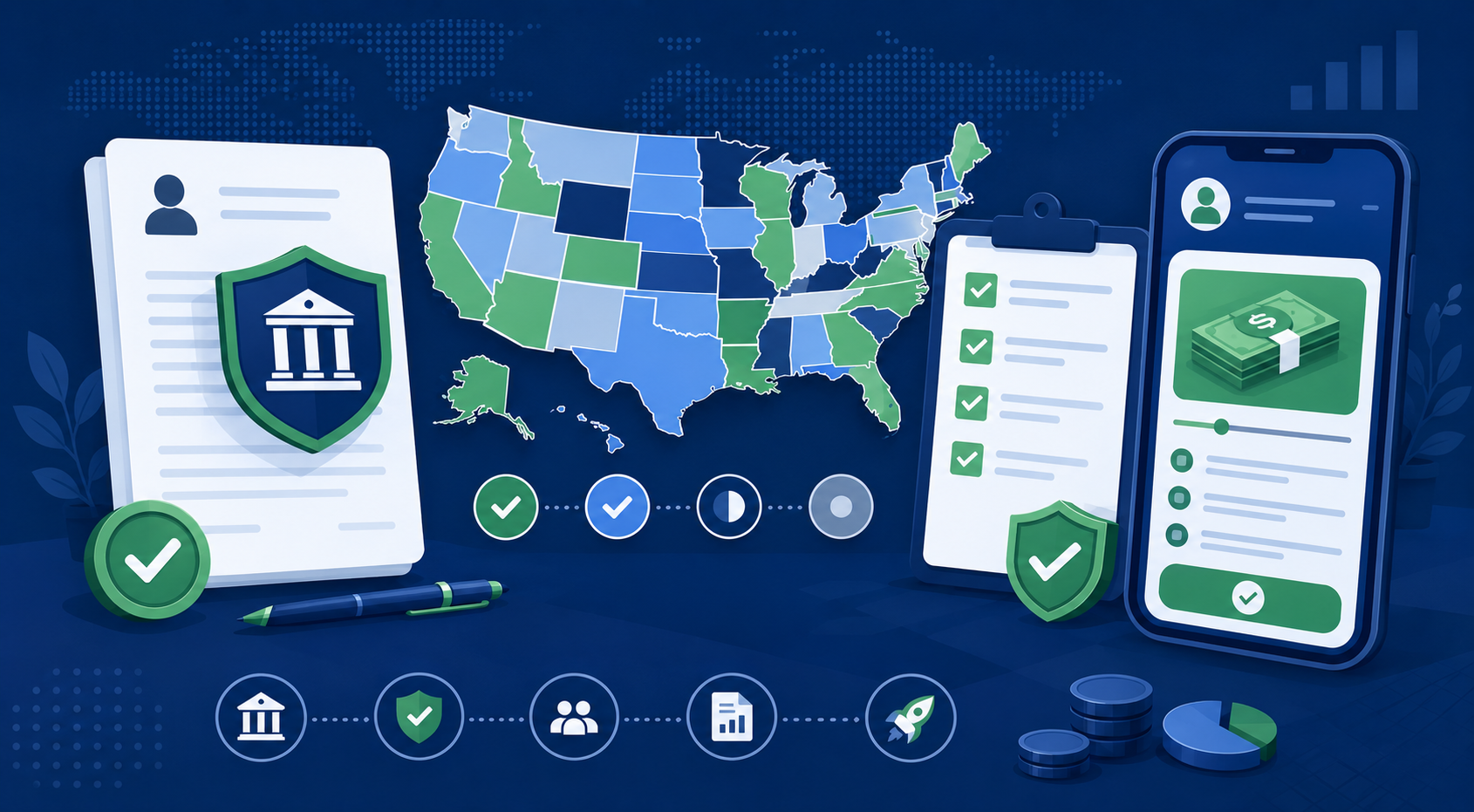
For lending fintechs pursuing a direct lending model, the state licensing strategy should prioritize states by population and by business concentration — the states where the largest numbers of target borrowers are located should typically be licensed first. A phased approach — launching in the most important states first and adding states as the business scales — is standard practice.
Building a state licensing portfolio for a national direct lending operation takes 12 to 24 months and requires sustained investment in legal and regulatory resources. For a broader framework on sequencing state licensing applications, see our guide on licensing strategy.
Frequently Asked Questions
How long does it take to get a lending license?
Processing times for state lending licenses vary by state from 30 days in some states to 6 to 12 months in others — particularly California, New York, and other states with high application volumes. Building a realistic licensing timeline that accounts for state-by-state processing is essential for launch planning.
Do I need a lending license to offer BNPL products?
Buy Now Pay Later products occupy a contested regulatory space. Some BNPL products are structured as credit sales rather than loans and may not require a traditional lending license in some states. However, the CFPB and state regulators have been increasingly active in extending consumer credit protections to BNPL, and the landscape is evolving. BNPL fintechs should get current legal analysis of their specific product before concluding that no license is required.
What happens if I lend without a required license?
Lending without a required state license exposes the fintech to significant regulatory and legal risk — including state regulatory enforcement action, civil penalties, potential loan voidability (meaning the borrower may not have to repay), and reputational consequences. Some states also have criminal penalties for unlicensed lending. The risk of operating without required licenses is not a cost of doing business — it is a potentially company-threatening compliance failure.
How ComplyOne Helps
ComplyOne helps fintech lenders navigate state licensing requirements — from conducting licensing analysis for specific product types to supporting state license applications to building the compliance programs that lending licenses require — through advisory services, compliance technology, or both.
Talk to the ComplyOne team to get started.
The information in this article is for general educational purposes and does not constitute legal or regulatory advice. Lending license requirements vary significantly by state and product type. Consult qualified legal counsel for guidance specific to your lending business model.