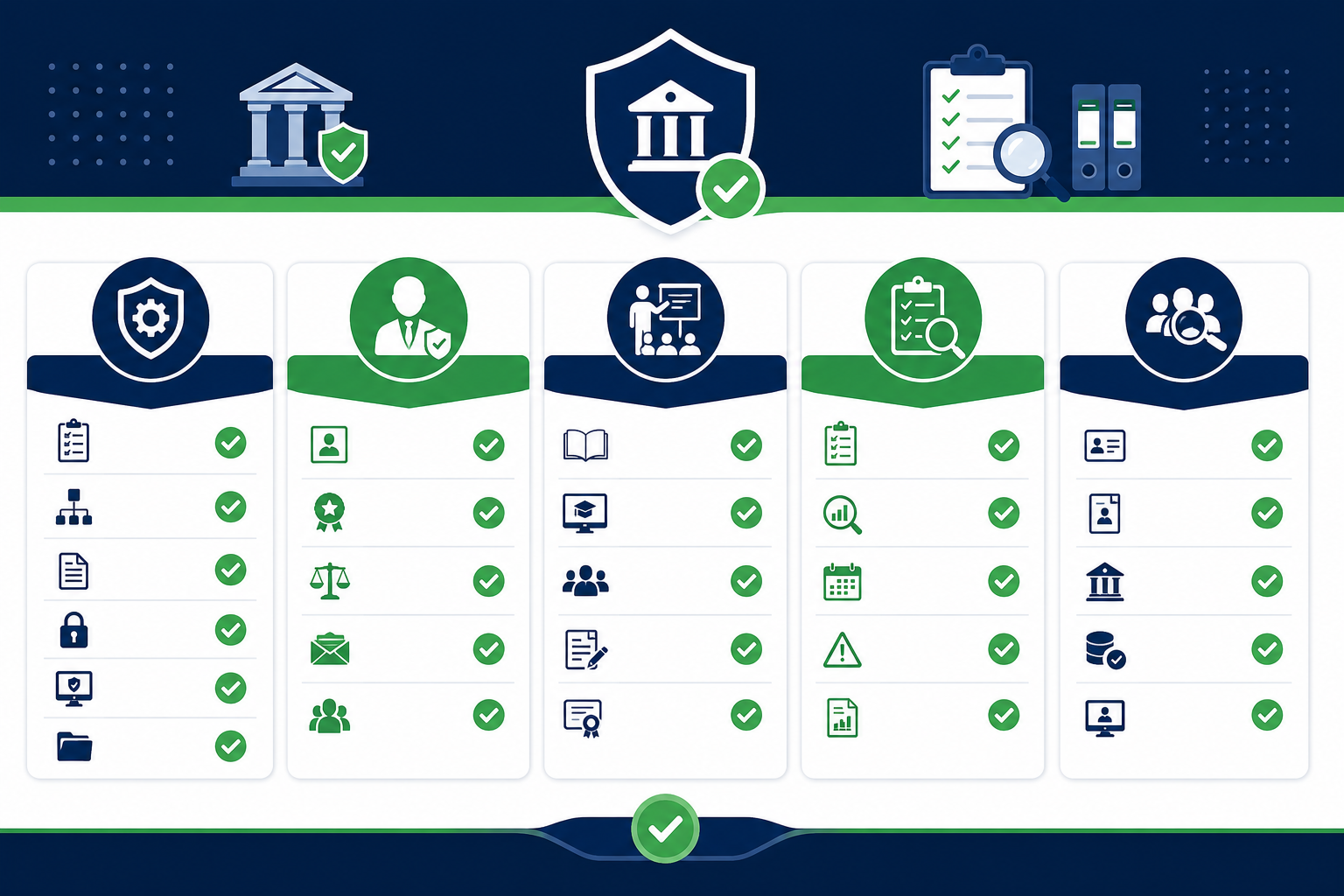
A complete AML compliance program covers five required pillars. Here is a practical checklist of everything your BSA/AML program must include — and how to confirm each element is actually operational.
AML Compliance Checklist for Fintechs: What Your Program Must Cover
A fintech's AML compliance program is only as strong as its weakest element. And the most common compliance program failures are not dramatic failures — they are quiet gaps in specific elements that look fine on paper but are missing in practice.
This checklist is designed to help you audit your own program systematically — confirming that each required element exists, is documented, and is actually operational. Use it to identify gaps before a regulator or sponsor bank does.
Pillar 1 — Internal Controls
Internal controls are the policies, procedures, and technology that form the operational backbone of your AML program.
Written AML Policy
Is your AML policy written and formally documented? Does it cover all five BSA pillars — internal controls, compliance officer, training, testing, and CDD? Is it specific to your business model — not a generic template? Has it been approved by senior management with documented evidence of that approval? Has it been reviewed in the past 12 months? Does it accurately describe how your compliance program actually operates today — not how it operated when it was written?
AML Risk Assessment
Is your AML risk assessment completed and documented? Does it cover customer risk, product and service risk, geographic risk, and delivery channel risk? Has it been updated in the past 12 months? Do your controls demonstrably reflect the risks identified in the assessment? Has it been approved by senior management?
Transaction Monitoring
Do you have a transaction monitoring program running continuously across all customer accounts and transactions? Are your monitoring rules calibrated to your specific risk profile based on your risk assessment — not just generic industry templates? Are alerts being generated and reviewed within defined SLA timelines? Is alert documentation complete for every alert reviewed — including cleared alerts? Is there a documented process connecting alerts to SAR filing when warranted? Have monitoring rules been reviewed and tuned in the past 12 months?
SAR Filing Program
Is there a documented investigation workflow for suspicious activity — from alert or referral through investigation to filing decision? Is someone specifically designated with authority to make SAR filing decisions? Are SARs being filed within the 30-day deadline consistently? Is complete investigation documentation being retained for every SAR filed and every SAR decision not to file? Is the SAR confidentiality rule communicated and understood by all relevant staff? Is your organization enrolled in FinCEN's BSA E-Filing System?
Sanctions Screening
Is OFAC SDN List screening occurring at onboarding for all new customers — before any transaction is permitted? Is ongoing screening occurring for existing customers when the SDN List is updated? Is transaction-level screening occurring for counterparties where information is available? Is your screening technology using fuzzy matching — not just exact name matching? Is there a documented hit review process with clear escalation for potential matches? Is OFAC reporting in place for blocked transactions and rejected transactions?
Recordkeeping
Are required BSA records being retained for a minimum of five years? Are customer identification records, transaction records, SAR supporting documentation, and training records all being maintained? Are records retrievable on reasonable notice for examination or law enforcement requests?
Pillar 2 — Designated Compliance Officer
Is a specific named individual designated as your BSA Officer? Is the designation documented — not just an informal understanding? Does the BSA Officer have sufficient authority to make compliance decisions? Does the BSA Officer have access to the transaction data and systems needed to perform the role? Does the BSA Officer have adequate AML expertise — through experience, certification, or both? Is senior management regularly informed of the BSA Officer's assessment of the compliance program? If your BSA Officer has changed recently, is the new designation formally documented?
Pillar 3 — Ongoing Employee Training
Is AML training conducted at least annually for all employees whose roles touch compliance-relevant functions? Is training role-specific — covering the specific compliance obligations and red flags relevant to each role? Is training completion documented — who attended, when, and what was covered? Are new hires receiving AML training before performing compliance-relevant functions? Is training content updated when regulations or internal policies change? Are training records retained and retrievable for examination?
Pillar 4 — Independent Testing
Has an independent review of your AML program been conducted within the past 12 to 18 months? Was the review conducted by someone genuinely independent of the compliance function — not the same person who runs the program? Did the review produce a written findings report? Were findings reported to senior management? Is there a formal management response to each finding with an assigned owner and remediation timeline? Are findings being tracked to completion? Is an independent review scheduled for the next 12 months?
Pillar 5 — Customer Due Diligence
Is your Customer Identification Program written and specifically covering both individual and business customers? Is identity verification actually occurring — not just information collection — for every customer? Are customer risk ratings being assigned at onboarding using defined, consistent criteria? Is your CDD program connected to your transaction monitoring — do monitoring alerts trigger customer-level CDD review when appropriate? Are periodic CDD reviews occurring on schedule for all risk tiers? Is Enhanced Due Diligence being applied to all customers meeting your defined EDD criteria? For business customers, is beneficial ownership being collected and actually verified?
After the Checklist — What to Do With Gaps
Identify every item where your honest answer is no, not consistently, or I am not sure. Each gap should be documented — what it is, how significant it is, who is responsible for addressing it, and by when.
Prioritize gaps by risk. Gaps in SAR filing, sanctions screening, and transaction monitoring create the most immediate regulatory exposure. Gaps in documentation and training, while significant, are typically less immediately dangerous.
Address gaps proactively before your next sponsor bank review, regulatory examination, or independent testing cycle. Examiners respond much more favorably to programs that identify and remediate their own gaps than to programs where gaps are discovered externally.
Frequently Asked Questions
How often should we run this checklist internally?
A full internal program review against this checklist should occur at least annually — ideally shortly before your annual independent review so you can identify and address gaps before the independent reviewer does. Some elements — SAR filing deadlines, alert review SLAs, ongoing screening — should be monitored continuously rather than only in annual reviews.
What if we find significant gaps?
Document the gaps, assign ownership, set remediation timelines, and get senior management visibility. Significant gaps should not be treated as embarrassing secrets — they are information your compliance leadership and your BSA Officer need to act on. If you are approaching a sponsor bank review or have reason to believe regulatory attention may be forthcoming, consult qualified compliance counsel about how to approach the situation.
Is this checklist sufficient for a sponsor bank review?
This checklist covers the core elements that sponsor banks evaluate. However, sponsor banks also evaluate the specific documentation supporting each element — the actual policy documents, the monitoring alert logs, the training records, the independent review report — not just whether you can answer yes to checklist questions. Use this checklist to prepare, then ensure your documentation is complete and retrievable.
How ComplyOne Helps
ComplyOne helps fintechs assess their AML compliance programs against this framework, identify and remediate gaps, and build programs that satisfy BSA requirements and pass sponsor bank and regulatory review — through advisory services, compliance technology, or both.
Talk to the ComplyOne team to get started.
The information in this article is for general educational purposes and does not constitute legal or regulatory advice. Consult a qualified compliance professional for guidance specific to your situation.