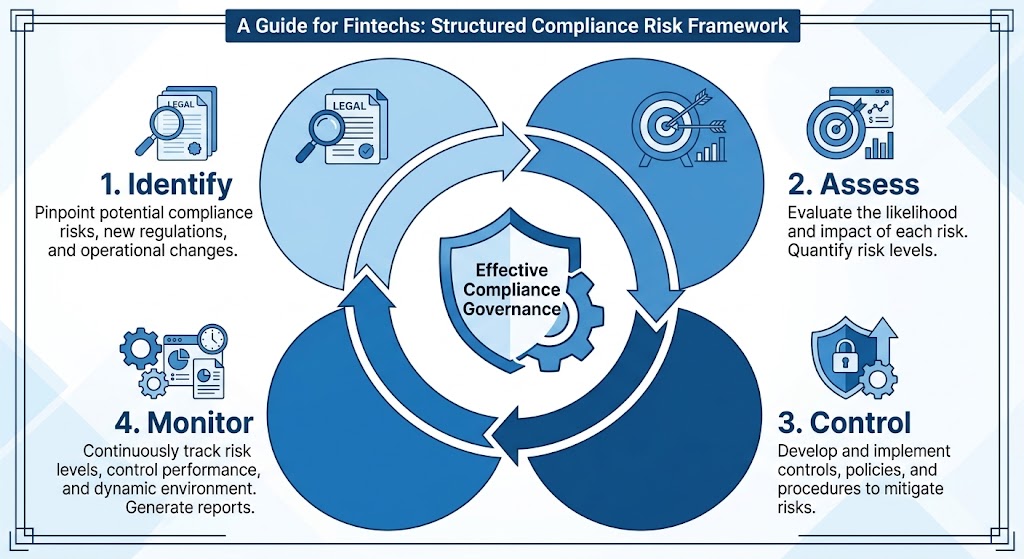
A compliance risk framework is the structured approach your fintech uses to identify, assess, manage, and monitor compliance risks across your business. This guide explains what it includes, how to build one, and why it matters.
What Is a Compliance Risk Framework? A Guide for Fintechs
A compliance program tells you what you need to do to comply with regulations. A compliance risk framework tells you how to systematically identify what could go wrong, assess the severity, put controls in place, and monitor whether those controls are working.
They're related — but the framework is what makes your compliance program defensible under scrutiny.
What Is a Compliance Risk Framework?
A compliance risk framework is a structured methodology for:
- Identifying the compliance risks your fintech faces
- Assessing the likelihood and potential impact of those risks
- Designing and implementing controls to mitigate the risks
- Monitoring whether the controls are functioning effectively
- Reporting on compliance risk status to management and the board
It's the governance architecture around your compliance program — the "how" behind your policies and procedures.
Why Fintechs Need a Compliance Risk Framework
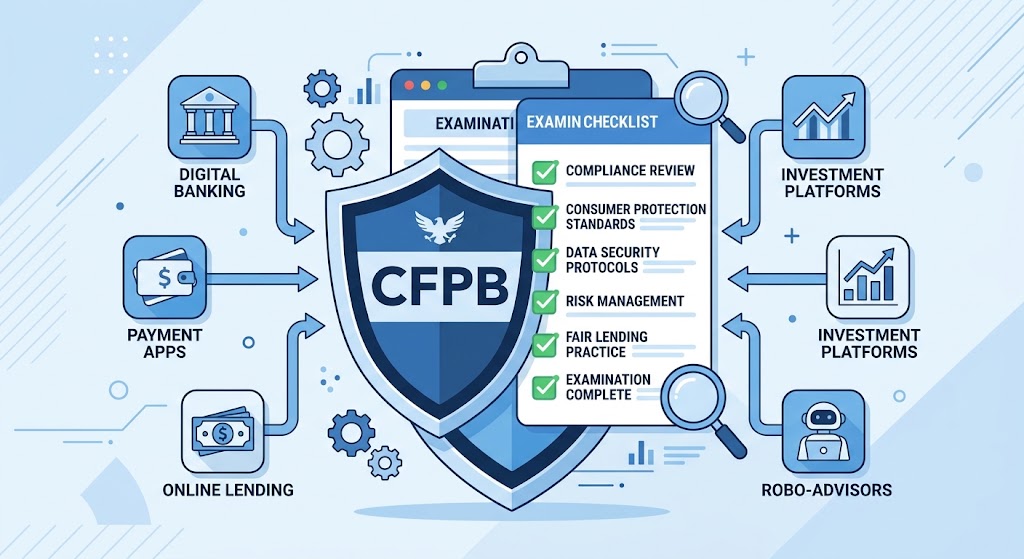
Regulators — from FinCEN to the CFPB to state banking regulators — don't just want to see that you have a compliance program. They want to see evidence that:
- You know what your risks are
- You've thought about them systematically
- You've designed controls proportionate to those risks
- You're monitoring whether the controls work
- Senior management and the board understand the risk picture
A compliance risk framework is what creates that evidence. Without it, your compliance program may be operationally sound but lacks the structured documentation that demonstrates risk-based thinking.
The Components of a Compliance Risk Framework
1. Risk Identification
The starting point: what compliance risks does your fintech face?
Risk identification should cover:
- Legal and regulatory risks — what regulations apply to your business, and what happens if you violate them? (BSA/AML, OFAC, CFPB, state licensing, etc.)
- Product and service risks — do any of your products have specific compliance obligations or heightened risks?
- Customer risks — does your customer base include higher-risk segments (MSBs, PEPs, international customers)?
- Geographic risks — do you operate in multiple states or countries with varying regulatory requirements?
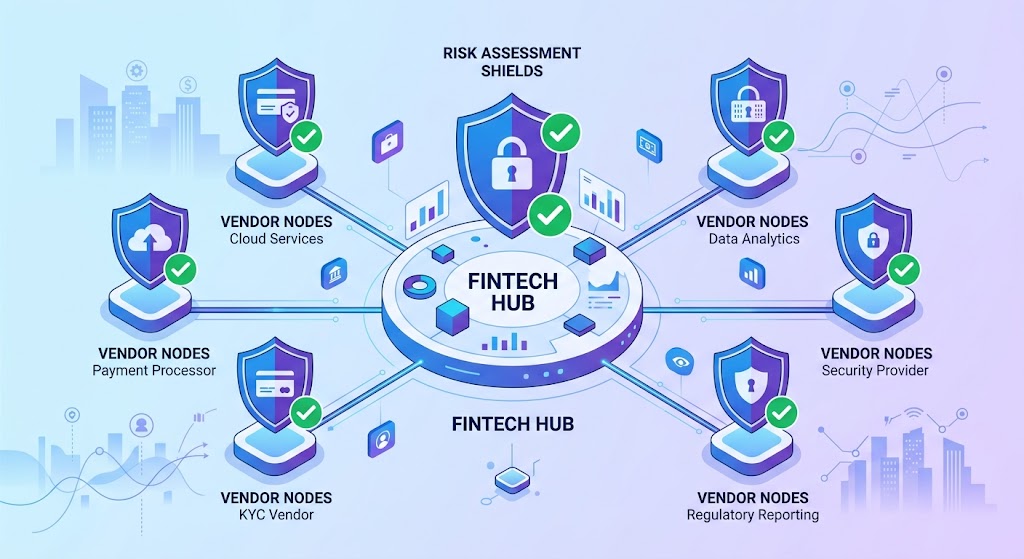
- Third-party risks — do your vendors or partners create compliance exposure?
- Operational risks — what internal failures (system outages, staff errors, data breaches) could create compliance violations?
This identification process is typically documented in a compliance risk inventory or risk register.
2. Risk Assessment
For each identified risk, assess:
- Likelihood — how probable is it that this risk event occurs? (Scale: Low / Medium / High)
- Impact — if it does occur, how severe are the consequences? (Scale: Low / Medium / High)
- Inherent risk rating — the risk level before controls are applied (Likelihood × Impact)
- Control effectiveness — how well do your existing controls mitigate the risk?
- Residual risk rating — the remaining risk level after controls are applied
The output is a risk assessment matrix or heat map that shows where your highest-residual-risk areas are.
3. Controls Design
For each material risk, design controls that reduce the risk to an acceptable level. Controls can be:
- Preventive — preventing the risk from occurring (e.g., OFAC screening before account opening prevents sanctioned parties from being onboarded)
- Detective — identifying when the risk has occurred (e.g., transaction monitoring alerts detect suspicious activity after it happens)
- Corrective — remedying the situation when a control failure is detected (e.g., SAR filing and account exit procedures)
Document each control with: what it does, who is responsible for it, and how it mitigates the associated risk.
4. Monitoring and Testing
Controls are only valuable if they work. Your framework must include:
- Periodic testing of key controls — are they functioning as designed?
- Key Risk Indicators (KRIs) — metrics that signal when a risk is increasing (e.g., transaction monitoring alert volume, false positive rate, SAR filing rate)
- Key Control Indicators (KCIs) — metrics that confirm controls are working (e.g., percentage of customers with complete KYC records, percentage of OFAC alerts resolved within SLA)
- Independent testing — an annual independent review of your overall compliance program
5. Reporting
The framework produces reports for multiple audiences:
- Compliance team — operational dashboards showing alert volumes, outstanding cases, control metrics
- Senior management — periodic summaries of the residual risk picture and any control failures
- Board — at least annual overview of compliance risk status, material issues, and remediation progress
Building a Framework as a Startup
Early-stage fintechs don't need a sophisticated enterprise risk framework from day one. A practical starting point:
- List your regulatory obligations — what laws and regulations apply to your business?
- Identify the 5–10 biggest risks — what are the most consequential things that could go wrong?
- Document the controls you have — what are you already doing to manage those risks?
- Identify the gaps — where are the biggest differences between your current controls and what you need?
- Create a remediation plan — prioritize the gaps by risk level and address them systematically
- Review annually — at minimum, review and update the framework every year
Compliance Risk Framework vs. Compliance Program
Both are needed. The compliance program is the execution layer. The risk framework is the governance layer.
Frequently Asked Questions
Is a compliance risk framework the same as an AML risk assessment?
Related but not the same. An AML risk assessment is a specific document required under BSA rules that assesses your institution's money laundering risk. A compliance risk framework is broader — it covers all compliance obligations, not just AML.
Do regulators expect to see a compliance risk framework?
Yes — particularly for more mature fintechs. In examinations, regulators will ask how you identify and manage compliance risk. The framework is your answer. Early-stage startups may have more basic documentation, but the framework should be developed as the business grows.
How often should the framework be updated?
Annually at a minimum. Significant business changes — new products, new markets, acquisitions, material staffing changes — should trigger an interim update.
This article is for educational purposes only and does not constitute legal or compliance advice. Regulations vary by jurisdiction and change frequently. Consult a qualified compliance professional or legal counsel for guidance specific to your business.