A compliance program built for a startup does not automatically scale with your business. Here is how to identify when your program needs to grow, what scaling looks like at each stage, and how to stay ahead of regulatory expectations.
How to Scale Your Fintech Compliance Program
A compliance program built for a pre-launch startup — a founder serving as BSA Officer, a basic KYC provider, a simple transaction monitoring setup — is appropriate for that stage of business. It is not appropriate for a fintech processing $50 million in transactions per month with 100,000 customers in 35 states.
The problem is that compliance programs do not automatically scale with the business. The technology you chose at launch may not be capable of handling current transaction volumes. The BSA Officer who was a founder juggling compliance alongside product and fundraising may no longer have the bandwidth for a function that has become significantly more complex. The risk assessment written two years ago may bear little resemblance to your current product set and customer base.
This guide covers how to identify when your compliance program needs to grow, what scaling looks like at each stage, and how to stay ahead of regulatory expectations rather than scrambling to catch up.
Signs Your Compliance Program Has Not Kept Pace
Several signals indicate that your compliance program is no longer appropriate for your current business stage.
Alert backlogs — if your compliance team has more monitoring alerts than they can review within your defined SLA, your program is under-resourced relative to your transaction volume. Unreviewed alerts are a BSA compliance failure — not just an operational inconvenience.
SAR filing deadlines being missed or cut close — if your team is consistently racing to file SARs within the 30-day window, your investigation capacity is insufficient for your alert volume.
Compliance documentation that does not reflect current operations — if your AML policy, risk assessment, or CDD procedures describe a business that no longer exists — old products, old customer types, old geographies — your program has fallen behind your business.
New products launched without compliance review — if your product team is launching features that affect compliance without a compliance review process, your program lacks the organizational integration it needs at growth stage.
Sponsor bank compliance reviews finding surprises — if your sponsor bank requirements reviews consistently identify gaps you were not aware of, your internal program assessment process needs strengthening.
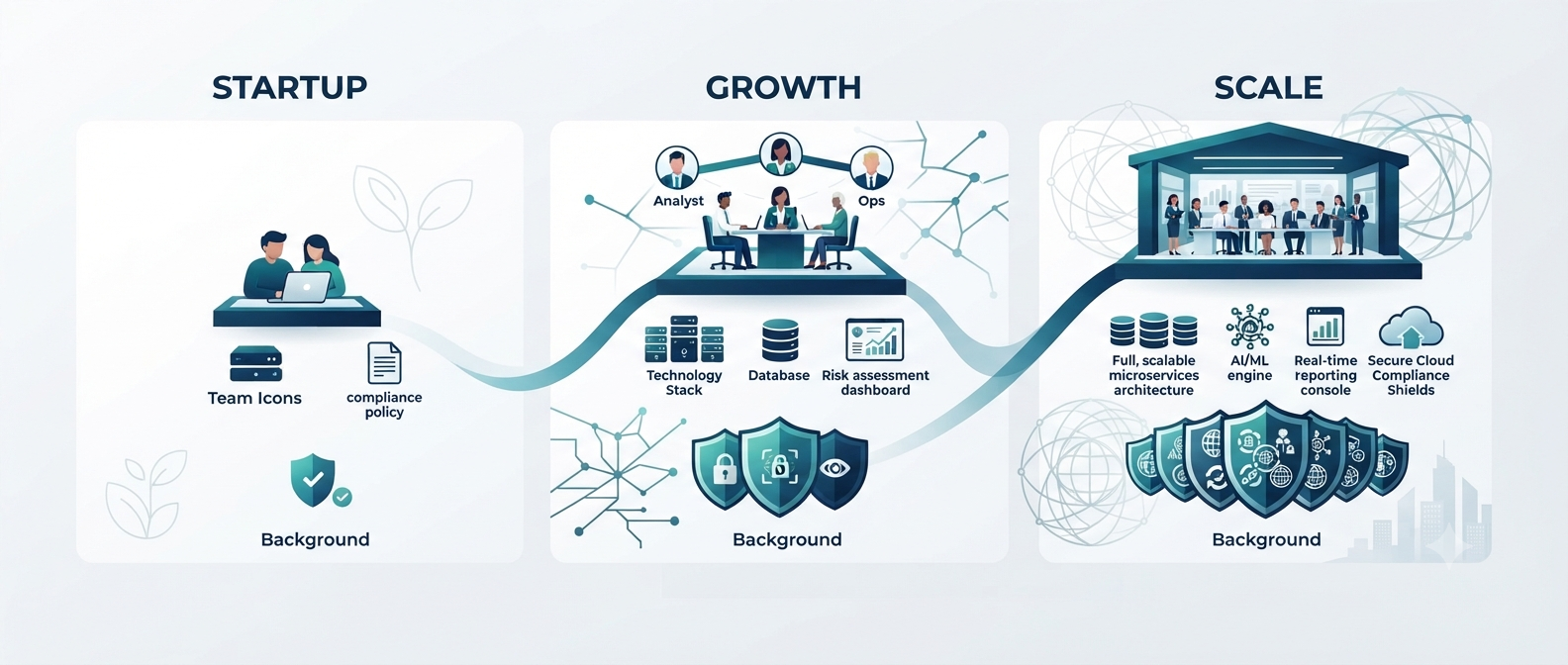
Stage 1 — Pre-Launch to Early Growth
At this stage, the compliance program is typically built and operated by a founder or small founding team. The focus is on building a functional baseline that satisfies BSA requirements and enables sponsor bank onboarding.
Key scaling indicators: You have processed your first transactions and have customers on the platform. You have gone live with your sponsor bank. You are handling a manageable but growing number of compliance events — KYC exceptions, monitoring alerts, and potentially your first SAR investigations.
What scaling looks like here: Formalizing the compliance documentation that may have been drafted quickly at launch. Conducting your first annual AML risk assessment update. Planning and scheduling your first independent AML review. Assessing whether your compliance technology is producing the audit trail and reporting your program needs.
Stage 2 — Growth Stage
At growth stage, transaction volumes and customer counts have increased significantly. The compliance program is generating meaningful alert volumes, handling regular KYC exceptions, and filing SARs with some frequency. The founder-as-BSA-Officer arrangement typically starts showing strain.
Key scaling indicators: Transaction monitoring is generating alert volumes your team struggles to review within SLA. You have hired operations staff who touch compliance-adjacent functions but may not have received adequate AML training. You are expanding into new states or adding new products that change your risk profile. Sponsor bank reviews are identifying gaps or requiring more detailed documentation.
What scaling looks like here: Hiring your first dedicated compliance professional to serve as BSA Officer or compliance analyst. Upgrading or recalibrating your transaction monitoring technology — rules that worked at lower volume may not be appropriate at higher volume. Conducting a thorough AML risk assessment update to capture new products, geographies, and customer types. Formalizing your periodic CDD review schedule and executing it systematically. Implementing a formal product compliance review process so new features go through compliance assessment before launch.
Stage 3 — Scale
At significant scale — meaningful transaction volumes, large customer bases, multi-state licensed operations — compliance is an organizational function in its own right. The program should have dedicated staffing, mature technology infrastructure, and systematic processes for every compliance function.
Key scaling indicators: Compliance is a meaningful operating cost. You have or are considering regulated entity status beyond your sponsor bank arrangement. You are subject to direct regulatory examination. You have experienced a significant compliance event — an enforcement action, a sponsor bank concern, or a SAR investigation leading to a law enforcement inquiry.
What scaling looks like here: Building a compliance team with specialized roles — compliance officers, monitoring analysts, KYC operations specialists, and potentially a regulatory affairs function. Implementing enterprise-grade compliance technology that can handle your transaction volumes, produce consistent audit trails, and support a multi-person compliance team. Conducting compliance examinations of your own program — not just waiting for external review. Building a formal regulatory change monitoring function to track and respond to developments in your applicable regulatory frameworks.
Key Compliance Scaling Decisions
When to Hire a Dedicated Compliance Professional
The triggers for a dedicated compliance hire are sustained alert volumes that exceed the founder's capacity, sponsor bank requirements for dedicated compliance resources, regulatory examination pressure, and the addition of high-risk products or geographies that require deeper compliance expertise. When these triggers appear, acting quickly rather than delaying is important — compliance gaps accumulate faster than they are resolved.
When to Upgrade Your Compliance Technology
Upgrade your compliance technology when your current platform cannot keep pace with your alert volumes or cannot produce the reporting your sponsor bank requires, when you are expanding into new products or geographies that require different monitoring rule sets, and when your audit trail completeness is insufficient for the examination standard your business now faces.
When to Formalize Your Compliance Governance
Formalize your compliance governance structure — board-level or senior management compliance reporting, a formal compliance committee or oversight function — when you reach the scale at which regulators expect institutional compliance oversight rather than individual BSA Officer oversight. This typically corresponds with the scale at which you are subject to direct regulatory examination.
Frequently Asked Questions
How do I know if my compliance program is appropriate for my current business stage?
The best way to assess this is through an independent AML review conducted by experienced compliance consultants who can evaluate your program against your current risk profile and regulatory expectations for your business type and size. An independent review provides an objective assessment that internal self-evaluation cannot replicate.
What is the biggest compliance scaling mistake fintechs make?
The most common mistake is delaying investment in compliance infrastructure until a crisis forces it — a sponsor bank concern, a regulatory inquiry, or an examination finding. Compliance programs built under pressure are consistently more expensive and less effective than programs built proactively. Anticipating scaling needs 6 to 12 months before they become critical allows for thoughtful, cost-effective program development. Learn more in our guide on fintech compliance for startups.
How should compliance program scaling be presented to investors?
Investors increasingly evaluate compliance maturity as part of their fintech due diligence. Present your compliance program scaling as infrastructure investment — similar to engineering infrastructure — that enables sustainable growth rather than growth that creates regulatory risk. A well-documented AML compliance program with a clear scaling roadmap is a positive signal to sophisticated fintech investors.
How ComplyOne Helps
ComplyOne works with fintechs at every stage of growth — helping them assess whether their compliance programs are appropriate for their current business stage, identify scaling needs before they become compliance failures, and build the infrastructure their business requires — through advisory services, compliance technology, or both.
Talk to the ComplyOne team to get started.
The information in this article is for general educational purposes and does not constitute legal or regulatory advice. Consult a qualified compliance professional for guidance specific to your situation.