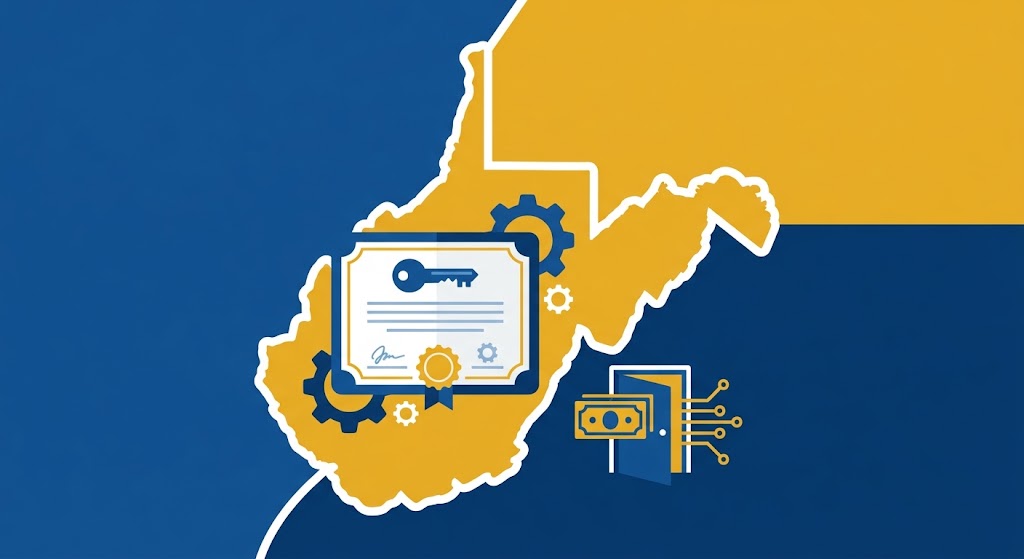
Fintechs transmitting money in West Virginia must obtain a money transmitter license from the West Virginia Division of Financial Institutions. This guide covers who needs a license, key requirements, the NMLS application process, and ongoing compliance obligations.
How to Get a Money Transmitter License in West Virginia
Fintechs that transmit money in West Virginia — whether processing consumer payments, operating digital wallets, or facilitating transfers — are generally required to obtain a money transmitter license from the West Virginia Division of Financial Institutions. West Virginia's licensing framework is governed by the West Virginia Money Services Business Act (W. Va. Code § 32A-1-1 et seq.), and applications are submitted through the Nationwide Multistate Licensing System (NMLS).
Does My Fintech Need a West Virginia Money Transmitter License?
Under the West Virginia Money Services Business Act, any person engaged in money transmission in West Virginia must be licensed. Money transmission includes receiving money or monetary value for transmission, transmitting money or monetary value by any means, and issuing payment instruments or stored value. Fintechs processing consumer payments, operating digital wallets, facilitating peer-to-peer transfers, or issuing prepaid products for West Virginia residents typically need this license.
Exemptions include banks and credit unions chartered under federal or West Virginia law, the US government and its agencies, and other specifically enumerated entities. The exemption analysis requires careful legal review.
Key Requirements for a West Virginia Money Transmitter License
What You'll Need to Apply
- Company formation documents: Articles of incorporation or organization, certificate of good standing, and operating agreement or bylaws
- Ownership and control information: Full disclosure of all direct and indirect owners and control persons
- Background checks: FBI criminal history records and credit reports for all control persons
- Financial statements: Audited or unaudited financial statements demonstrating required net worth, per Division requirements
- Business plan: Description of operations, products, anticipated transaction volumes, and compliance structure
- AML/BSA compliance program: Written Bank Secrecy Act compliance program with designated compliance officer
- Surety bond: Bond from an approved surety in the amount required by the Division
- Sample agreements: Customer agreements and, if applicable, agent agreements
The NMLS West Virginia Division of Financial Institutions checklist is the authoritative source for current required documents. Download it from mortgage.nationwidelicensingsystem.org before beginning your application.
How to Apply: Step-by-Step
- Register on NMLS: Create a company account on NMLS if not already registered
- Download the West Virginia checklist: Access Division-specific requirements from the NMLS state licensing page
- Prepare your application package: Gather all required documents, financial statements, background authorizations, and surety bond
- Submit through NMLS: Complete the NMLS company form (MU1), upload required documents, and pay applicable fees
- Respond to deficiency notices: The Division will issue deficiency notices if the application is incomplete — respond promptly
- Receive license: Upon approval, the license is issued through NMLS
Ongoing Compliance Obligations
- Annual renewal: Licenses must be renewed annually through NMLS
- Annual report: Submission of an annual report covering transaction volumes and financial condition
- Permissible investments: Maintaining permissible investments equal to outstanding consumer payment obligations
- BSA/AML compliance: Ongoing maintenance of an AML compliance program and FinCEN registration
- Change notifications: Notifying the Division through NMLS of material changes to the business
- Examination readiness: The Division may conduct periodic examinations of licensees
Multi-State Licensing Strategy
West Virginia is one of the majority of states requiring a state-level money transmitter license. See our guide on how to prioritize your state licensing applications for a framework for sequencing multi-state applications efficiently.
Frequently Asked Questions
Who is exempt from West Virginia's money transmitter license requirement?
Exemptions include banks and credit unions chartered under federal or West Virginia law, the US government and its agencies, and other specifically enumerated entities under the West Virginia Money Services Business Act. Always consult qualified legal counsel before relying on an exemption.
Can I operate in West Virginia while my application is pending?
No. West Virginia law requires a license before conducting money transmission with West Virginia consumers. See our guide on what happens if you operate without a money transmitter license.
How long does a West Virginia money transmitter license take?
Processing times vary based on application completeness and Division review volume. See our guide on how long it takes to get a money transmitter license.
Does West Virginia use NMLS for money transmitter applications?
Yes. West Virginia processes money transmitter license applications through NMLS. See our guide on what NMLS is and how it works.
This article is for educational purposes only and does not constitute legal or compliance advice. Licensing requirements are subject to change. Always verify current requirements directly with the West Virginia Division of Financial Institutions and NMLS before filing an application.