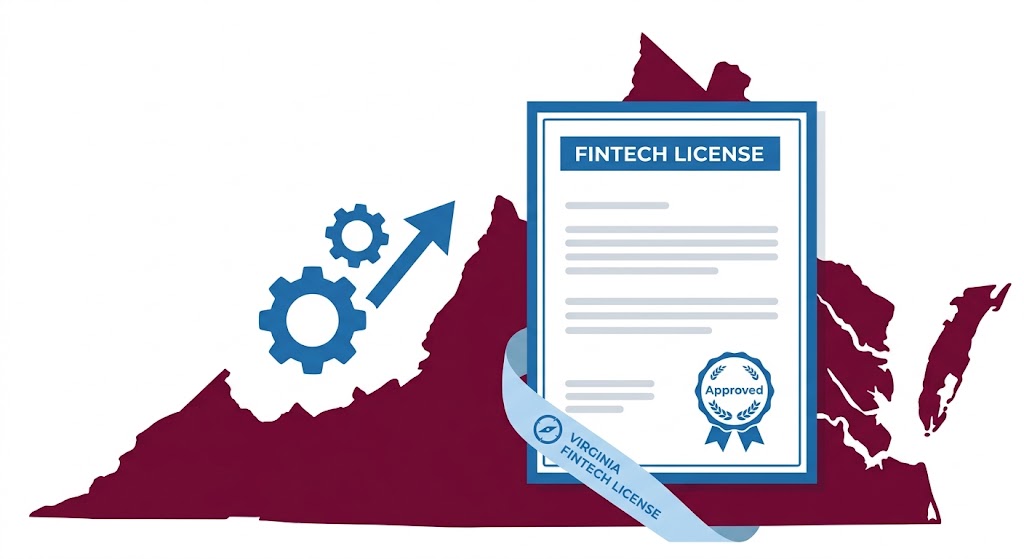
Virginia requires a Money Transmitter License from the Bureau of Financial Institutions for fintechs transmitting money in the state. This guide covers Virginia's requirements, fees, bond amounts, and the full NMLS application process.
How to Get a Money Transmitter License in Virginia
Virginia is one of the most strategically important states for fintech licensing — home to Northern Virginia's technology corridor, a major banking sector, and significant payment processing activity. If you transmit money in Virginia, here's what you need.
Does My Fintech Need a Virginia Money Transmitter License?
Under the Virginia Money Transmitters Act (Va. Code § 6.2-1900 et seq.), any person or entity engaged in the business of money transmission in Virginia must be licensed by the Virginia Bureau of Financial Institutions (BFI), a division of the State Corporation Commission (SCC).
Standard bank and credit union exemptions apply.
Key Requirements at a Glance
Virginia is considered one of the more efficient states for money transmitter licensing — processing times are often faster than larger states.
What You'll Need to Apply
Business Documentation
- Certificate of good standing
- Articles of incorporation or organization
- Organizational chart and ownership list
- Three years of financial statements (audited preferred)
- Business plan with projected Virginia transaction volume
- Description of money transmission services
Individual Background Checks
Controlling persons must complete MU2 forms and submit fingerprints. Virginia requires background checks on all principals.
Surety Bond
Virginia uses a tiered bond structure starting at $50,000, scaling up based on your outstanding Virginia transmission liabilities. The bond must name the Commonwealth of Virginia as obligee.
AML Compliance Program
Submit your written AML/BSA compliance program with your application.
How to Apply Through NMLS
- Create or log in to your NMLS account
- Complete MU1 and MU2 forms
- Upload Virginia-specific required documents
- Submit fingerprints
- Pay the application fee
- Monitor for BFI deficiency letters
Virginia's Fintech-Friendly Regulatory Environment
Virginia's SCC/BFI is generally considered to have a responsive and efficient licensing process compared to other states. The state has also been proactive about engaging with fintech companies and offering regulatory clarity — making it a relatively straightforward licensing experience.
Ongoing Compliance After Approval
- Annual renewal through NMLS
- Annual reporting of Virginia transmission volumes
- Bond maintenance — update if volume tier changes
- Material change notifications to BFI
- Examinations — BFI conducts periodic reviews
Frequently Asked Questions
Is Virginia a good first state to license in?
Virginia is often included in the first tier of MTL applications due to its relatively reasonable requirements and faster processing times. It's particularly important for fintechs with a Mid-Atlantic or East Coast focus.
Does Virginia have crypto licensing requirements?
Virginia applies its money transmitter laws to fiat-involving cryptocurrency activities. Pure virtual currency exchanges without fiat conversion may be treated differently — confirm with BFI or legal counsel.
This article is for educational purposes only. Verify current requirements directly with the Virginia BFI/SCC and on NMLS before filing.