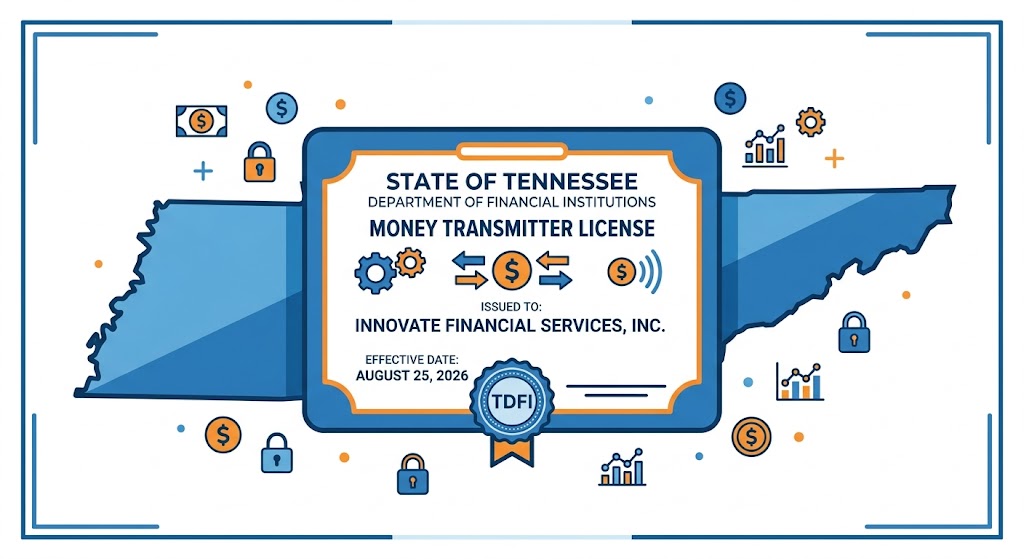
Tennessee requires a Money Transmitter License from the Department of Financial Institutions for fintechs transmitting money in the state. This guide covers Tennessee's requirements, fees, bond amounts, and the full application process.
How to Get a Money Transmitter License in Tennessee
Tennessee is a growing financial services and fintech market — Nashville in particular has emerged as a significant hub for financial technology companies. If your fintech transmits money in Tennessee, you need a state license.
Does My Fintech Need a Tennessee Money Transmitter License?
Under Tennessee's Money Transmitter Act (Tenn. Code Ann. § 45-7-201 et seq.), any person or entity engaged in the business of money transmission in Tennessee must be licensed by the Tennessee Department of Financial Institutions (TDFI). Money transmission includes receiving money for transmission, transmitting money by any means, and issuing payment instruments.
Standard exemptions apply for banks and other regulated entities.
Key Requirements at a Glance
Tennessee is generally considered one of the more accessible Southern states for money transmitter licensing.
What You'll Need to Apply
Business Documentation
- Certificate of good standing
- Articles of incorporation or organization
- Organizational chart and ownership list
- Financial statements (audited preferred)
- Business plan with projected Tennessee transaction volume
Individual Background Checks
Controlling persons must complete MU2 forms and submit fingerprints.
Surety Bond
A minimum $25,000 surety bond naming the State of Tennessee as obligee. The bond scales with your outstanding Tennessee liabilities.
AML Compliance Program
Submit your written AML/BSA compliance program.
How to Apply Through NMLS
Tennessee uses NMLS. Complete MU1/MU2 forms, upload required documents, submit fingerprints, and pay the application fee.
Tennessee in a Multi-State Licensing Strategy
Tennessee is typically included in a second or third phase of a national licensing rollout, particularly for fintechs focused on the Southeast. The relatively low bond requirement and faster processing time make it one of the more accessible Southern licenses.
Frequently Asked Questions
Is Tennessee crypto-friendly for licensing?
Tennessee has taken a relatively open approach to fintech and cryptocurrency. The state does not have standalone crypto-specific licensing separate from its money transmitter framework. Consult TDFI and legal counsel for guidance on your specific activities.
How does Tennessee compare to neighboring states?
Tennessee is generally more accessible than Florida or Georgia in terms of net worth and bond requirements, but similar in processing time. It's a good licensing target for Southeastern expansion.
This article is for educational purposes only. Verify current requirements directly with the Tennessee TDFI and on NMLS before filing.