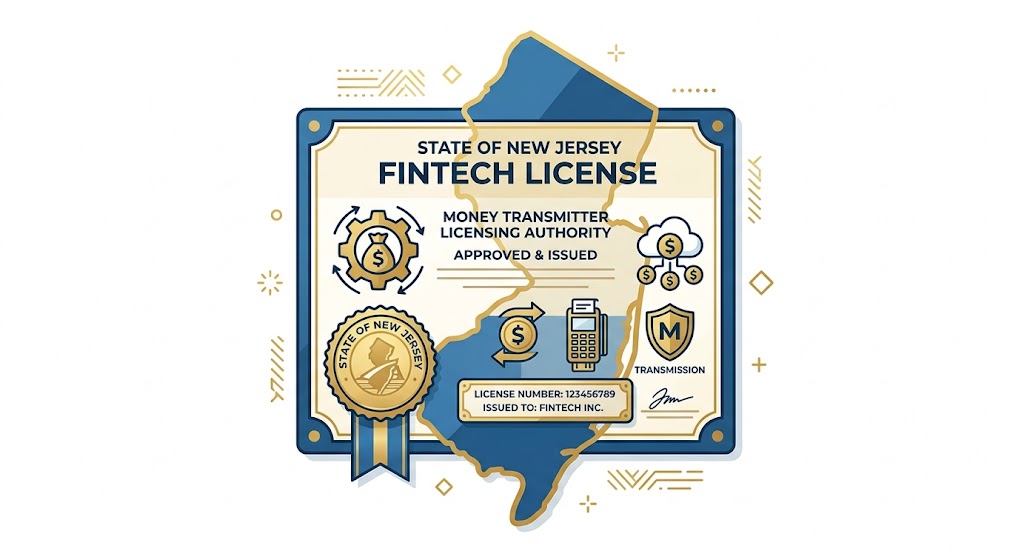
New Jersey requires a Money Transmitter License from the Department of Banking and Insurance for fintechs transmitting money in the state. This guide covers requirements, bond amounts, fees, and the full NMLS application process.
How to Get a Money Transmitter License in New Jersey
New Jersey is a major financial services market with proximity to New York — and one of the more demanding states for money transmitter licensing. If your fintech transmits money in New Jersey, here's exactly what you need.
Does My Fintech Need a New Jersey Money Transmitter License?
Under the New Jersey Money Transmitters Act (N.J.S.A. 17:15C), any person or entity engaged in money transmission in New Jersey must be licensed by the New Jersey Department of Banking and Insurance (DOBI). Money transmission includes receiving money for transmission, transmitting money by any means, and issuing payment instruments or stored value.
Exemptions include banks, credit unions, and other specifically regulated entities. Most fintech payment companies serving New Jersey residents require this license.
Key Requirements at a Glance
New Jersey is one of the slower-processing states — plan your timeline accordingly, especially if you need to be live in New Jersey by a specific date.
What You'll Need to Apply
Business Documentation
- Certificate of good standing from your home state
- Articles of incorporation or organization
- Organizational chart and complete ownership list
- List of all officers, directors, and shareholders owning 10%+
- Three years of audited financial statements (or from inception)
- Business plan with projected New Jersey transaction volume
- Description of money transmission products and services
Individual Background Checks
All principals and controlling persons must complete MU2 individual forms in NMLS and submit fingerprints for federal and state criminal background checks.
Surety Bond
New Jersey requires a minimum $150,000 surety bond — one of the higher minimums nationally. The bond must name the State of New Jersey as obligee. The required amount may increase based on your outstanding New Jersey liabilities.
Net Worth Documentation
$100,000 in tangible net worth, verified through audited financial statements.
AML Compliance Program
New Jersey DOBI reviews your AML/BSA compliance program as part of the application. Submit your full written AML policy, CIP procedures, and transaction monitoring program.
How to Apply Through NMLS
- Create or log in to your NMLS account
- Complete MU1 (company) and MU2 (individual) forms
- Upload all New Jersey-specific required documents
- Submit fingerprints through an NMLS-approved vendor
- Pay the application fee
- Monitor for DOBI deficiency letters — respond within the required timeframes
New Jersey DOBI is known for detailed application reviews. Ensure every section of your application is complete before submission to minimize deficiency requests.
Ongoing Compliance After Approval
- Annual license renewal through NMLS
- Annual financial reporting to DOBI
- Bond maintenance — must remain in force and updated if volume increases
- Material change notifications within required timeframes
- Periodic examinations by DOBI
Frequently Asked Questions
Why is New Jersey's processing time so long?
DOBI conducts thorough reviews including financial analysis, background checks, and AML program assessment. Complex ownership structures or incomplete applications extend the timeline. Submit a complete, organized application from the start.
Does New Jersey have crypto-specific licensing?
New Jersey applies its money transmitter laws to fiat-involving cryptocurrency transactions. Consult DOBI guidance and legal counsel for current requirements specific to your business model.
What happens if I serve New Jersey customers without a license?
Operating as an unlicensed money transmitter in New Jersey is a criminal offense under the Money Transmitters Act and can result in significant penalties.
This article is for educational purposes only and does not constitute legal or compliance advice. Licensing requirements change. Verify current requirements directly with the New Jersey DOBI and on NMLS before filing.