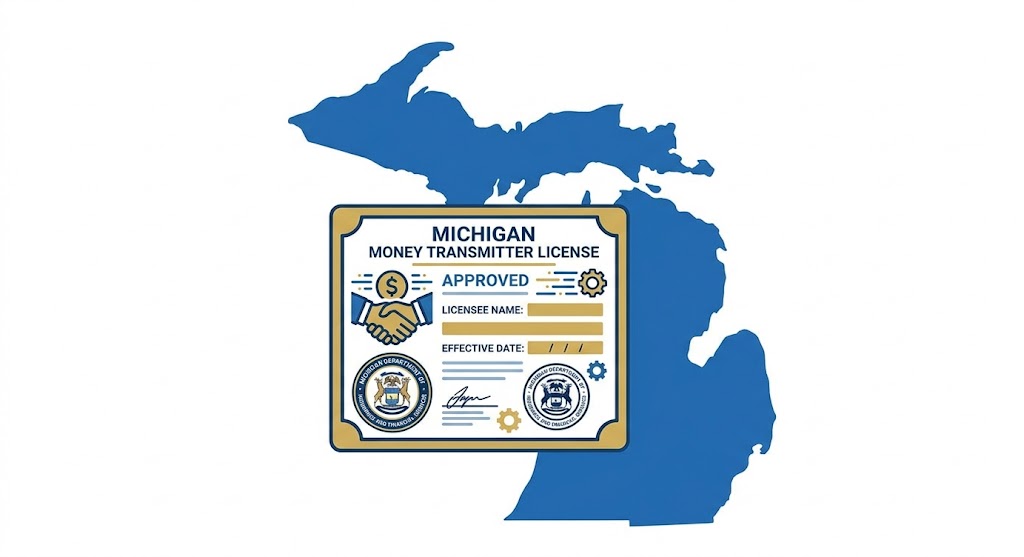
Michigan requires a Money Transmitter License from the Department of Insurance and Financial Services for fintechs transmitting money in the state. This guide covers requirements, fees, bond amounts, and the full NMLS application process.
How to Get a Money Transmitter License in Michigan
Michigan is the tenth most populous state and an important market for fintechs with Midwest distribution. The state administers money transmitter licensing through the Michigan Department of Insurance and Financial Services (DIFS). Here's what you need to know.
Does My Fintech Need a Michigan Money Transmitter License?
Under Michigan's Money Transmission Services Act (MCL 487.1001 et seq.), any person or entity engaged in money transmission in Michigan must be licensed by DIFS. Money transmission includes receiving money for the purpose of transmission, transmitting money by any means, and issuing payment instruments or stored value.
Standard exemptions apply for banks, credit unions, and other regulated entities.
Key Requirements at a Glance
What You'll Need to Apply
Business Documentation
- Certificate of good standing
- Articles of incorporation or organization
- Organizational chart and ownership structure
- Three years of audited financial statements
- Business plan with projected Michigan transaction volume
- Description of money transmission products
Individual Background Checks
All principals and controlling persons must complete MU2 forms and submit fingerprints for background checks.
Surety Bond
Michigan requires a minimum $100,000 surety bond naming the State of Michigan as obligee. The required amount may increase based on your Michigan outstanding liabilities.
Net Worth Documentation
Minimum $100,000 tangible net worth, verified through audited financial statements.
AML Compliance Program
Submit your written AML/BSA compliance program.
How to Apply Through NMLS
- Create or log in to your NMLS account
- Complete MU1 and MU2 forms
- Upload Michigan-specific required documents
- Submit fingerprints
- Pay the application fee
- Respond promptly to DIFS deficiency letters
Ongoing Compliance After Approval
- Annual license renewal through NMLS
- Annual financial reporting to DIFS
- Bond maintenance
- Material change notifications
- Periodic DIFS examinations
Frequently Asked Questions
Does Michigan have crypto-specific licensing requirements?
Michigan applies existing money transmission laws to fiat-involving cryptocurrency transactions. Consult DIFS guidance and legal counsel for current requirements.
How does Michigan compare to neighboring states in terms of requirements?
Michigan's requirements ($100,000 net worth and $100,000 bond) are mid-tier — more demanding than some Midwest states but significantly less than Pennsylvania or Texas. Processing times are reasonable at 90–180 days.
This article is for educational purposes only. Verify current requirements directly with Michigan DIFS and on NMLS before filing.