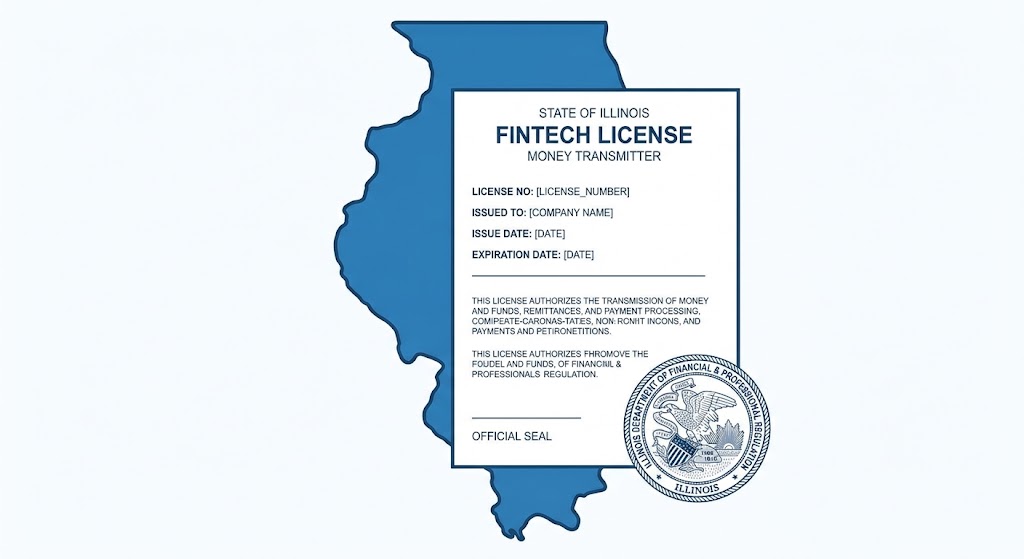
Illinois requires a Transmitter of Money license from the IDFPR to legally transmit money in the state. This guide covers the requirements, fees, bond amounts, and application process step by step.
How to Get a Money Transmitter License in Illinois
If your fintech transmits money in Illinois — through ACH transfers, payment processing, digital wallets, or remittances — you need a state license before you can legally operate.
Illinois calls it the Transmitter of Money license, and it's administered by the Illinois Department of Financial and Professional Regulation (IDFPR).
Does My Fintech Need an Illinois Money Transmitter License?
Under the Illinois Transmitters of Money Act, any person or entity that engages in the business of transmitting money for a fee — receiving money in Illinois for transmission or transmitting money from Illinois — is required to be licensed. Common business types that need this license include payment processors, digital wallet providers, remittance companies, peer-to-peer payment platforms, crypto exchanges, and BaaS fintechs processing payments for Illinois residents.
Key Requirements at a Glance
What You'll Need to Apply
Business Documentation
Articles of incorporation or organization, certificate of good standing from your home state, list of officers and directors, organizational chart, three years of audited financial statements, and a business plan including projected transaction volumes by state.
Individual Disclosures
Illinois requires background checks and fingerprinting for all principals, key shareholders (typically 10%+ ownership), and executives. Each person must complete an Individual (MU2) form in NMLS.
Surety Bond
Illinois requires a surety bond of at least $100,000. The bond amount may be increased based on projected Illinois transaction volume.
AML/BSA Compliance Program
You must submit a written AML compliance program, including your BSA policies, CIP procedures, transaction monitoring program, and SAR filing process.
How to Apply Through NMLS
- Create an NMLS account at mortgage.nationwidelicensingsystem.org
- Complete the Company (MU1) form — your company's primary application
- Complete Individual (MU2) forms for all required principals
- Submit Illinois-specific documents — financial statements, AML program, business plan
- Submit fingerprints for background checks
- Pay the application fee
- Monitor your application through NMLS for any deficiency requests from IDFPR
How Long Does It Take?
Illinois money transmitter license applications typically take 6–12 months from submission to approval, depending on application completeness and IDFPR's current workload.
Ongoing Compliance After Approval
Once licensed, maintain your Illinois license by renewing annually through NMLS, filing quarterly or annual reports of Illinois transaction volume, maintaining your surety bond, updating your NMLS record if key personnel or business details change, and preparing for periodic examinations by IDFPR.
How Illinois Fits Into a Multi-State Strategy
Illinois is one of the most significant states for money transmitter licensing given Chicago's role as a major financial center. Also see our guide on FinCEN MSB registration to ensure your federal obligations are covered.
Frequently Asked Questions
Do I need an Illinois MTL if I'm already licensed in another state?
Yes. Illinois does not have a reciprocity agreement with other states. If you transmit money in Illinois, you need an Illinois license regardless of what other state licenses you hold.
Can I operate in Illinois while my application is pending?
Generally, no. You should not transmit money in Illinois until your license is approved.
What is the difference between the Illinois MTL and FinCEN MSB registration?
FinCEN MSB registration is a federal requirement. The Illinois MTL is a state requirement. You need both if you're operating in Illinois as an MSB.
This article is for educational purposes only and does not constitute legal or compliance advice. Licensing requirements change. Verify current requirements directly with IDFPR and on NMLS before filing your application.