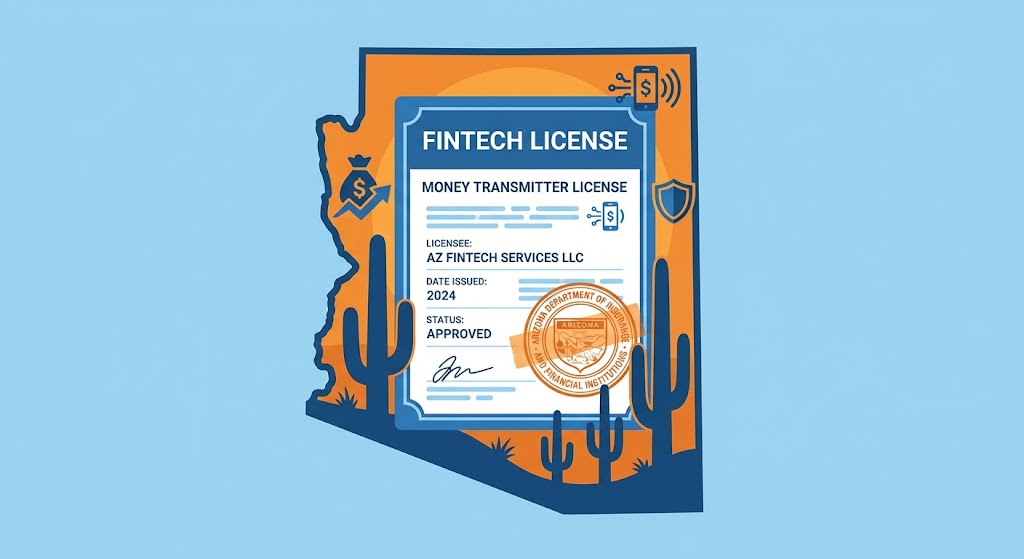
Arizona requires a Money Transmitter License from the Department of Insurance and Financial Institutions for fintechs transmitting money in the state. This guide covers requirements, fees, and the full application process.
How to Get a Money Transmitter License in Arizona
Arizona is a growing technology and financial services market — home to a significant fintech community and increasingly a destination for businesses expanding into the Southwest. If your fintech transmits money in Arizona, you need a state license.
Does My Fintech Need an Arizona Money Transmitter License?
Under Arizona Revised Statutes Title 6, Chapter 12 (Money Transmission), any person or entity engaging in money transmission in Arizona must be licensed by the Arizona Department of Insurance and Financial Institutions (DIFI).
Money transmission in Arizona includes receiving money for the purpose of transmitting it to another location, transmitting money by electronic means, and issuing payment instruments or stored value.
Exemptions include banks, credit unions, and certain other specifically regulated entities. Most fintech payment companies operating in Arizona need this license.
Key Requirements at a Glance
Arizona's net worth and bond minimums are lower than some states, making it a relatively accessible license — though DIFI conducts thorough reviews.
What You'll Need to Apply
Business Documentation
- Certificate of good standing
- Articles of incorporation or organization
- Organizational chart and ownership list
- Financial statements (audited or reviewed; from inception for newer companies)
- Business plan with projected Arizona transaction volume
- Description of money transmission products and services
Individual Background Checks
Principals and controlling persons must complete MU2 forms in NMLS and submit fingerprints for background checks.
Surety Bond
A minimum $25,000 surety bond naming the State of Arizona as obligee. DIFI may require a higher bond amount based on your outstanding liabilities.
Net Worth Documentation
Minimum $25,000 tangible net worth, verified through financial statements.
AML Compliance Program
Submit your written AML/BSA compliance program.
How to Apply Through NMLS
Arizona uses NMLS:
- Create or log in to your NMLS account
- Complete MU1 (company) and MU2 (individual) forms
- Upload Arizona-specific required documents
- Submit fingerprints
- Pay the application fee
- Monitor for DIFI deficiency notices and respond promptly
Arizona's Regulatory Sandbox
Arizona was the first US state to establish a formal fintech regulatory sandbox (2018), allowing qualifying fintechs to test innovative financial products with real consumers under reduced regulatory requirements. If you're launching an innovative product that may not fit neatly into existing license categories, Arizona's sandbox program is worth exploring.
Ongoing Compliance After Approval
- Annual license renewal through NMLS
- Annual reporting of Arizona transaction volumes and outstanding liabilities
- Bond maintenance
- Material change notifications to DIFI
- Examination readiness — DIFI conducts periodic examinations
Frequently Asked Questions
Is Arizona's regulatory sandbox an alternative to getting a money transmitter license?
The sandbox is an alternative for testing purposes, with a limited number of customers. Once you scale beyond the sandbox parameters, you need a full license. Most fintechs use the sandbox during early product development and then transition to a full license.
Does Arizona have crypto-specific licensing?
Arizona has been relatively open to crypto and has not enacted standalone crypto licensing laws separate from existing money transmission requirements. Consult DIFI guidance and legal counsel for your specific activities.
How does Arizona compare to other Western states for licensing?
Arizona is one of the more accessible Western states to license — lower net worth and bond requirements than California, Nevada, or Washington State, with processing times that are typically faster than the largest states.
This article is for educational purposes only and does not constitute legal or compliance advice. Licensing requirements change. Verify current requirements directly with Arizona DIFI and on NMLS before filing.