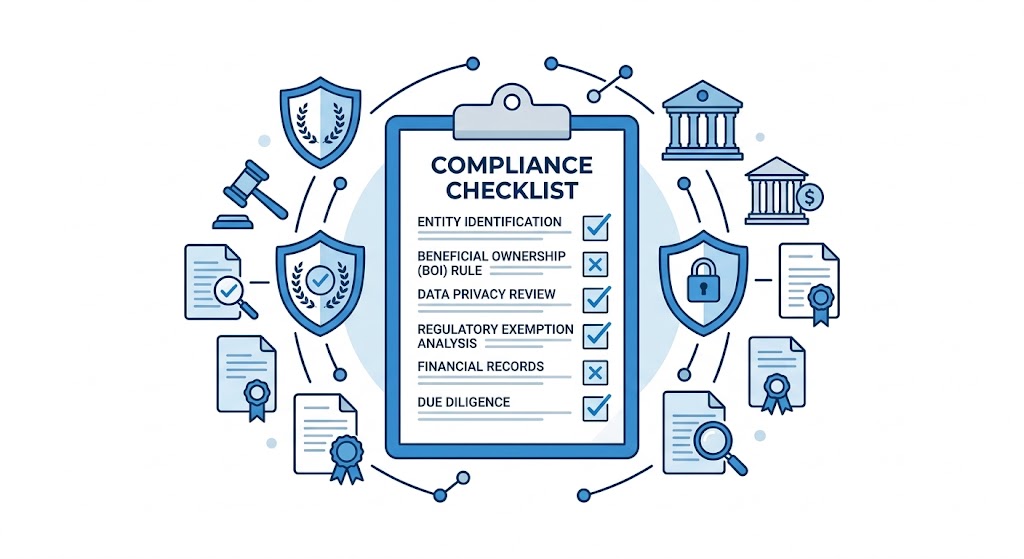
Not every company is required to file a BOI report with FinCEN. The Corporate Transparency Act has 23 exemption categories. This guide explains who qualifies, how to determine your status, and the key exemptions relevant to fintechs.
Corporate Transparency Act Exemptions — Who Doesn't Need to File a BOI Report?
The Corporate Transparency Act (CTA) requires most US companies to file Beneficial Ownership Information (BOI) reports with FinCEN. But not every company is a "reporting company." The CTA includes 23 exemption categories — and understanding whether your fintech qualifies could mean the difference between a significant compliance obligation and no obligation at all.
The 23 CTA Exemption Categories
FinCEN has identified the following categories of entities that are exempt from BOI reporting requirements:
- Securities reporting issuers
- Governmental authorities
- Banks
- Credit unions
- Depository institution holding companies
- Money services businesses (registered with FinCEN)
- Brokers or dealers in securities
- Securities exchange or clearing agencies
- Other Exchange Act registered entities
- Investment companies or investment advisers
- Venture capital fund advisers
- Insurance companies
- State-licensed insurance producers
- Commodity Exchange Act registered entities
- Accounting firms
- Public utilities
- Financial market utilities
- Pooled investment vehicles
- Tax-exempt entities
- Entity assisting a tax-exempt entity
- Large operating companies
- Subsidiaries of certain exempt entities
- Inactive entities
The Most Relevant Exemptions for Fintechs
Exemption 6: Money Services Businesses
This is a critical one for the fintech space. An entity that is registered with FinCEN as a money services business is exempt from BOI reporting. This means that if your fintech is registered with FinCEN as an MSB, you may be exempt.
Key nuance: The exemption applies specifically to MSBs as defined in FinCEN's regulations. Not all fintechs that process payments are MSBs — only those that meet FinCEN's specific definition and are registered. Verify your MSB status before claiming this exemption.
Exemption 21: Large Operating Companies
A company qualifies for this exemption if it meets all three of these criteria:
- More than 20 full-time employees in the United States
- More than $5 million in gross receipts or sales (as reported on the prior year's federal tax return)
- A physical operating presence at an office or location in the United States
Important: All three criteria must be met simultaneously. Most early-stage fintechs don't qualify for this exemption.
Exemption 22: Subsidiaries of Certain Exempt Entities
A subsidiary is exempt if its ownership interests are entirely controlled or wholly owned, directly or indirectly, by one or more exempt entities. However, subsidiaries of large operating companies are not automatically exempt — only subsidiaries of certain specific exempt categories.
Exemption 23: Inactive Entities
An entity is exempt if it: was in existence on or before January 1, 2020; is not engaged in active business; is not owned by a foreign person; has not experienced a change in ownership in the past 12 months; has not sent or received funds of more than $1,000 in the past 12 months; and does not hold any assets (including interests in other entities). This applies to dormant shell companies, not operating businesses.
Regulated Financial Institution Exemptions
The following financial entities are fully exempt from BOI reporting because they are already subject to substantial federal regulatory oversight:
- Banks supervised by the OCC, FDIC, or Federal Reserve
- Federally or state-chartered credit unions
- Bank holding companies
- Broker-dealers registered with the SEC
- Registered investment advisers and investment companies
- Insurance companies
A fintech that holds a bank charter, or whose parent is a bank holding company, may qualify. Most non-bank fintechs do not qualify under these categories.
What If You're Unsure Whether You Qualify?
The consequences of incorrectly claiming an exemption are serious — willful failure to file when required can result in civil penalties and criminal liability. If you're uncertain whether your fintech qualifies for an exemption:
- Review the FinCEN Small Entity Compliance Guide, available at fincen.gov
- Review the specific statutory language for each exemption category
- Consult with a qualified attorney who specializes in financial regulatory compliance
When in doubt, filing is the safer path.
Frequently Asked Questions
If I qualify for an exemption, do I need to notify FinCEN?
No. You do not file anything with FinCEN to claim an exemption — you simply don't file a BOI report. However, document your exemption analysis in case it is ever questioned.
What if my exemption status changes?
If you previously qualified for an exemption and no longer do (for example, your FinCEN MSB registration lapses), you must file a BOI report within 30 days of the change in status.
Does the MSB exemption cover all types of MSBs?
The exemption applies to entities registered with FinCEN as money services businesses. Check current FinCEN guidance to confirm which specific MSB categories qualify and ensure your registration is current.
This article is for educational purposes only and does not constitute legal or compliance advice. BOI reporting rules have been subject to litigation and regulatory changes — always verify current requirements at fincen.gov or with qualified legal counsel.