Wire transfers are one of the most closely regulated activities under the Bank Secrecy Act. Fintechs that originate, process, or facilitate wire transfers must comply with the BSA's Travel Rule, recordkeeping requirements, and transaction monitoring obligations. This guide explains what's required and why it matters.
Wire Transfer Compliance: BSA Requirements for Fintechs
Wire transfers are one of the highest-risk payment methods from an anti-money laundering perspective — they move large sums of money rapidly across institutions and jurisdictions, often with limited time for review before funds are gone. For this reason, the Bank Secrecy Act (BSA) imposes specific and detailed compliance requirements on any financial institution or money services business that originates, processes, or benefits from wire transfers.
If your fintech touches wire transfers in any way — as an originating institution, intermediary, or beneficiary institution — you need to understand these rules. This guide explains what the BSA requires and how to build compliance into your wire transfer operations.
What Is a Wire Transfer Under the BSA?
For BSA purposes, a wire transfer is a transaction carried out by a financial institution on behalf of a person (the sender) through a fund transfer system (such as Fedwire, CHIPS, or SWIFT) by which a specified amount is transferred to a beneficiary at a different financial institution.
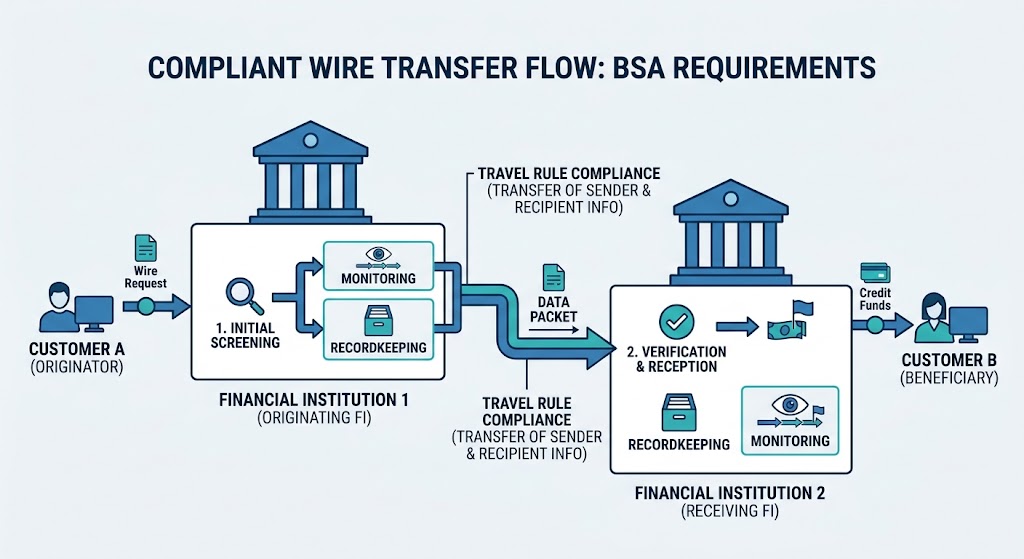
The BSA defines specific terms: the "transmittor" is the sender, the "originator's financial institution" is the bank or money services business that initiates the transfer, "intermediary financial institutions" handle the transfer in transit, and the "beneficiary's financial institution" is the receiving institution.
Wire transfer rules apply to both US domestic wires and cross-border international wire transfers. Cross-border transfers face additional scrutiny and reporting requirements.
The BSA Travel Rule for Wire Transfers
The Travel Rule (31 CFR 1010.410(f)) is the core wire transfer compliance requirement under the BSA. It requires that financial institutions and money services businesses pass along specific information about the sender and recipient when a wire transfer of $3,000 or more is made.
What Information Must Travel with the Wire?
When a wire transfer of $3,000 or more is ordered, the originating financial institution must include the following information in the transmission order:
- The name of the transmittor (the sender)
- The transmittor's account number (if the transmittor is an established customer) or physical address or Social Security/tax identification number
- The name of the transmittor's financial institution
- The amount of the transfer
- The execution date of the transfer
- The identity of the beneficiary's financial institution
- The name and account number of the beneficiary (or as much information about the beneficiary as is available)
Intermediary financial institutions that receive a wire transfer must pass this information along to the next institution in the chain. Beneficiary institutions must retain the information they receive.
The term "Travel Rule" comes from the requirement that this information must "travel" with the wire through every link in the payment chain.
The $3,000 Recordkeeping Rule
Separately from the Travel Rule's information transmission requirement, 31 CFR 1010.410(e) requires financial institutions and money services businesses to collect and retain records for every wire transfer of $3,000 or more, regardless of whether a Currency Transaction Report (CTR) is filed.
For each wire transfer of $3,000 or more, the originating institution must collect and retain:
- The name and address of the transmittor
- The amount of the payment order
- The date of the payment order
- Any payment instructions received from the transmittor
- The identity of the beneficiary's financial institution
- The name and account number or address of the beneficiary
These records must be retained for five years and be retrievable on request from law enforcement or regulators. This five-year retention requirement is non-negotiable under BSA rules.
Currency Transaction Reports and Wire Transfers
If a wire transfer involves currency (physical cash) in an amount exceeding $10,000 in a single day, the financial institution must file a Currency Transaction Report (CTR) with FinCEN. While most wire transfers involve electronic funds rather than physical cash, some contexts — particularly at money services businesses handling cash-originated remittances — can trigger CTR obligations.
Structuring wire transfers to stay below the $10,000 CTR threshold is itself a federal crime under the BSA, regardless of whether the underlying funds are derived from legal or illegal sources.
Suspicious Activity Reports and Wire Transfers
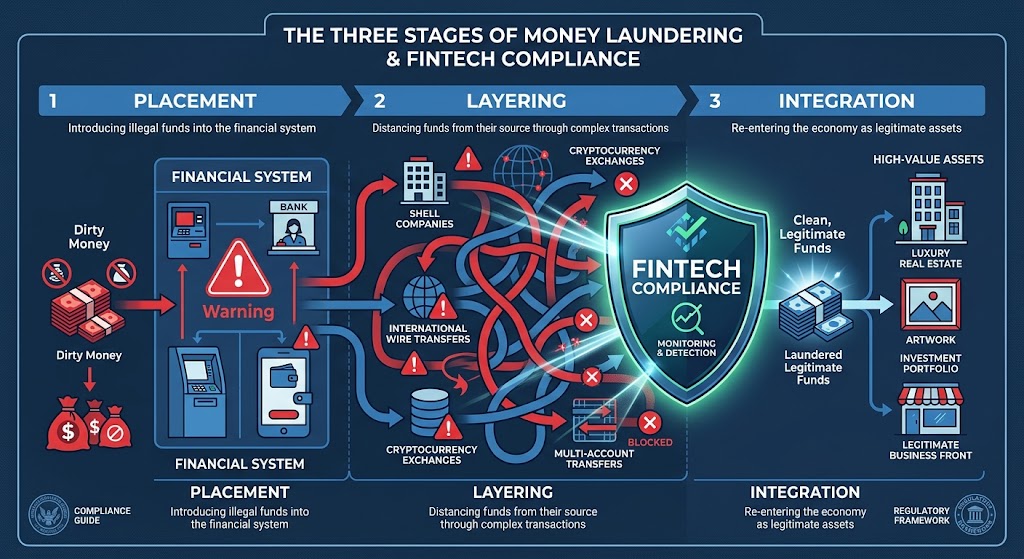
Wire transfers are a common vehicle for money laundering due to their speed, size, and cross-border capabilities. Fintechs and financial institutions must monitor wire transfer activity for suspicious patterns and file Suspicious Activity Reports (SARs) when transactions meet BSA SAR thresholds.
Common wire transfer patterns that warrant SAR analysis include:
- Wires to or from jurisdictions on FATF blacklists or FinCEN geographic targeting orders
- Structured wires just below reporting or recordkeeping thresholds
- Rapid movement of funds ("round-tripping") through multiple institutions with no apparent business purpose
- Wire activity inconsistent with the customer's stated business type or account history
- Wires to or from counterparties on OFAC sanctions lists
See our guide on what is a SAR for SAR filing thresholds and procedures.
The Travel Rule and Cryptocurrency
FinCEN's Travel Rule has historically applied to traditional wire transfers through regulated financial institutions. However, FinCEN has made clear that its Travel Rule requirements extend to virtual asset service providers (VASPs) — including cryptocurrency exchanges and money transmitters handling digital assets — when transmitting convertible virtual currency (CVC) of $3,000 or more.
The application of the Travel Rule to cryptocurrency transfers is an area of ongoing regulatory development globally, with the Financial Action Task Force (FATF) pushing for VASP-to-VASP Travel Rule compliance internationally. Fintechs handling cryptocurrency transfers should maintain close awareness of FinCEN and FATF guidance on this topic.
Building Wire Transfer Compliance into Your Operations
For fintechs that originate or process wire transfers, compliance starts with understanding your role in the wire transfer chain and building processes accordingly:
If You Are an Originating Institution
- Collect and verify all required transmittor information before executing any wire of $3,000 or more
- Include all required Travel Rule information in transmission orders
- Apply transaction monitoring controls to wire activity
- Retain required records for five years with reliable retrieval capability
If You Are an Intermediary Institution
- Pass through all Travel Rule information received from the originating institution
- Retain records of transfers you process for five years
- Apply OFAC sanctions screening at each transfer stage
If You Are a Beneficiary Institution
- Retain all Travel Rule information received with incoming wires
- Screen incoming wires against OFAC sanctions lists before crediting beneficiary accounts
- Monitor incoming wire patterns for suspicious activity indicators
Integration with Your AML Program
Wire transfer compliance does not operate in isolation — it must be integrated into your broader AML compliance program. Your written AML policy must specifically address wire transfer procedures, your transaction monitoring system must include wire-specific rules, and your compliance officer must be trained on the full wire transfer compliance framework.
Frequently Asked Questions
Does the BSA Travel Rule apply to ACH transfers?
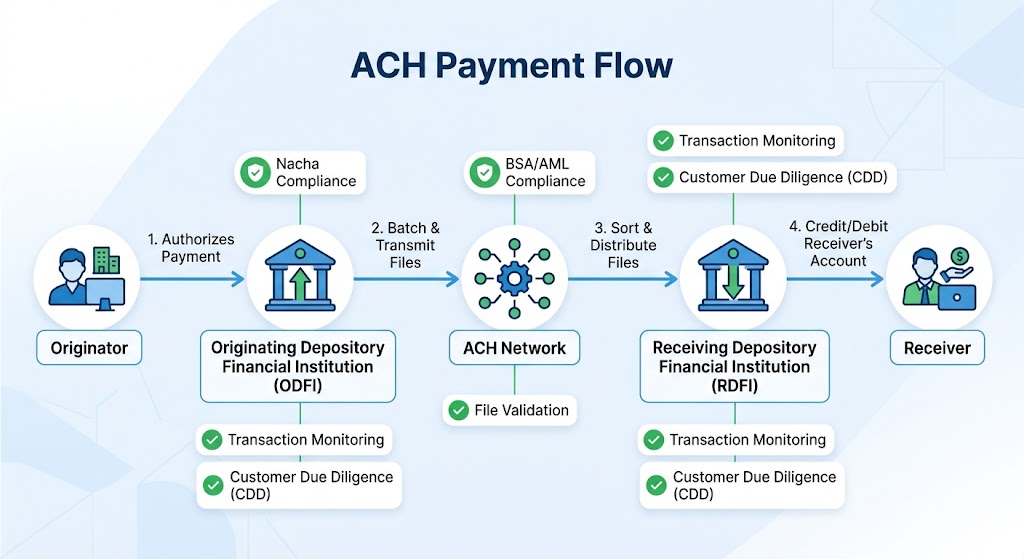
The BSA Travel Rule was written specifically for wire transfers and applies to transactions processed through wire transfer systems like Fedwire, CHIPS, and SWIFT. ACH transfers are subject to separate BSA recordkeeping requirements but are not subject to the same Travel Rule information-passing obligations. However, ACH transfers that meet SAR thresholds must still be reported to FinCEN.
What is the penalty for Travel Rule non-compliance?
FinCEN can impose civil money penalties for Travel Rule violations. Penalties have ranged from thousands to millions of dollars depending on the scope and willfulness of violations. Criminal liability is also possible for willful violations. FinCEN has brought enforcement actions against both large banks and smaller MSBs for Travel Rule failures.
Do wire transfer rules apply to international transfers?
Yes — the BSA Travel Rule applies to cross-border transfers involving US financial institutions. International transfers are also subject to additional OFAC screening requirements and may trigger additional reporting obligations under country-specific regulations in the recipient jurisdiction.
What technology solutions exist for Travel Rule compliance?
Several specialized compliance technology providers offer solutions for Travel Rule data exchange between financial institutions, particularly for cryptocurrency VASPs. For traditional wire transfers, Travel Rule data typically travels within the payment message itself (e.g., SWIFT message fields). Fintechs should consult with their acquiring bank or SWIFT service bureau to confirm how Travel Rule data is handled in their specific payment architecture.
This article is for educational purposes only and does not constitute legal or compliance advice. BSA requirements are complex and subject to change. Verify current requirements with FinCEN guidance and consult qualified legal counsel for your specific operations.