Money laundering is the process of concealing the origins of illegally obtained funds to make them appear legitimate. For fintechs, understanding how money laundering works — and the regulatory framework designed to stop it — is foundational to building a compliant business.
What Is Money Laundering? A Plain English Guide for Fintechs
Money laundering is the process of making illegally obtained funds appear to come from a legitimate source. It is one of the most significant financial crimes globally, and it is a primary reason regulators require fintechs, banks, and payment companies to maintain robust AML compliance programs.
If your company moves money — whether through payments, transfers, stored value, or digital assets — understanding how money laundering works is not optional. Regulators expect every licensed money services business and fintech to understand the risks specific to their products and take active steps to detect and prevent them.
The Three Stages of Money Laundering
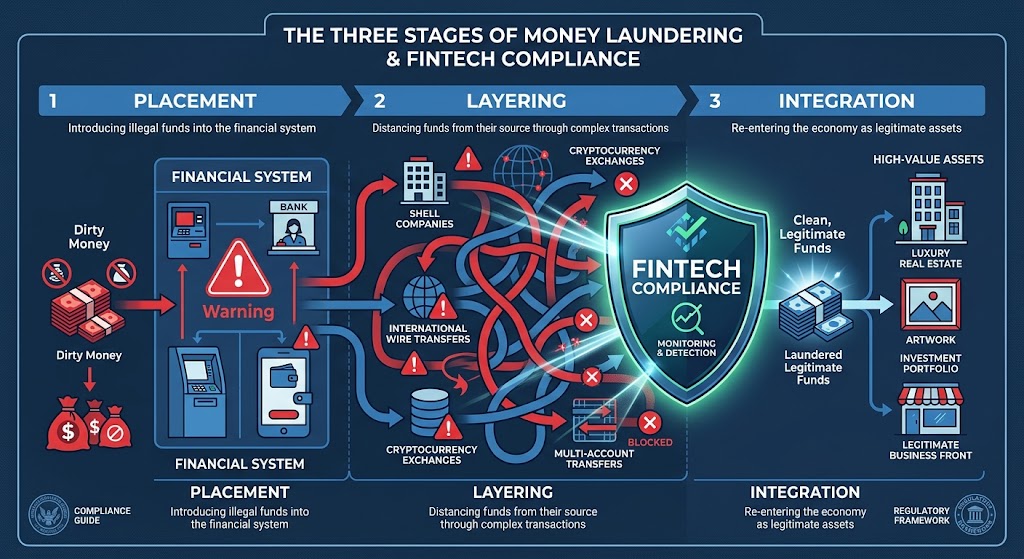
Money laundering is typically described in three stages: placement, layering, and integration. Each stage presents different risks and different detection opportunities for fintechs and financial institutions.
Stage 1: Placement
Placement is the introduction of illicit funds into the financial system. This is often the riskiest stage for criminals because it requires converting physical cash or traceable assets into financial instruments. Common placement methods include:
- Structuring (or "smurfing"): Breaking large amounts of cash into smaller deposits below reporting thresholds (currently $10,000 in the US) to avoid triggering Currency Transaction Reports (CTRs). Structuring is itself a federal crime under the Bank Secrecy Act.
- Cash-intensive business commingling: Mixing illegal proceeds with legitimate revenues from cash-heavy businesses like restaurants, car washes, or retail stores.
- Money services business abuse: Using money transfer services, check cashers, or prepaid cards to convert cash into electronic form.
Stage 2: Layering
Layering involves creating a complex web of financial transactions to obscure the origin of funds and make them harder to trace. Layering may involve:
- Wire transfers through multiple accounts across multiple jurisdictions
- Purchases and sales of high-value assets (real estate, luxury goods, art)
- Shell company transactions across multiple countries
- Cryptocurrency transactions through mixing services or chain-hopping between blockchains
- Trade-based money laundering (over- or under-invoicing international shipments)
Fintechs are particularly relevant at the layering stage because digital payment products can be used to rapidly move funds across accounts and jurisdictions. This is why transaction monitoring is a core component of every AML compliance program.
Stage 3: Integration
Integration is when laundered funds re-enter the legitimate economy in a form that appears clean. Examples include:
- Purchasing real estate or businesses with laundered funds
- Repaying loans from shell companies
- Receiving "consulting fees" from front companies
- Investing in securities or other financial instruments
Once funds reach the integration stage, they are extremely difficult for law enforcement to trace without a complete record of the earlier transactions.
Why Fintechs Are at Higher Risk
Fintechs face elevated money laundering risk for several structural reasons:
- Speed: Real-time and near-real-time payment products can move funds across multiple accounts before transaction monitoring systems flag activity.
- Scale: High transaction volumes make it easier for criminal activity to blend in with legitimate transactions.
- Customer anonymity: Digital onboarding, especially for lower-value accounts, may have weaker identity verification than traditional banks — making fintechs attractive for account-based layering schemes.
- Cross-border activity: International remittance and payment products expose fintechs to jurisdictions with weaker AML regimes.
- Cryptocurrency integration: Products touching digital assets face additional layering risk through mixing services and decentralized exchanges.
The Regulatory Framework: Bank Secrecy Act and FinCEN
In the United States, the Bank Secrecy Act (BSA) is the primary federal anti-money laundering law. It requires financial institutions — including money services businesses (MSBs) and many fintech companies — to establish AML programs, file Suspicious Activity Reports (SARs), and maintain records that help law enforcement trace financial crimes.
FinCEN (the Financial Crimes Enforcement Network), a bureau of the US Treasury Department, administers the BSA and sets the AML rules that fintechs must follow. FinCEN also maintains the beneficial ownership registry required under the Corporate Transparency Act.
Under the BSA, registered MSBs — which include most money transmitters, prepaid card issuers, and cryptocurrency exchangers — must:
- Develop and maintain a written AML program
- Designate a qualified compliance officer
- Train employees on AML requirements
- Conduct independent audits of the AML program
- File SARs for suspicious activity and Currency Transaction Reports for cash transactions over $10,000
See our plain English guide to the Bank Secrecy Act for a full breakdown of requirements.
Common Money Laundering Red Flags for Fintechs
Regulators and the Financial Action Task Force (FATF) have published extensive guidance on money laundering red flags. For fintechs, the most commonly observed patterns include:
Customer Behavior Red Flags
- Customer is reluctant to provide identification or beneficial ownership information
- Customer provides inconsistent or implausible information about their business or source of funds
- Customer attempts to structure transactions just below reporting thresholds
- Customer account shows no business purpose or is inconsistent with stated business activity
- Unusual customer interest in avoiding record-keeping or reporting requirements
Transaction Pattern Red Flags
- Rapid movement of funds through accounts (funds in, funds out with minimal time in the account)
- Round-dollar transactions in large amounts with no apparent business purpose
- Transactions to or from high-risk jurisdictions on FATF blacklists or OFAC sanctions lists
- Multiple small transactions to the same recipient that collectively total large amounts
- Activity inconsistent with the customer's stated business type or transaction history
Geographic and Counterparty Red Flags
- Transactions involving jurisdictions with weak AML frameworks or known as money laundering havens
- Counterparties on OFAC sanctions lists or Politically Exposed Persons (PEP) lists
- Transactions to or from shell companies with no apparent business substance
What Happens When Fintechs Fail to Prevent Money Laundering
The consequences of inadequate AML controls are severe. Recent enforcement actions against fintechs and payment companies have resulted in:
- Civil money penalties in the tens and hundreds of millions of dollars
- Criminal prosecution of executives and compliance officers
- License revocation or suspension
- Consent orders requiring enhanced compliance programs under regulatory supervision
- Reputational damage that permanently impairs banking relationships and customer trust
FinCEN, the OCC, state banking regulators, and the DOJ have all pursued enforcement actions against payment and fintech companies for BSA/AML violations. No license type, company size, or business model is exempt.
Building an AML Program That Addresses Money Laundering Risk
Every fintech that processes payments, holds funds, or transmits money needs a risk-based AML program. The program must be tailored to the specific money laundering risks inherent in your products, customers, and geographies. A generic template is not sufficient — regulators expect evidence of a genuine risk assessment and controls calibrated to your actual risk profile.
The core components are: a written AML policy, a designated compliance officer, employee training, independent auditing, and procedures for filing SARs and maintaining required records. See our complete guide to building an AML compliance program for a step-by-step breakdown.
Frequently Asked Questions
What is the difference between money laundering and fraud?
Fraud involves deception to obtain money or property illegally. Money laundering involves concealing the proceeds of any crime to make them appear legitimate. The two often overlap — fraud generates criminal proceeds that then need to be laundered — but they are distinct offenses under US law.
Is cryptocurrency money laundering common?
Yes. While blockchain's public ledger provides traceability that cash does not, criminals use mixing services, privacy coins, and cross-chain transactions to obscure fund flows. FinCEN, FATF, and international law enforcement agencies have all identified cryptocurrency-based money laundering as a significant and growing threat.
What is a SAR and when must a fintech file one?
A Suspicious Activity Report (SAR) is filed with FinCEN when a fintech knows, suspects, or has reason to suspect that a transaction involves funds derived from illegal activity or is designed to evade reporting requirements. SARs must generally be filed within 30 days of detecting suspicious activity. See our guide to what is a SAR for the full filing framework.
Does my fintech need an AML program even if we are not a bank?
Yes. Non-bank fintechs that qualify as money services businesses (MSBs) under FinCEN's rules must register with FinCEN and maintain a written AML program. Most money transmitters, prepaid card issuers, and cryptocurrency businesses qualify as MSBs regardless of their bank status.
This article is for educational purposes only and does not constitute legal or compliance advice. AML requirements are complex and subject to change. Consult a qualified compliance professional or legal counsel for guidance specific to your business.