The OFAC SDN List is the US government's list of sanctioned individuals, entities, and countries that financial institutions must screen against. This guide explains what's on it, who must use it, and how to screen correctly.
What Is the OFAC SDN List? How to Screen Against It
If your fintech processes payments, opens accounts, or provides any financial service to US customers or through US financial infrastructure, you're legally required to screen against the OFAC SDN List. No exceptions.
What Is the OFAC SDN List?
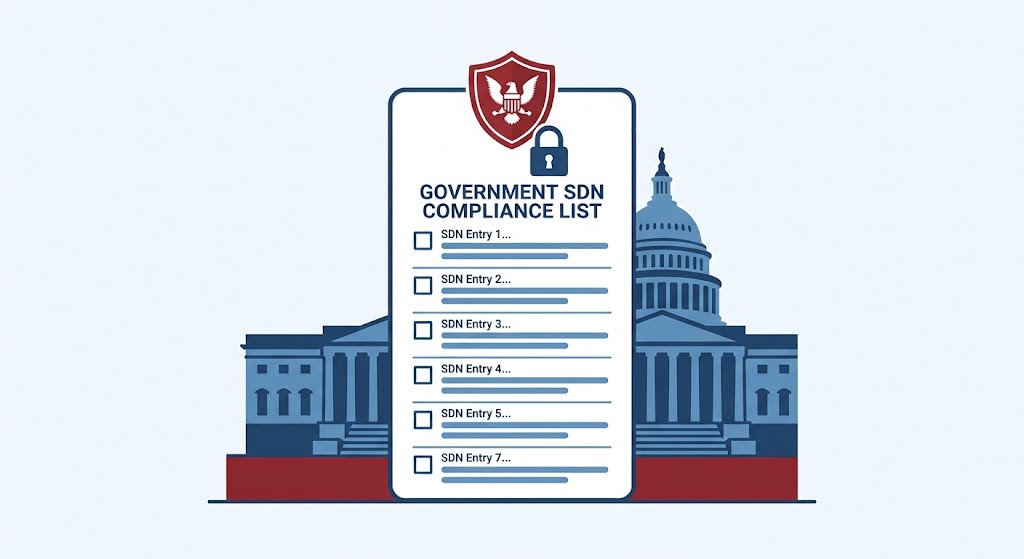
The Specially Designated Nationals and Blocked Persons List — commonly called the SDN List — is maintained by the Office of Foreign Assets Control (OFAC), a division of the US Department of the Treasury. It contains the names of individuals, companies, and entities that US persons are prohibited from doing business with.
The SDN List includes: terrorists and terrorist organizations, narcotics traffickers, WMD proliferators, rogue regimes and their supporters (Iran, North Korea, Russia, Cuba, Syria), human traffickers, cybercriminals, and cryptocurrency wallet addresses (since 2018).
Who Is Required to Screen Against the SDN List?
All US persons and entities. OFAC's jurisdiction applies to all US citizens and permanent residents regardless of location, all companies incorporated in the United States, anyone conducting transactions in US dollars, and foreign branches of US companies.
What Happens If You Transact With an SDN?
Transacting with a person or entity on the SDN List can result in civil penalties of up to $368,136 per violation (or twice the amount of the transaction, whichever is greater), criminal penalties for willful violations up to $1 million per violation and 20 years in prison, and blocking of the funds. There is no de minimis threshold — even a $10 transaction with an SDN is a violation.
What Other OFAC Lists Exist?
The SDN List is the most comprehensive, but OFAC also maintains the Sectoral Sanctions Identifications (SSI) List, the Foreign Sanctions Evaders (FSE) List, and the Correspondent Account or Payable-Through Account (CAPTA) List. Most commercial screening tools consolidate these into a single screening process.
How to Screen Against the OFAC SDN List
Option 1: Manual Screening (Not Recommended for Scale)
OFAC publishes a publicly available, downloadable version of the SDN List at treasury.gov. Manual searching is only feasible for very low-volume, one-off checks.
Option 2: Automated Screening (Recommended)
Virtually all fintechs use automated screening tools integrated into their onboarding and transaction processing workflows. Leading providers include Refinitiv (LSEG), Dow Jones Risk & Compliance, Accuity, and LexisNexis. Automated screening matches customer name, date of birth, nationality, and other identifiers using fuzzy matching logic — which catches name variations, alternative spellings, and transliterations.
What to Do When There's a Match
- Alert generated — the screening tool flags a potential match
- Manual review — a compliance analyst reviews the hit to determine if it's a true match or false positive
- True match confirmed — transaction is blocked, funds are frozen, OFAC is notified
- False positive cleared — analyst documents the review and clears the alert; transaction proceeds
OFAC Screening in Crypto
OFAC began listing cryptocurrency wallet addresses on the SDN List in 2018. For crypto companies, screening means matching not just names but on-chain wallet addresses against OFAC's listed addresses. Blockchain analytics tools like Chainalysis, Elliptic, and TRM Labs provide this capability.
Frequently Asked Questions
How often is the SDN List updated?
OFAC updates the SDN List continuously — sometimes multiple times per week. Your screening system must be updated on the same cadence. Screening against a stale list is a compliance failure.
What is the difference between the SDN List and other sanctions lists?
The SDN List is the most comprehensive — anyone on it is completely blocked from US financial services. Other lists have more nuanced restrictions. See our guides on OFAC sanctions screening and how to conduct OFAC screening for more detail.
Do I need to screen existing customers, not just new ones?
Yes. Your screening program should include ongoing monitoring of your entire customer base against updated sanctions lists.
What is a false positive and how do I handle it?
A false positive is a screening alert for a customer who shares a name with (but is not) a sanctioned person. Resolve it by reviewing full identity information — date of birth, nationality, address — and documenting your conclusion.
This article is for educational purposes only and does not constitute legal or compliance advice. Regulations vary by jurisdiction and change frequently. Consult a qualified compliance professional or legal counsel for guidance specific to your business.