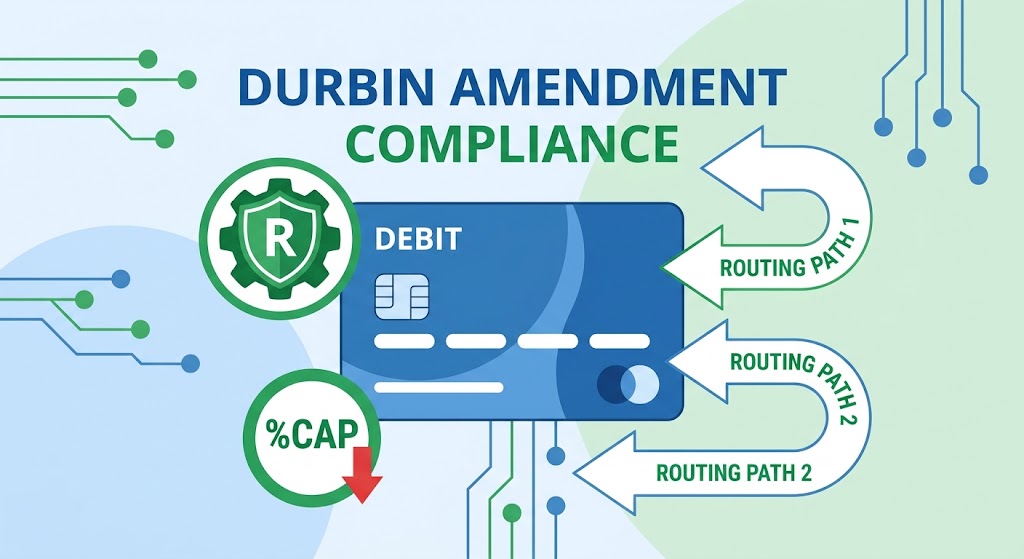
The Durbin Amendment caps debit interchange fees and requires debit card transaction routing choice. For fintechs building on debit rails, Durbin compliance is a core regulatory requirement. This guide explains what the amendment requires, who it applies to, and how it affects fintech business models.
What Is the Durbin Amendment? How It Affects Fintech
The Durbin Amendment — formally Section 1075 of the Dodd-Frank Wall Street Reform and Consumer Protection Act of 2010 — made significant changes to how debit card interchange works in the United States. For fintechs that issue debit cards, build on debit payment rails, or participate in the debit ecosystem, understanding the Durbin Amendment and its implementing regulation (Regulation II) is essential. The rules affect interchange economics, card program design, and network routing obligations.
What the Durbin Amendment Does
The Durbin Amendment has two primary components:
1. Interchange Fee Cap
The amendment directed the Federal Reserve to establish standards for what constitutes a "reasonable and proportional" interchange fee for debit card transactions. The Federal Reserve implemented this through Regulation II, which sets the interchange fee cap that applies to covered debit card issuers.
The cap applies to debit card issuers with assets of $10 billion or more (large issuers). Banks and credit unions with less than $10 billion in assets are exempt from the cap — a distinction that has significant implications for fintech banking-as-a-service programs.
The Federal Reserve periodically updates the interchange fee standards under Regulation II. Fintechs should consult the Federal Reserve's Regulation II page at federalreserve.gov for current figures, as the standards are subject to regulatory revision.
2. Network Exclusivity and Routing Requirements
The second component of Durbin requires that debit card issuers enable merchants to route debit transactions over at least two unaffiliated payment networks. This prevents issuers from limiting routing to a single network (which would typically be the most expensive option for merchants).
The Federal Reserve's Regulation II specifies the routing requirements, including requirements around card-not-present (online) transactions — an area that was the subject of subsequent regulatory clarification by the Federal Reserve.
Who Does Durbin Apply To?
The interchange fee cap applies to debit card issuers with $10 billion or more in consolidated assets. This is measured at the issuing bank level, not the fintech program level. Key distinctions:
- Large bank issuers: Subject to the interchange fee cap under Regulation II
- Small bank issuers (under $10 billion): Exempt from the interchange fee cap — can receive market-rate interchange
- Fintech-issued debit cards: Durbin applicability depends on the assets of the bank that issues the card, not the fintech. A fintech whose card is issued by a small bank sponsor is generally not subject to the cap
The routing requirements apply more broadly — they govern how debit card transactions can be routed regardless of issuer size.
How Durbin Affects Fintech Business Models
BaaS and Sponsor Bank Selection
One of the most significant Durbin implications for fintechs is the choice of banking-as-a-service (BaaS) partner. Fintechs whose card programs are issued through community banks or credit unions with under $10 billion in assets may receive higher interchange revenue than programs issued through large banks subject to the cap. This has made small bank sponsors attractive partners for fintechs whose economics depend on interchange.
Prepaid Cards
The Durbin Amendment exemption for small issuers does not automatically apply to prepaid cards in the same way it applies to traditional debit cards. Regulation II's applicability to different types of prepaid products has specific rules that fintechs offering prepaid programs should review carefully with counsel.
Interchange-Dependent Business Models
Fintechs that have built revenue models around debit interchange — including neobanks and consumer finance apps — must understand how Durbin affects their unit economics. Programs issued by Durbin-exempt small banks have structurally different interchange economics than programs issued by large banks.
Routing Compliance
Fintechs and their bank partners must ensure debit card programs comply with Regulation II's routing requirements, including for card-not-present transactions. This is an operational compliance obligation that affects card program setup and network agreements.
Recent Developments
The Federal Reserve has issued guidance clarifying Regulation II's application to card-not-present debit transactions, expanding routing choice requirements to the online environment. Fintechs operating debit programs should confirm their network routing configuration complies with current Federal Reserve guidance. Check the Federal Reserve's Regulation II resource page at federalreserve.gov for the most current regulatory guidance.
Frequently Asked Questions
Does Durbin apply to credit cards?
No. The Durbin Amendment applies only to debit card interchange. Credit card interchange is not subject to the Regulation II fee cap — which is why credit card interchange rates are substantially higher than Durbin-capped debit interchange.
What is the practical impact of Durbin on a fintech neobank?
For fintechs that generate significant revenue from debit interchange, Durbin is a core economics question. Choosing a small bank sponsor (exempt from the cap) versus a large bank (subject to the cap) can mean a material difference in interchange per transaction. This is one reason many consumer fintechs have historically partnered with smaller BaaS banks.
What are the routing requirements under Durbin?
Regulation II requires that debit card issuers allow merchants to route transactions over at least two unaffiliated networks — meaning the issuer cannot limit routing to networks all owned by the same company. The Federal Reserve has extended this requirement to card-not-present transactions, requiring that at least two unaffiliated networks be available for online debit transactions as well.
Where can I find the current Regulation II interchange cap?
The Federal Reserve publishes Regulation II and its updates at federalreserve.gov. The current interchange fee standards, as well as any pending rulemaking, are available there. Fintechs and their legal counsel should review the current rule text rather than relying on secondary sources, as the standards are subject to regulatory updates.
This article is for educational purposes only and does not constitute legal or compliance advice. Regulatory requirements are subject to change. Consult qualified legal counsel for guidance specific to your fintech's card program.