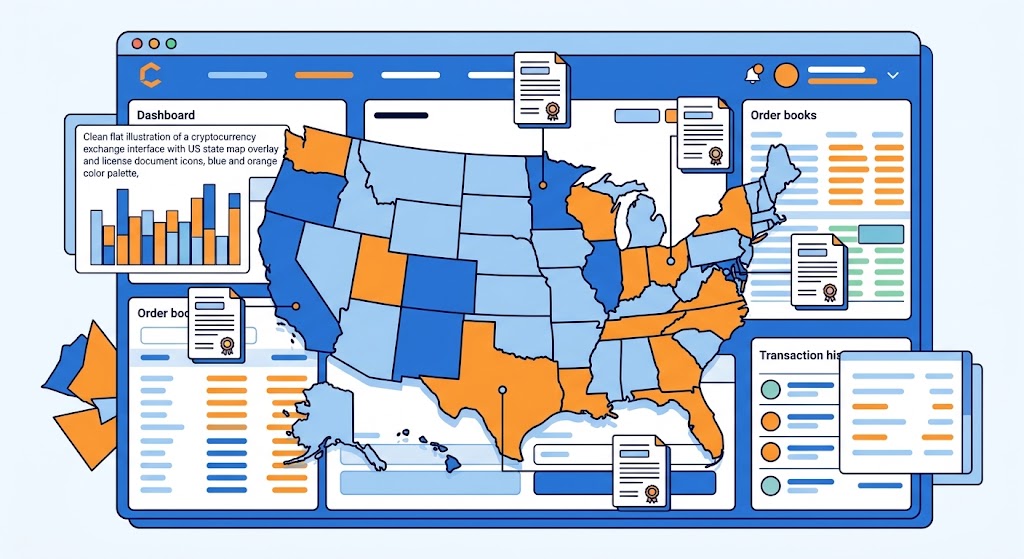
Crypto exchanges in the US may need state money transmitter licenses, a New York BitLicense, FinCEN MSB registration, or other authorizations depending on their activities. This guide explains what licenses apply to your exchange and how to get them.
What Is a Crypto Exchange License in the US? A State-by-State Guide
There is no single "crypto exchange license" in the United States. Instead, depending on what your exchange does and where it operates, you may need a combination of state money transmitter licenses, New York's BitLicense, FinCEN MSB registration, and potentially SEC or CFTC registration.
Here's how to navigate the patchwork.
What Determines Which Licenses a Crypto Exchange Needs?
Three factors primarily determine your licensing requirements:
- What you're doing — exchanging crypto for fiat, crypto for crypto only, providing custody, offering derivatives
- Where your customers are — which US states they're located in
- What assets you're handling — Bitcoin and Ethereum are treated differently from tokens the SEC may classify as securities
The Three Main US Licensing Frameworks for Crypto Exchanges
1. State Money Transmitter Licenses (MTLs)
Most states apply their existing money transmitter laws to cryptocurrency exchanges that convert crypto to fiat or transmit fiat on behalf of customers. If your exchange allows users to:
- Buy crypto with USD (fiat on-ramp)
- Sell crypto for USD (fiat off-ramp)
- Withdraw fiat to a bank account
...you are almost certainly conducting money transmission in the states where those users are located, and you need an MTL in each of those states.
2. New York BitLicense
New York requires a separate BitLicense from NYDFS for any business that receives virtual currency for transmission, stores or holds virtual currency for customers, buys and sells virtual currency as a business, or performs exchange services.
The BitLicense is one of the most rigorous crypto licenses in the country — the application takes 12–24+ months and requires extensive disclosure of technology infrastructure, security practices, and AML programs.
3. FinCEN MSB Registration (Federal)
Most crypto exchanges qualify as Money Services Businesses under the Bank Secrecy Act and must register with FinCEN. This registration is:
- Free and filed through BSA E-Filing
- Required biennial renewal
- Separate from state licensing
- Requires maintaining a full BSA/AML compliance program
What About Pure Crypto-to-Crypto Exchanges?
Exchanges that only exchange crypto for crypto — never touching fiat — operate in a regulatory gray area at the state level. Some states have determined that crypto-to-crypto exchanges are not money transmission; others have not taken a clear position.
At the federal level, FinCEN's guidance indicates that entities engaged in exchanging virtual currencies may be MSBs requiring registration. For pure crypto-to-crypto exchanges, consult legal counsel — the analysis is state-by-state and evolving.
Additional Federal Considerations
SEC: If any tokens traded on your exchange are securities, your exchange may need to register as a national securities exchange or operate under an exemption.
CFTC: If your exchange offers crypto derivatives, CFTC registration as a derivatives exchange may be required.
How Many State MTLs Do I Need?
Most crypto exchanges pursuing broad US distribution aim for MTLs in all or most states that require them. Common approaches:
- Phase 1: License in the 5–10 most critical states for your customer base
- Phase 2: Expand to remaining states over 12–24 months
- Interim: Restrict service to licensed states until full coverage is achieved
Frequently Asked Questions
Can I operate in all 50 states before I'm licensed everywhere?
No — you must restrict service to licensed states. Geo-blocking users from unlicensed states is common practice during the licensing buildout period.
Is there any state that doesn't require a crypto license?
A few states have not applied money transmitter laws to all crypto activities. Our guide on states without crypto license requirements covers this in detail.
How long does it take to get all the licenses?
Obtaining MTLs in 40+ states takes 18–36 months from when you start, depending on state-by-state processing times and application completeness.
This article is for educational purposes only and does not constitute legal or compliance advice. Crypto regulation is evolving rapidly. Consult qualified legal counsel for guidance specific to your business.