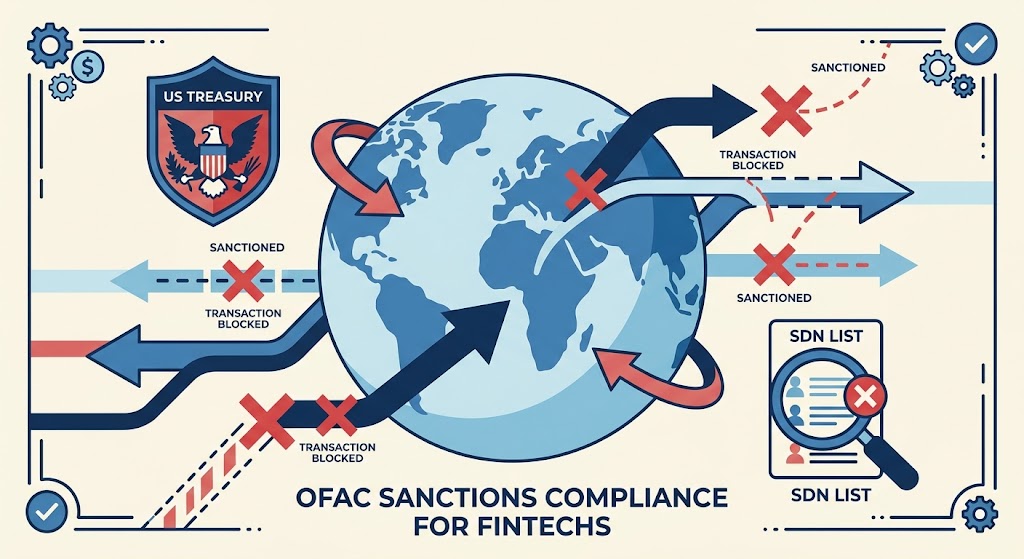
The Office of Foreign Assets Control (OFAC) administers US economic sanctions that prohibit transactions with sanctioned countries, entities, and individuals. Fintechs face strict liability for OFAC violations — this guide explains the sanctions screening obligations every fintech must meet.
OFAC Sanctions Compliance for Fintechs
The Office of Foreign Assets Control (OFAC) — a division of the US Department of the Treasury — administers and enforces US economic sanctions programs. For fintechs, OFAC compliance is not optional: US sanctions apply to all US persons and entities, including fintechs, and violations can result in civil penalties in the millions of dollars. Critically, OFAC operates on a strict liability basis — a fintech can be penalized for a sanctions violation even if the violation was unintentional.
What Are OFAC Sanctions?
OFAC sanctions are legal restrictions that prohibit US persons from engaging in transactions with designated countries, individuals, and entities. OFAC administers dozens of sanctions programs targeting specific countries and regions, as well as global programs targeting specific threat categories (terrorism, narcotics trafficking, weapons proliferation). The key tools OFAC uses include:
- Specially Designated Nationals and Blocked Persons (SDN) List: A list of individuals, companies, and groups whose assets are blocked and with whom US persons are generally prohibited from dealing. OFAC maintains the SDN list and updates it regularly at ofac.treas.gov.
- Consolidated Sanctions List: A broader list combining the SDN list with other OFAC-maintained lists, available through OFAC's website and APIs
- Country-based sanctions: Comprehensive sanctions on certain countries — such as Cuba, Iran, North Korea, and Syria — that broadly prohibit transactions involving those countries
- Sectoral sanctions: Restrictions targeting specific sectors of certain economies (such as Russian finance, energy, and defense) without comprehensively sanctioning the country
OFAC Sanctions Apply to All US Fintechs
OFAC's regulations apply to:
- All US citizens and permanent residents, wherever located
- All persons and entities within the United States
- US incorporated entities and their foreign branches
This means every US fintech — regardless of size, licensing status, or business model — must comply with OFAC sanctions. There is no de minimis exception. A fintech that processes a single payment to or from a sanctioned party faces potential liability.
Core OFAC Compliance Obligations for Fintechs
1. Sanctions Screening
The foundation of OFAC compliance is screening: checking customers, counterparties, and transaction data against OFAC's sanctions lists before executing transactions. Fintechs must screen:
- All customers at onboarding (name, address, date of birth, national ID)
- All beneficial owners and control persons
- All transaction counterparties where identifiable
- All payments for references to sanctioned parties, countries, or keywords
OFAC screening should be real-time or near-real-time for payment processing, and periodic rescreening of the customer base is a best practice to catch newly designated parties.
2. Blocking and Rejecting Transactions
When a fintech's screening identifies a potential match to a sanctioned party or country, the fintech must:
- Block the transaction if it involves property of a sanctioned party (the funds must be held, not returned)
- Reject the transaction if it is a prohibited transaction that does not involve property requiring blocking
Both blocked and rejected transactions must be reported to OFAC. OFAC publishes guidance on reporting requirements on its website at ofac.treas.gov.
3. Annual Reporting
Fintechs that block transactions or property must submit annual reports to OFAC by September 30 of each year, detailing all blocked property held during the preceding year.
4. Recordkeeping
OFAC regulations require that records of blocked transactions and compliance activities be maintained for at least five years.
Building an OFAC Compliance Program
OFAC's Framework for Compliance Commitments identifies five essential components of a robust sanctions compliance program:
- Management commitment: Senior leadership support for the compliance program and adequate resources
- Risk assessment: Regular assessment of the fintech's OFAC risk based on customers, products, geographies, and transaction types
- Internal controls: Screening procedures, transaction monitoring, blocking and reporting workflows, and escalation processes
- Testing and auditing: Regular testing of screening systems and independent auditing of the compliance program
- Training: Regular OFAC training for all relevant staff, updated as sanctions programs change
Penalties for OFAC Violations
OFAC can impose significant civil penalties for sanctions violations. Penalty amounts are set by statute and adjusted periodically for inflation — current penalty amounts are published by OFAC at ofac.treas.gov. OFAC's Enforcement Guidelines describe the factors it considers in setting penalty amounts, including the voluntary self-disclosure of violations, the egregiousness of the conduct, and the sophistication of the compliance program. Self-disclosure and a strong compliance program can substantially reduce penalties.
Frequently Asked Questions
Does OFAC apply to small fintechs?
Yes. OFAC sanctions apply to all US persons and entities regardless of size. Small fintechs are not exempt. However, OFAC's enforcement guidelines do consider the size and resources of the organization when calculating penalties.
What is the SDN list and how often is it updated?
The Specially Designated Nationals list is OFAC's primary list of sanctioned individuals, companies, and entities. OFAC updates the SDN list frequently — sometimes multiple times per week — as new designations are made. Fintechs should use automated screening tools that update from OFAC's list feed rather than relying on manual checks.
What is a "false positive" in sanctions screening?
A false positive occurs when a screening system flags a transaction or customer as a potential sanctions match, but upon investigation the match is determined to be a different person or entity with a similar name. False positives are common and must be reviewed and documented. Fintech screening programs should include a defined process for investigating and clearing false positives without creating regulatory risk.
How does OFAC interact with AML obligations?
OFAC and AML compliance are distinct but complementary programs. AML compliance focuses on detecting and reporting suspicious transactions (through SARs and CTRs). OFAC compliance focuses on blocking prohibited transactions with sanctioned parties. Both programs require transaction monitoring, but their purposes, triggers, and required actions differ. A strong fintech compliance program addresses both.
This article is for educational purposes only and does not constitute legal or compliance advice. OFAC sanctions programs and penalty amounts are subject to change. Always consult OFAC's official resources at ofac.treas.gov and qualified legal counsel for guidance specific to your business.