The Fair Credit Reporting Act (FCRA) governs how consumer credit information is collected, used, and shared. Fintechs that pull credit reports, furnish data to credit bureaus, or use consumer report information in decisions must comply with FCRA's strict rules.
FCRA Compliance for Fintechs: Fair Credit Reporting Act Requirements
The Fair Credit Reporting Act (FCRA) — codified at 15 U.S.C. § 1681 et seq. — is the federal law governing the collection, use, and sharing of consumer credit information. For fintechs, FCRA compliance arises in several critical ways: pulling credit reports on applicants, using consumer report data in credit or account decisions, furnishing consumer data to credit bureaus, and providing consumers with adverse action notices. FCRA violations carry significant legal exposure — including class action liability — making it a foundational compliance obligation for any fintech that touches credit data.
Who Does the FCRA Apply To?
The FCRA establishes obligations for three categories of entities:
- Consumer Reporting Agencies (CRAs): Companies that compile and sell consumer report information — primarily Equifax, Experian, and TransUnion, but also specialty reporting agencies for employment, tenant screening, insurance, and banking
- Users of consumer reports: Any person or entity that obtains a consumer report — including fintechs that pull credit reports for credit decisions, account opening, or other purposes
- Furnishers of information: Any person or entity that provides information about consumers to CRAs — including fintechs that report payment history, account status, or derogatory information to credit bureaus
Most fintechs fall into at least one — and often two or three — of these categories.
Permissible Purposes for Pulling a Consumer Report
A fintech can only obtain a consumer report for a permissible purpose enumerated in the FCRA. Permissible purposes include:
- In connection with a credit transaction — to evaluate an application for credit or to review an existing credit account
- For account underwriting — such as evaluating a consumer's eligibility for a financial product
- Employment purposes — with the consumer's written authorization
- A legitimate business need in connection with a transaction initiated by the consumer
Obtaining a consumer report for any other purpose is a FCRA violation. Fintechs should document the permissible purpose for each consumer report pull and ensure they are not using report data for unapproved purposes.
Adverse Action Requirements
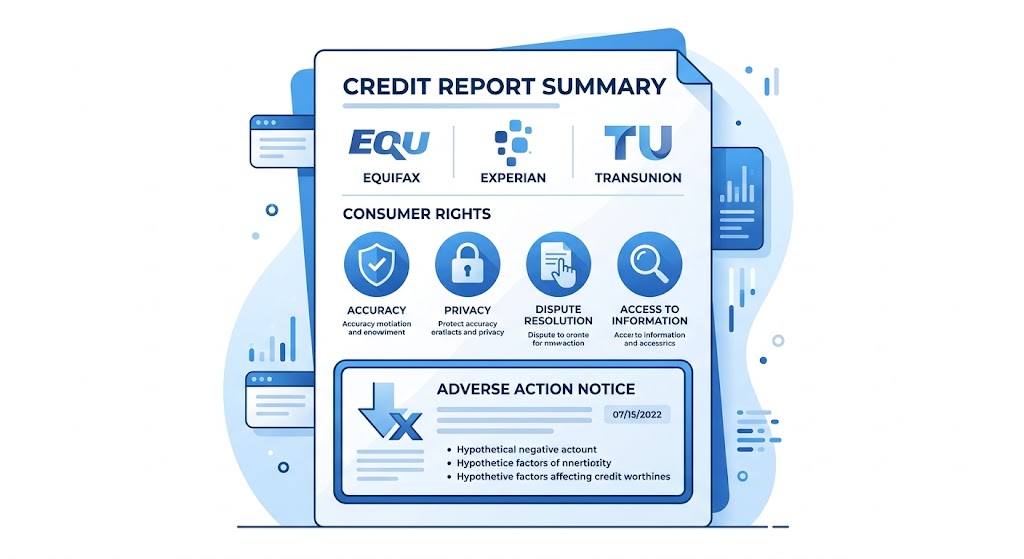
When a fintech takes adverse action — denying a credit application, closing an account, or offering less favorable terms — based in whole or in part on information in a consumer report, it must provide the consumer with an adverse action notice. The notice must include:
- Notice of the adverse action taken
- The name, address, and phone number of the consumer reporting agency that furnished the report
- A statement that the CRA did not make the decision and cannot explain why it was made
- Notice of the consumer's right to obtain a free copy of the report from the CRA within 60 days
- Notice of the consumer's right to dispute inaccurate information in the report
Adverse action notices must be timely — generally within a reasonable period of the decision being made. CFPB regulations and the FCRA itself specify the timing requirements.
Furnisher Obligations
Fintechs that report consumer data to credit bureaus are "furnishers" under the FCRA and have significant compliance obligations. Furnishers must:
- Report accurate information — furnishing inaccurate data is a FCRA violation
- Investigate consumer disputes — when a consumer disputes information with a CRA, the CRA notifies the furnisher, who must conduct a reasonable investigation and report results back
- Correct or delete inaccurate information promptly
- Not furnish information if notified that it is disputed by the consumer
- Maintain data integrity policies and procedures as required by FCRA regulations
The CFPB's Regulation V (12 C.F.R. Part 1022) implements the FCRA's furnisher obligations and requires furnishers to maintain written policies and procedures for ensuring the accuracy and integrity of reported information.
Consumer Rights Under the FCRA
The FCRA grants consumers significant rights that fintechs must respect and facilitate:
- Right to obtain their consumer report (free annually from each major CRA)
- Right to dispute inaccurate or incomplete information
- Right to know when a consumer report was used against them (adverse action notice)
- Right to place a security freeze or fraud alert on their report
- Right to opt out of pre-screened credit offers
FCRA Enforcement and Penalties
The FCRA is enforced by the CFPB and the FTC at the federal level, and by state attorneys general. Consumers also have a private right of action under the FCRA — meaning they can sue fintechs directly for FCRA violations. Statutory damages range from $100 to $1,000 per violation for willful noncompliance, plus punitive damages and attorney's fees. Class action lawsuits for systematic FCRA violations can result in significant aggregate liability.
Frequently Asked Questions
Does FCRA apply to data from alternative data sources?
The FCRA's definition of "consumer report" is broad — it covers any written, oral, or other communication of information by a CRA bearing on a consumer's creditworthiness, credit standing, credit capacity, character, general reputation, personal characteristics, or mode of living used for credit, employment, housing, or insurance purposes. Alternative data (such as bank transaction data, rental payment history, or utility data) may constitute a consumer report if it meets this definition and is reported by a CRA. Fintechs using alternative data in credit decisions should analyze whether FCRA applies.
What is the FCRA "soft pull" vs. "hard pull" distinction?
A "hard pull" (or hard inquiry) occurs when a fintech obtains a full consumer report for a credit decision — it is visible on the consumer's credit report and can affect their credit score. A "soft pull" (or soft inquiry) occurs when a consumer checks their own report, or when a fintech conducts a pre-qualification check — it is typically not visible to lenders and does not affect the credit score. Both types of pulls must have a permissible purpose under the FCRA.
How long does a furnisher have to respond to a consumer dispute?
Under the FCRA, a furnisher generally has 30 days after receiving a dispute notice from a CRA to conduct a reasonable investigation and report results back to the CRA. In some cases this can be extended to 45 days. Failure to respond within the required timeframe can constitute a FCRA violation.
This article is for educational purposes only and does not constitute legal or compliance advice. FCRA requirements are subject to change through regulation, guidance, and court decisions. Consult qualified legal counsel for guidance specific to your fintech's use of consumer data.