Buy Now Pay Later products face increasing regulatory scrutiny from the CFPB, state regulators, and Congress. This guide explains the current BNPL compliance landscape — from credit law applicability to state licensing requirements — and what BNPL fintechs must do to stay compliant.
Buy Now Pay Later (BNPL) Compliance: What Fintechs Need to Know
Buy Now Pay Later (BNPL) — the ability for consumers to pay for purchases in interest-free installments — has grown from a niche product to a mainstream consumer credit option. With that growth has come significant regulatory attention. The CFPB has issued guidance asserting that many BNPL products are subject to existing consumer credit laws, and state regulators have begun applying lending and licensing requirements to BNPL providers. For BNPL fintechs, understanding the evolving compliance landscape is essential.
The CFPB's Position on BNPL
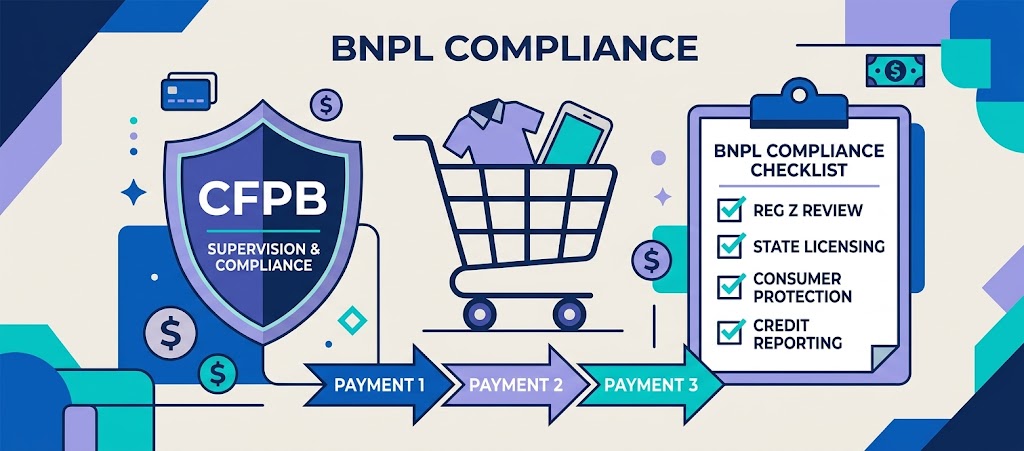
In 2022, the CFPB conducted a market monitoring inquiry into the BNPL industry and published findings highlighting consumer risks — including debt accumulation, lack of consistent dispute resolution, data harvesting, and inconsistent credit bureau reporting. In 2024, the CFPB issued interpretive guidance asserting that certain BNPL products qualify as "credit cards" under the Truth in Lending Act (TILA) and Regulation Z — which would trigger credit card disclosure requirements, dispute resolution obligations, and periodic statement requirements. The CFPB's position on BNPL continues to evolve; fintechs should monitor CFPB guidance at consumerfinance.gov for current requirements.
Does Regulation Z Apply to BNPL?
Regulation Z (12 C.F.R. Part 1026), which implements TILA, governs credit disclosures, terms, and consumer protections. The applicability of Reg Z to BNPL depends on the product structure:
- Pay-in-4 installment products (typically four payments over six weeks with no interest) have been the subject of the CFPB's credit card characterization argument. If a BNPL product meets the definition of a "credit card" under TILA, the issuer must comply with credit card disclosure, billing statement, and dispute resolution requirements.
- Longer-term installment loans with interest are more clearly subject to TILA closed-end credit disclosures — including the APR, finance charge, total amount financed, and payment schedule disclosures.
BNPL fintechs should conduct a Reg Z applicability analysis for each product they offer, with reference to current CFPB interpretive guidance.
State Lending Licenses for BNPL
Many states require a consumer lending license or money transmitter license for BNPL products. Whether a BNPL product triggers state lending licensure depends on several factors:
- Whether the product charges interest or fees
- Whether the product is structured as a loan or a deferred payment agreement
- The specific definitions of "credit," "loan," and "finance charge" under each state's law
California, for example, requires a DFPI license for consumer installment lending. New York, Texas, and other states have their own licensing frameworks that may apply to BNPL products. BNPL fintechs operating nationally must conduct a state-by-state licensing analysis before launch.
Consumer Protection Obligations for BNPL
Regardless of specific licensing requirements, BNPL fintechs face consumer protection obligations that apply broadly:
- Dispute resolution: The CFPB has emphasized that BNPL providers must have a clear dispute resolution process. If the CFPB's credit card characterization applies, BNPL providers must follow Reg Z's billing error resolution requirements.
- Clear disclosures: Consumers must understand the total cost of the product, the payment schedule, and the consequences of missed payments — including late fees, account suspension, or negative credit reporting
- UDAAP compliance: Marketing claims that a product is "interest-free" or "no cost" must be accurate and not misleading
- Credit reporting: If BNPL providers furnish data to credit bureaus, they must comply with FCRA furnisher obligations
BNPL and Credit Reporting
A significant area of regulatory focus for BNPL is credit reporting. Many BNPL products historically did not report payment history to credit bureaus — which meant consumers could not build credit through responsible BNPL use, but also could not be penalized for missed payments. As BNPL providers begin reporting more consistently, they must comply with FCRA's furnisher obligations, including accuracy requirements and dispute investigation procedures.
Frequently Asked Questions
Is BNPL regulated as a loan?
It depends on the product structure and the jurisdiction. Interest-bearing installment BNPL products are generally subject to lending laws. Interest-free pay-in-4 products have been subject to varying treatment — the CFPB has asserted credit card rules may apply, while state regulators have applied their own analyses. There is no single definitive federal answer as of the time of this writing; BNPL fintechs should conduct product-level regulatory analysis with counsel.
What states have specific BNPL regulations?
Several states have issued guidance or applied existing lending laws to BNPL products, including California, where the DFPI has jurisdiction over consumer installment lenders. The landscape varies significantly by state. BNPL fintechs should review state-by-state requirements with licensed counsel before launching in any new state.
Do BNPL providers need to register with FinCEN?
If a BNPL provider qualifies as a money services business under FinCEN's definitions — for example, if it issues payment instruments or transmits money — it must register with FinCEN and maintain an AML compliance program. Whether BNPL activities trigger MSB registration is a product-specific analysis.
What is the biggest compliance risk for BNPL fintechs right now?
The CFPB's increasing focus on BNPL — including the assertion that certain products qualify as credit cards — is the most significant near-term compliance risk. BNPL fintechs that have not conducted a Reg Z applicability analysis should do so urgently, and should monitor CFPB guidance and enforcement actions for developments in this rapidly evolving area.
This article is for educational purposes only and does not constitute legal or compliance advice. BNPL regulation is rapidly evolving at both federal and state levels. Consult qualified legal counsel for guidance specific to your product and jurisdiction.